01Facts
By a 1979 Government Order, the State permitted three police associations, with membership assigned according to rank.
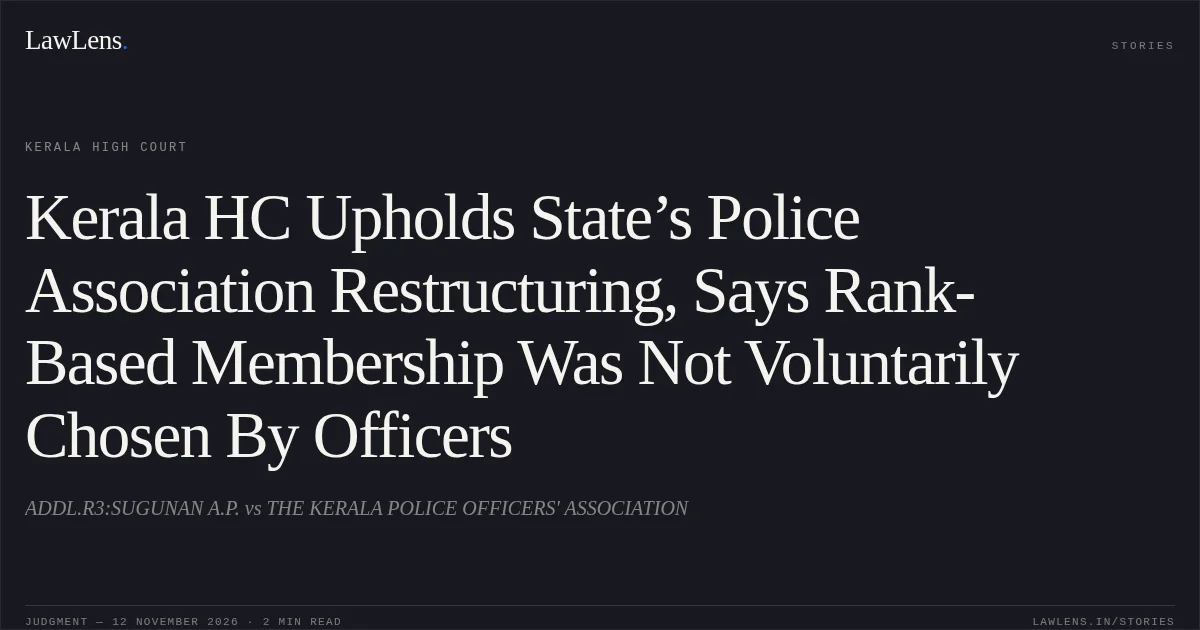
pp. 9–15A Government Order dated 27 July 2026 abolished the Kerala Police Officers’ Association (KPOA) and redistributed its members between the Kerala Police Association (KPA) and the Kerala Police Senior Officers’ Association (KPSOA).
pp. 9–15Members and associations challenged the restructuring. The Single Judge quashed the Order, holding that it infringed associational rights and had been made without following the applicable procedure. The State and affected members appealed.
pp. 9–1502Issues
i.Whether members of police associations formed and constituted by the Government, with membership determined automatically by rank, could claim that restructuring those associations infringed their right under Article 19(1)(c) of the Constitution.
pp. 16–21ii.Whether the Government had authority to restructure the associations and whether the impugned restructuring was an unlawful or irrational exercise of that authority.
pp. 21–2603Law Applied
Article 19(1)(c) protects the right to form and continue an association, including protection against alteration of its composition without members’ consent; however, the right presupposes voluntary formation or membership (Damyanti Naranga v. Union of India).
pp. 16–17Where an association is created by statute and membership is governed by statutory conditions, Article 19(1)(c) does not apply in the same way (Daman Singh v. State of Punjab; Zoroastrian Cooperative Housing Society Ltd. v. District Registrar).
p. 17Articles 19(4) and 33, read with the Police Forces (Restriction of Rights) Act, 1966 and the Rules framed under it, permit restrictions on police personnel’s rights to ensure discipline and proper discharge of duties.
pp. 17–20The Court also treated the Government’s authority to form and restructure the associations as arising from its executive power under Article 162 and continuing under Section 109 of the Kerala Police Act, 2011; such policy action is reviewable for rationality.
pp. 21–23Provisions in the judgment · 1
Kerala Police Act, 1960 Section 109
04Reasoning
The associations had been constituted by the Government, and personnel became members automatically according to their rank; as officers progressed, their association membership shifted with their rank. The members therefore had not voluntarily formed or joined the associations, so the restructuring did not alter an association they had chosen to constitute or continue, and did not infringe their Article 19(1)(c) rights.
pp. 20–22The bye-laws regulated the associations’ functioning but did not give members an independent right to control their formation or continuation; the Government retained the authority to permit and regulate them.
pp. 22–23The stated objective—grouping personnel with common service conditions, promotional avenues and administrative interests—was consistent with the associations’ aims and was rational. The Court therefore found no basis to interfere with the policy decision.
pp. 24–2605Holding
It held that the restructuring did not infringe the members’ Article 19(1)(c) rights and disclosed no irrational exercise of the State’s authority.
p. 26The Court allowed the appeals, set aside the Single Judge’s judgment and dismissed the writ petitions challenging the Government Order dated 27 July 2026. No order as to costs.
p. 26Original Court PDF
ADDL.R3:SUGUNAN A.P.vsTHE KERALA POLICE OFFICERS' ASSOCIATION
Click to open original judgment
Original judgment, available to read, download and summarize on LawLens.in