01Facts
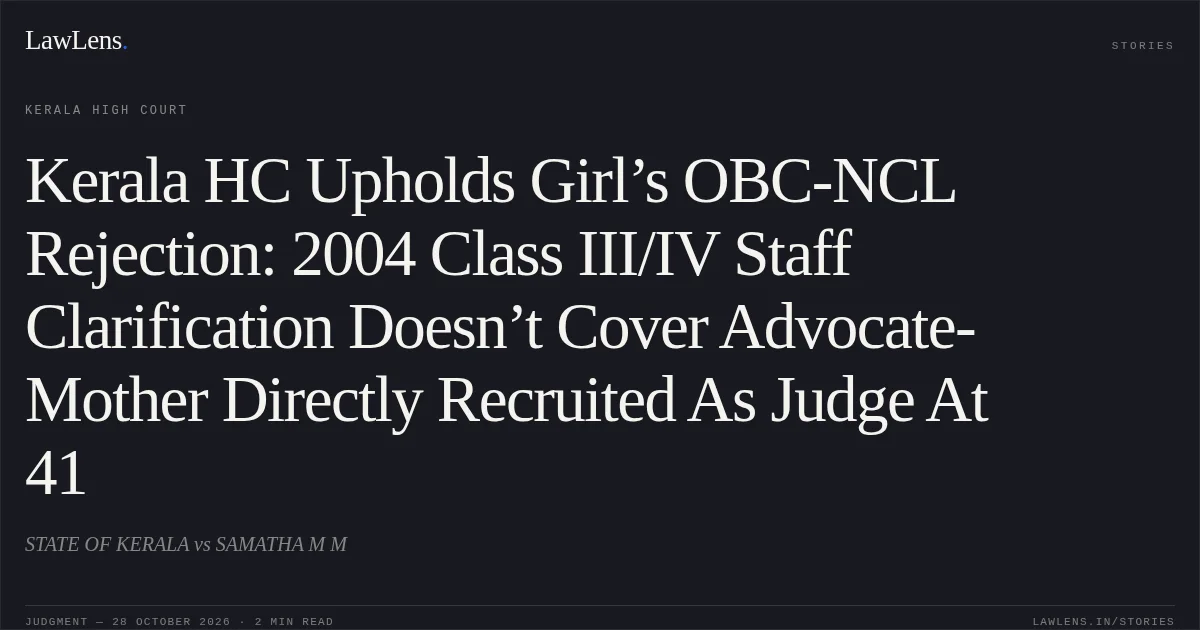
Samatha, a minor belonging to the Mappila community, applied for an OBC Non-Creamy Layer (NCL) certificate to claim reservation in CLAT 2027. Her mother had practised as an advocate before being directly appointed as an Additional District and Sessions Judge at age 41; her father was an Assistant Public Prosecutor.
¶ 2–8The Tahsildar rejected the application because the mother held a Class I/Group A post. A Single Judge quashed that rejection and directed issuance of the certificate, reading the 1993 Office Memorandum and its 2004 clarification together. The State appealed.
¶ 2–802Issues
i.Whether the 2004 clarification to the 1993 Office Memorandum applied to the child of a former practising advocate directly appointed to a Class I/Group A judicial post after age 40.
¶ 20–25ii.Whether the mother’s Class I/Group A status attracted the exclusionary criterion despite her earlier professional income, and whether applying that criterion amounted to discrimination.
¶ 30–3303Law Applied
The Schedule to the Government of India’s Office Memorandum dated 8 September 1993 prescribes distinct creamy-layer criteria by category. Under Category II(A), children of a parent who is a Class I/Group A officer fall within the stated exclusion, subject to the Schedule’s express exceptions.
¶ 12–13, 16–19The clarification dated 14 October 2004 addresses specified cases of a government employee initially recruited to a lower service category and subsequently entering Group A service; it must be read within, and cannot override or enlarge, the 1993 Memorandum.
¶ 20–29The Court relied on Indra Sawhney v. Union of India, 1992 Supp (3) SCC 217, on the constitutional basis for creamy-layer exclusion; Union of India v. Rohith Nathan, (2026) 6 SCC 1, on applying the Memorandum’s distinct categories and the limited role of a clarification; and Ashoka Kumar Thakur v. State of Bihar, (1995) 5 SCC 403, on excluding the affluent sections so reservation benefits reach the more disadvantaged.
¶ 12, 14–15, 27–28, 35–36Provisions in the judgment · 1
Karnataka Co-Operative Societies Act, 1959 Section 4
04Reasoning
The mother was not a government employee initially recruited to Group C/Class III or Group D/Class IV service who later entered Group A, the circumstances addressed by the 2004 clarification. Her direct appointment to a Class I/Group A judicial post therefore brought the case within the service-status criterion in Category II(A); entry at age 41, without more, did not attract the clarification.
¶ 19, 22–25Her earlier professional income did not displace that criterion. The Court also held that differences between direct recruitment and promotion from a lower judicial post did not establish discrimination under the governing criteria; the validity of those criteria had not been challenged.
¶ 30–3305Holding
The Division Bench allowed the State’s appeal, set aside the Single Judge’s judgment, and upheld the Tahsildar’s rejection of the NCL certificate application.
¶ 38–39Samatha was held not entitled to the relief sought in the writ petition.
¶ 38–39Original Court PDF
STATE OF KERALAvsSAMATHA M M
Click to open original judgment
Original judgment, available to read, download and summarize on LawLens.in