01Facts
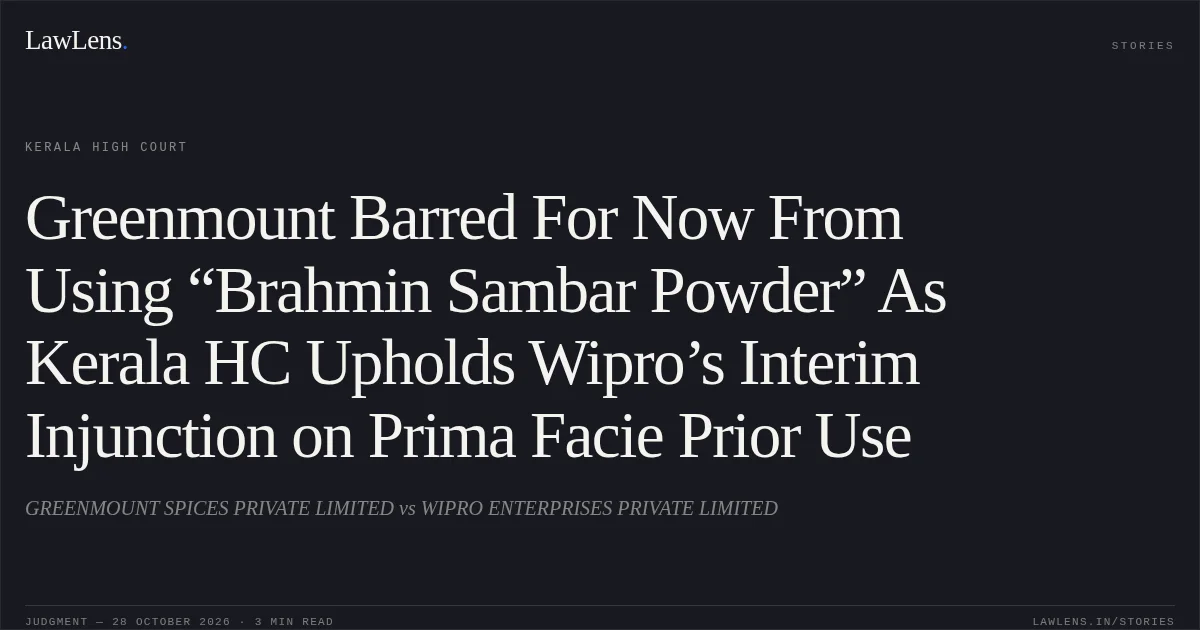
Wipro Enterprises, which claimed ownership of the “Brahmins” trade mark and acquired the Brahmins group business, sued Greenmount Spices for using “Brahmin” and “Brahmin Sambar Powder” on food products.
pp. 3, 15–17It sought an injunction against use of those expressions, including on product packaging and in advertising.
pp. 3, 15–17Greenmount contended that its distinctive mark was “Greenmount” and that “Brahmin Sambar Powder” was merely descriptive; it also claimed use since 2011 and relied on Section 30(2)(a) of the Trade Marks Act, 1999.
pp. 4–6, 15The Trial Court granted Wipro’s application for temporary injunction. Greenmount appealed against that order.
p. 402Issues
i.1. Whether the Trial Court’s order granting temporary injunction disclosed an error or illegality warranting appellate interference
p. 14 · ¶ 5ii.2. Whether Wipro had established a prima facie case, balance of convenience and irreparable injury sufficient to sustain the temporary injunction, notwithstanding Greenmount’s defence of descriptive use under Section 30(2)(a)
pp. 14–18 · ¶ 9–1203Law Applied
Sections 27 and 28 of the Trade Marks Act, 1999 distinguish infringement claims from passing off and provide that valid registration confers an exclusive right to use the mark for the registered goods or services, subject to the Act and registration limitations; Section 29 sets out when use of a mark constitutes infringement.
pp. 13–14 · ¶ 8Section 30(2)(a) excludes infringement where use genuinely indicates the kind or another characteristic of goods, but whether the use is descriptive depends on its context and presentation.
p. 14, 16 · ¶ 8, 11Section 135 authorises injunctions in infringement and passing-off suits.
pp. 12–13Interim injunctions require a prima facie case, balance of convenience and irreparable injury; under Wander Ltd. v. Antox India Pvt. Ltd., an appellate court should not substitute its discretion for that of the trial court unless the order is arbitrary, capricious, perverse or contrary to settled principles.
pp. 19–23 · ¶ 14The Court also relied on Shruti Manav Sharma v. Sunanina Singh for the interlocutory-injunction principles and limited appellate review, and on Midas Hygiene Industries Pvt. Ltd. v. Sudhir Bhatia for the principle that injunctions ordinarily follow in cases of trade mark or copyright infringement.
pp. 19–24 · ¶ 14–15Provisions in the judgment · 9 · Linked ones open on LawLens
Trade Marks Act, 1999 9 provisions
Section 15Section 17Section 23Section 27Section 28Section 29Section 30Section 134Section 13504Reasoning
Wipro’s materials, including documents indicating that its predecessor’s food products were launched in 1987 and registrations incorporating “Brahmins,” provided prima facie support for prior commercial use; Greenmount’s own case placed its use of “Greenmount Brahmin Sambar Powder” from 2011.
p. 17 · ¶ 12The Court held that “Greenmount” being used as a mark did not, by itself, answer whether “Brahmin Sambar Powder” was presented so as to suggest a commercial association.
p. 16 · ¶ 11–12The descriptive-use defence required assessment of the registration particulars and the product’s overall presentation, including the prominence and placement of the words—matters requiring trial rather than final resolution at the interlocutory stage.
pp. 16–18 · ¶ 11–12Given the prima facie case and the potential erosion of the mark’s distinctiveness, the Court found the balance of convenience favoured Wipro and the potential injury was not readily compensable in damages.
p. 24 · ¶ 15Applying the restrained standard for appellate interference, it found no arbitrariness or perversity in the Trial Court’s order.
pp. 22–24 · ¶ 14–1505Holding
The Court held that no error or illegality justified appellate interference and dismissed Greenmount’s appeal, thereby leaving the temporary injunction in force.
p. 24 · ¶ 15It directed the Trial Court to decide the suit according to law, untrammelled by observations in either the impugned order or the appellate judgment.
p. 25Original Court PDF
GREENMOUNT SPICES PRIVATE LIMITEDvsWIPRO ENTERPRISES PRIVATE LIMITED
Click to open original judgment
Original judgment, available to read, download and summarize on LawLens.in