Facts
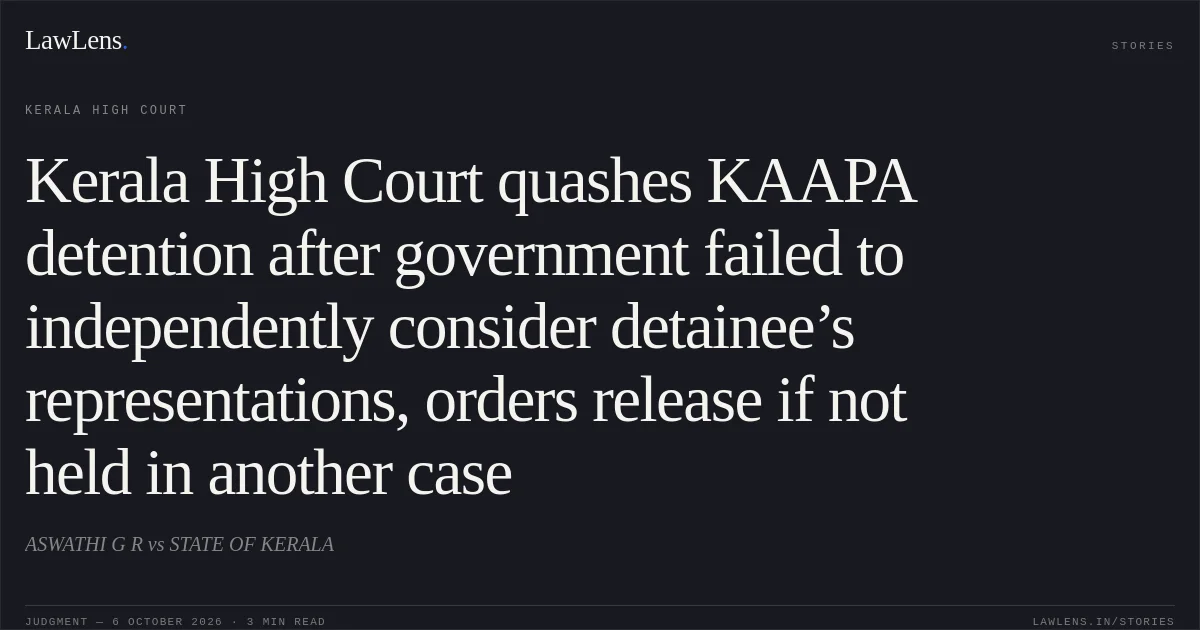
The petitioner, the wife of Sugathan R., challenged his preventive detention under Section 3(1) of the Kerala Anti-Social Activities (Prevention) Act, 2007 (“KAAPA”).
Source reference: p. 3–6The District Magistrate classified him as a “known rowdy” based on seven criminal cases, and the Government approved and later confirmed the detention for six months.
Source reference: p. 3–6, 16–17The petitioner contended, among other things, that the Government failed independently to consider the detenu’s representations; the detention order did not assess the sufficiency of his anticipatory-bail conditions; several supplied documents were missing or illegible; and the order misstated or omitted material facts concerning the criminal cases.
Source reference: p. 7–12Issues
1. Whether the Government’s failure to independently consider the detenu’s representations, and its alleged delay pending the Advisory Board’s opinion, violated Article 22(5) of the Constitution.
Source reference: p. 17–18, 36–372. Whether the detention order was vitiated because it did not assess the efficacy of the anticipatory-bail conditions imposed in the last prejudicial-activity case.
Source reference: p. 38–413. Whether the supply of missing or illegible material documents deprived the detenu of an effective opportunity to represent against his detention.
Source reference: p. 46–564. Whether omissions and inaccuracies concerning the criminal cases and related proceedings demonstrated non-application of mind by the detaining authority.
Source reference: p. 56–585. Whether the detention order was otherwise invalid for relying on conduct affecting law and order rather than public order.
Source reference: p. 41–46Law Applied
Article 22(5) of the Constitution requires the appropriate Government to consider a detenu’s representation independently and expeditiously; that duty is distinct from the Advisory Board’s consideration, and the Government cannot defer its decision merely while awaiting the Board’s opinion (*S.K. Abdul Karim v. State of West Bengal*; *Jayanarayan Sukul v. State of West Bengal*; *Smt. Gracy v. State of Kerala*; *Sarabjeet Singh Mokha v. District Magistrate, Jabalpur*).
Source reference: p. 18–36Under Section 7(2) of KAAPA, the detenu must be furnished with the grounds and relevant documents, and illegible or missing material relied upon may prevent an effective representation and invalidate detention under Article 22(5).
Source reference: p. 48–56Where bail has been granted in the same matter, the detaining authority must consider whether the bail conditions are sufficient to address the apprehended future conduct (*Joyi Kitty Joseph v. Union of India*).
Source reference: p. 38–41Preventive detention must also be based on a properly formed subjective satisfaction, supported by consideration of relevant facts; the distinction between law and order and public order turns on the act’s impact on the community.
Source reference: p. 41–46, 56–58Reasoning
The Government’s orders did not show independent consideration of the detenu’s representations dated 12 June 2026; the representations identified in the subsequent Government communications concerned other representations. The Court therefore found the constitutional duty of independent consideration unfulfilled.
Source reference: p. 36–38The detention order did not set out the anticipatory-bail conditions or disclose an assessment of their sufficiency, so the required satisfaction regarding the need for preventive detention was not demonstrated.
Source reference: p. 38–41The record also substantiated that several pages supplied to the detenu were missing or illegible, and the State did not establish that the affected material was immaterial or not relied upon.
Source reference: p. 46–56Further, the order omitted or misstated material matters, including a counter-case, the status of a bail-cancellation application, the withdrawn compounding petition, an extension of time to comply with the anticipatory-bail order, and the stay of certain proceedings. Taken cumulatively, these defects showed a casual consideration of the record and non-application of mind.
Source reference: p. 56–58The Court rejected the separate public-order challenge, finding no basis on the facts to conclude that the authority had failed to consider breach of public order.
Source reference: p. 41–46Holding
The Court held that the detention was unsustainable on the grounds of non-consideration of the detenu’s representations, failure to assess the bail conditions, non-supply of legible and complete material documents, and non-application of mind.
It allowed the writ petition and set aside the detention order, approval order, and confirmation order (Exts. P1, P2 and P32). The Superintendent of the Central Prison, Viyyur, was directed to release Sugathan R. forthwith unless his detention was required in another case.
Source reference: p. 59Acts & Sections Cited
17 provisions across 6 statutes referred to in this judgment. Each provision opens on LawLens.
Bharatiya Nyaya Sanhita, 20237
Bharatiya Nagarik Suraksha Sanhita, 20233
Code of Criminal Procedure, 19732
National Security Act, 19801
Prevention of Illicit Traffic in Narcotic Drugs and Psychotropic Substances Act, 19882
Telangana Prevention of Dangerous Activities of Boot-leggers, Dacoits, Drug-Offenders, Goondas, Immoral Traffic Offenders Land-Grabbers, Spurious Seed Offenders, Insecticide Offenders, Fertiliser Offenders, Food Adulteration Offenders, Fake Document Offenders, Scheduled Commodities Offenders, Forest Offenders, Gaming Offenders, Sexual Offenders, Explosive Substances Offenders, Arms Offenders, Cyber Crime Offenders and White Collar or Financial Offenders Act, 1986.2
Original Court PDF
ASWATHI G RvsSTATE OF KERALA
Click to open original judgment
Original judgment, available to read, download and summarize on LawLens.in