Facts
The petitioner, Dr. V. Madhu, a faculty member of the Cochin University of Science and Technology (“CUSAT”), filed a Public Interest Litigation seeking a writ of quo warranto and quashing of the appointment of Respondent No. 6 as Professor in the Department of Mathematics, CUSAT.
Source reference: para. 2Respondent No. 6 had been appointed as Professor on 7 August 2019 with effect from 24 July 2019.
Source reference: para. 4By the time the petition was filed in 2026, Respondent No. 6 had also become a member of the Senate and the Syndicate of CUSAT.
Source reference: para. 4The petitioner had been teaching in the institution since 2006 and alleged that the appointment was contrary to applicable statutory or regulatory requirements.
Source reference: no citationThe Court observed that the challenge was brought after a considerable delay and appeared to arise from a private dispute between the petitioner and Respondent No. 6.
Source reference: para. 4Issues
Whether the office of Professor in CUSAT constitutes a “public office” amenable to a writ of quo warranto.
Source reference: paras. 2–3Whether the Public Interest Litigation challenging Respondent No. 6’s appointment was maintainable, or was in substance a private service dispute filed belatedly and for an ulterior purpose.
Source reference: paras. 4–5Whether the petitioner was entitled to an order quashing Respondent No. 6’s appointment.
Source reference: paras. 2, 5Law Applied
The Court applied the principle that a writ of quo warranto lies only where the challenged office is of a public nature, created by a charter, statute, or the Constitution, substantive in character, and actually occupied by the incumbent, as recognised in G. Sasidharan v. State of Kerala and Others, 2026 KHC 312.
Source reference: para. 3Relying on Dr. Neetu Singh v. State of U.P., 2019 SCC OnLine All 5871, the Court held that the office of a Professor in a statutory university does not, merely by reason of the university’s educational functions, become a public office involving the exercise of sovereign governmental functions.
Source reference: para. 2The Court further relied on Ashok Kumar v. State of West Bengal, (2004) 3 SCC 349, for the principle that Public Interest Litigations in service matters are generally not maintainable except in limited cases involving quo warranto, and that courts must decline petitions that are motivated, frivolous, or filed under the guise of public interest.
Source reference: para. 5A public office, in this context, must involve the delegation of some portion of sovereign power for the benefit of the public.
Source reference: para. 5Reasoning
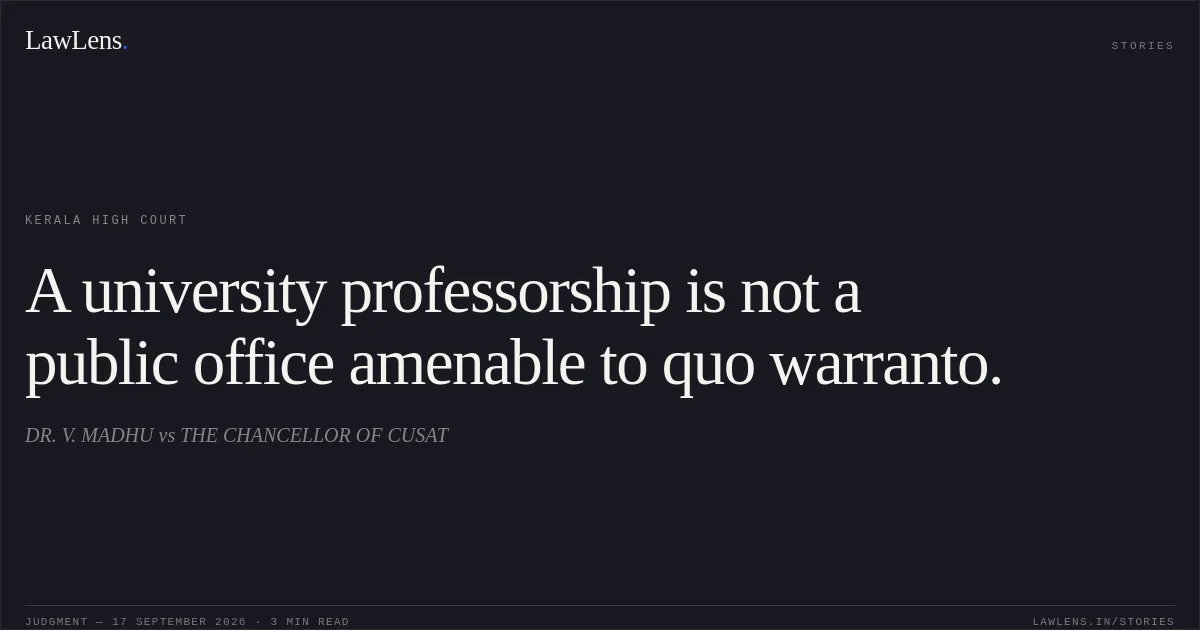
The Court held that the post of Professor at CUSAT did not involve the exercise of executive, legislative, or judicial sovereign functions and therefore did not satisfy the essential character of a public office for the purpose of quo warranto.
Source reference: paras. 2, 5Although CUSAT is a statutory university, that status alone was insufficient to convert every academic post into a public office.
Source reference: para. 2The Court also found that the petition was essentially a service-related dispute between two individuals.
Source reference: no citationThe petitioner had an earlier opportunity to challenge the 2019 appointment but approached the Court only in 2026, after Respondent No. 6 had acquired positions in the Senate and Syndicate.
Source reference: para. 4This delay, together with the apparent personal nature of the dispute, justified the Court’s conclusion that the petition had been filed to settle scores rather than to vindicate a genuine public right.
Source reference: paras. 4–5Consequently, the Court found no basis to issue quo warranto or to examine the appointment on the merits.
Source reference: no citationHolding
The Court answered the issues against the petitioner.
It held that the professorial post occupied by Respondent No. 6 was not a public office amenable to quo warranto and that the PIL was an impermissible, belated service dispute presented in the guise of public interest.
Source reference: paras. 2, 4–5The writ petition was dismissed, with no order as to costs.
Source reference: no citationThe reply affidavit filed by the respondent was taken on record.
Source reference: para. 5Acts & Sections Cited
1 provisions across 1 statute referred to in this judgment. Each provision opens on LawLens.
Prevention of Corruption Act, 19881
Original Court PDF
DR. V. MADHUvsTHE CHANCELLOR OF CUSAT
Click to open original judgment
Original judgment, available to read, download and summarize on LawLens.in