Facts
The petitioner, the wife of Ibrahim Kalandhar @ K. Ibrahim, challenged his preventive detention under Section 3(1) of the Kerala Anti-Social Activities (Prevention) Act, 2007 (“KAA(P) Act”). The detention order relied on six criminal cases and was issued while he was in judicial custody; it was later confirmed by the Government and continued for six months.
Source reference: p.3, para. 1; pp.4, 7, paras. 2, 7The petitioner contended that the detenue knew only Kannada but was supplied the detention order and relied-on documents in Malayalam, without Kannada translations. The State maintained that their contents had been explained to him in a language he understood.
Source reference: pp.5–8, paras. 5–8Issues
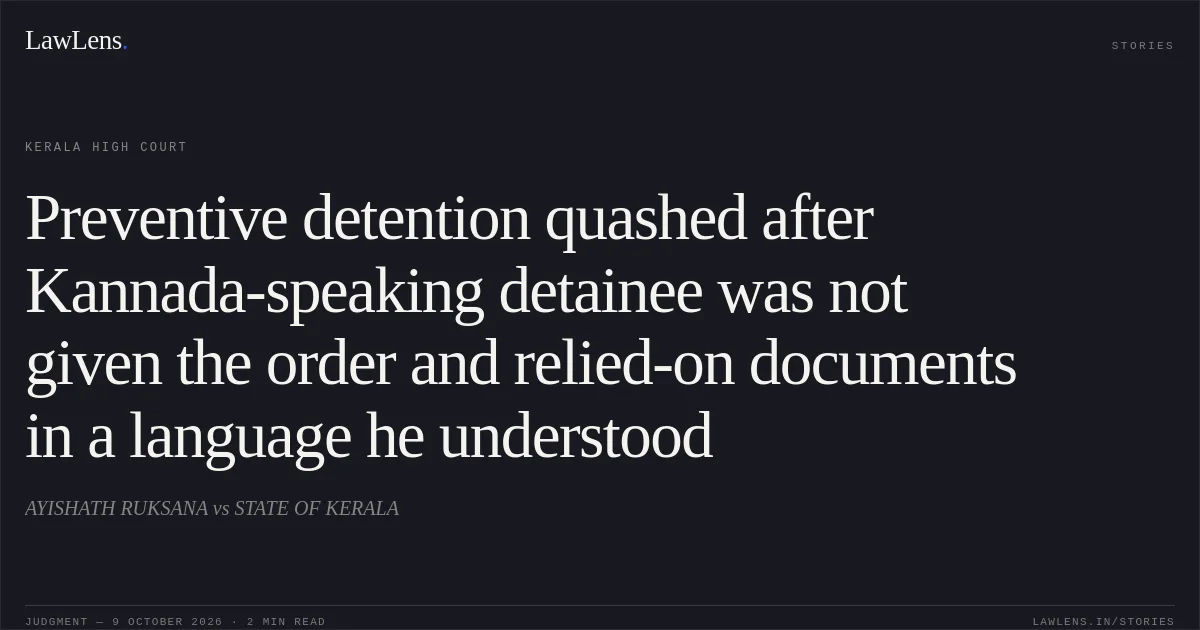
Whether failure to supply the detention order and relied-on documents in a language understood by the detenue violated his right under Article 22(5) of the Constitution and invalidated the detention
Source reference: pp.8–15, paras. 8–12Whether the detention order was invalid because it verbatim reproduced the sponsoring report, or because some documents supplied to the detenue were illegible
Source reference: pp.5–6, para. 5; pp.15–16, paras. 13–14Law Applied
Article 22(5) of the Constitution requires that the grounds of detention be effectively communicated to the detenue in a language he understands, so that he can make a meaningful representation; oral explanation alone is insufficient.
Source reference: pp.9–14, paras. 9–12The Court relied on Hadibandhu Das v. District Magistrate, Cuttack, AIR 1969 SC 43, and Lallubhai Jogibhai Patel v. Union of India, (1981) 2 SCC 427, for this requirement, and on Mortuza Hussain Choudhary v. State of Nagaland, 2025 SCC OnLine SC 502, which reaffirmed that a detenue must receive the grounds in a language he understands and, if literate, a script he can read.
Source reference: pp.9–14, paras. 9–12Section 7(2) of the KAA(P) Act also provides for the detenue’s right to make a representation against the detention.
Source reference: p.15, para. 12Reasoning
The sponsoring report and detention order recorded that the detenue was from Karnataka, resided in a linguistic-minority area, and knew Kannada. On examining the detention file, the Court found no evidence that Kannada translations of the detention order or relied-on documents had been supplied, or that the detenue had acknowledged receiving them.
Source reference: pp.8–15, paras. 8–12The State’s assertion that the contents were explained orally did not satisfy Article 22(5), because effective communication requires written material in a language the detenue understands.
Source reference: pp.8–15, paras. 8–12The Court rejected the separate challenge that the detention order merely reproduced the sponsoring report, finding independent consideration of the material.
Source reference: pp.15–16, para. 13It also found no illegibility in the supplied documents, but held that this did not cure the failure to provide them in Kannada.
Source reference: p.16, para. 14Holding
The Court held that non-supply of the detention order and relied-on documents in a language understood by the detenue violated Article 22(5) and invalidated the detention.
It allowed the petition, set aside the detention and continued-detention orders (Exts. P2 and P4), and directed the Superintendent of Central Prison, Kannur, to release the detenue forthwith unless his detention was required in another case.
Source reference: p.17, para. 15Acts & Sections Cited
5 provisions across 3 statutes referred to in this judgment. Each provision opens on LawLens.
Bharatiya Nyaya Sanhita, 20233
Conservation of Foreign Exchange and Prevention of Smuggling Activities Act, 19741
Prevention of Illicit Traffic in Narcotic Drugs and Psychotropic Substances Act, 19881
Original Court PDF
AYISHATH RUKSANAvsSTATE OF KERALA
Click to open original judgment
Original judgment, available to read, download and summarize on LawLens.in