Facts
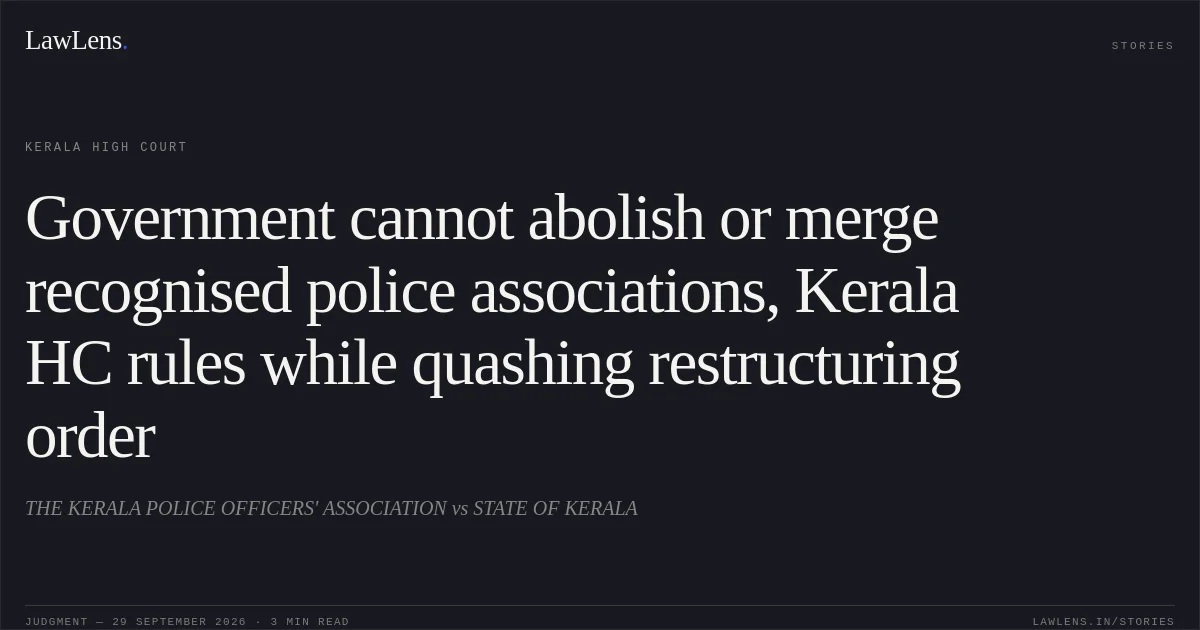
The State had recognised three police associations: the Kerala Police Association (KPA), the Kerala Police Officers’ Association (KPOA), and the Kerala Police Senior Officers’ Association (KPSOA). By Government Order dated 27 July 2026, the State abolished KPOA, redistributed its members, assets, rights, and liabilities between KPA and KPSOA, and directed the formation of ad hoc committees pending elections.
Source reference: para. 2–6, 12The State Police Chief constituted those committees the following day, displacing the elected committees. KPA and KPOA, together with members of KPOA, challenged the Government Order and the committee-formation orders. The State defended the reorganisation as an administrative measure to align association membership with the police service structure. The Court considered the petitions together.
Source reference: para. 2–6, 12Issues
1. Whether the Government had power to restructure the three recognised police associations and, in doing so, abolish one of them.
Source reference: para. 11(i)2. Whether the orders abolishing KPOA and constituting ad hoc committees were legally valid.
Source reference: para. 11(ii)3. Whether the writ petitions were maintainable.
Source reference: para. 11(iii)Law Applied
Article 19(1)(c) protects not only the right to form an association but also the right to continue it with its voluntarily agreed membership and rules; Article 19(4) permits reasonable restrictions, while Article 33 enables Parliament to modify or restrict Part III rights of specified forces, including police personnel.
Source reference: para. 13–19The Court applied the Police Forces (Restriction of Rights) Act, 1966, particularly section 3(1)(b), which permits police personnel to associate with an association recognised as part of the force, and the Police Forces (Restriction of Rights) Rules, 1966, rules 8 and 9, which provide for recognition and require an opportunity to make representations before recognition is revoked.
Source reference: para. 13–19It also considered section 109 of the Kerala Police Act, 2011, and the associations’ Government-approved byelaws, under which amendments required a two-thirds general-body majority and Government approval.
Source reference: para. 21, 23Applying Smt. Damyanti Naranga v. Union of India, (1971) 1 SCC 678, and O.K. Ghosh v. E.X. Joseph, AIR 1963 SC 812, the Court held that the right of association includes the right to continue with the agreed composition. It distinguished Delhi Police Non-Gazetted Karmachari Sangh v. Union of India, (1987) 1 SCC 115, as concerning different facts and issues.
Source reference: para. 24–29Reasoning
The three associations remained recognised when the impugned order was made, and neither the Government nor the State Police Chief had revoked that recognition in accordance with the applicable rules.
Source reference: para. 22–23, 30, 33The order nevertheless abolished KPOA, imposed its members on the other associations, transferred its assets and liabilities, and replaced the elected committees with ad hoc committees—without the members’ consent or compliance with the associations’ byelaws.
Source reference: para. 22–23, 30, 33The State Police Chief’s proposal had in fact recommended retaining all three associations, making the Government’s contrary action additionally unsupported by the proposal on which the order purported to rely.
Source reference: para. 32The Court therefore found an interference with the members’ Article 19(1)(c) rights and held the consequential committee orders unsustainable.
Source reference: para. 33On maintainability, it found that individual members had standing in W.P.(C) No. 26295 of 2026; in W.P.(C) No. 26155 of 2026, KPA’s existence as a recognised association was acknowledged by the Government and the respondents. KPA could also assert its legal right to protect its byelaws and membership structure.
Source reference: para. 35–36Holding
The Court held that the Government lacked authority to impose the impugned restructuring and abolish KPOA in the circumstances presented. It further held that the abolition and the formation of the ad hoc committees were legally invalid, and that both writ petitions were maintainable.
The writ petitions were allowed, and the impugned Government Order, Ext. P3 in both petitions, and Exts. P4 and P5 in W.P.(C) No. 26295 of 2026 were set aside.
Source reference: no citationActs & Sections Cited
2 provisions across 1 statute referred to in this judgment. Each provision opens on LawLens.
Original Court PDF
THE KERALA POLICE OFFICERS' ASSOCIATIONvsSTATE OF KERALA
Click to open original judgment
Original judgment, available to read, download and summarize on LawLens.in