Facts
The petitioner complained that Respondent No. 2, a Chartered Accountant, facilitated unauthorised access to and alteration of the petitioner’s Income Tax account by allowing the petitioner’s wife to use his laptop and providing an OTP.
Source reference: p. 1–3, paras. 1–6The Director (Discipline) formed a prima facie opinion that Respondent No. 2 was guilty of “Other Misconduct” under Section 22 read with Item (2) of Part IV of the First Schedule to the Chartered Accountants Act, 1949.
Source reference: p. 1–3, paras. 1–6The Board of Discipline disagreed and closed the complaint.
Source reference: p. 1–3, paras. 1–6After earlier proceedings, the High Court set aside the Board’s prior decision and remanded the matter for fresh consideration.
Source reference: p. 1–3, paras. 1–6On remand, the Board again declined to concur with the prima facie opinion, leading to this petition under Article 226.
Source reference: p. 1–3, paras. 1–6Issues
1. Whether the Board’s decision, on remand, to decline concurrence with the Director (Discipline)’s prima facie opinion and close the complaint warranted interference under Article 226.
Source reference: pp. 3–5, paras. 10–172. Whether Respondent No. 2’s alleged assistance with access to the petitioner’s Income Tax account constituted “Other Misconduct” under Item (2) of Part IV of the First Schedule, notwithstanding the absence of a professional relationship and the pendency of criminal proceedings.
Source reference: pp. 3–5, paras. 7–15Law Applied
Section 22 read with Item (2) of Part IV of the First Schedule to the Chartered Accountants Act, 1949, addresses “Other Misconduct,” including conduct bringing disrepute to the profession whether or not related to professional work.
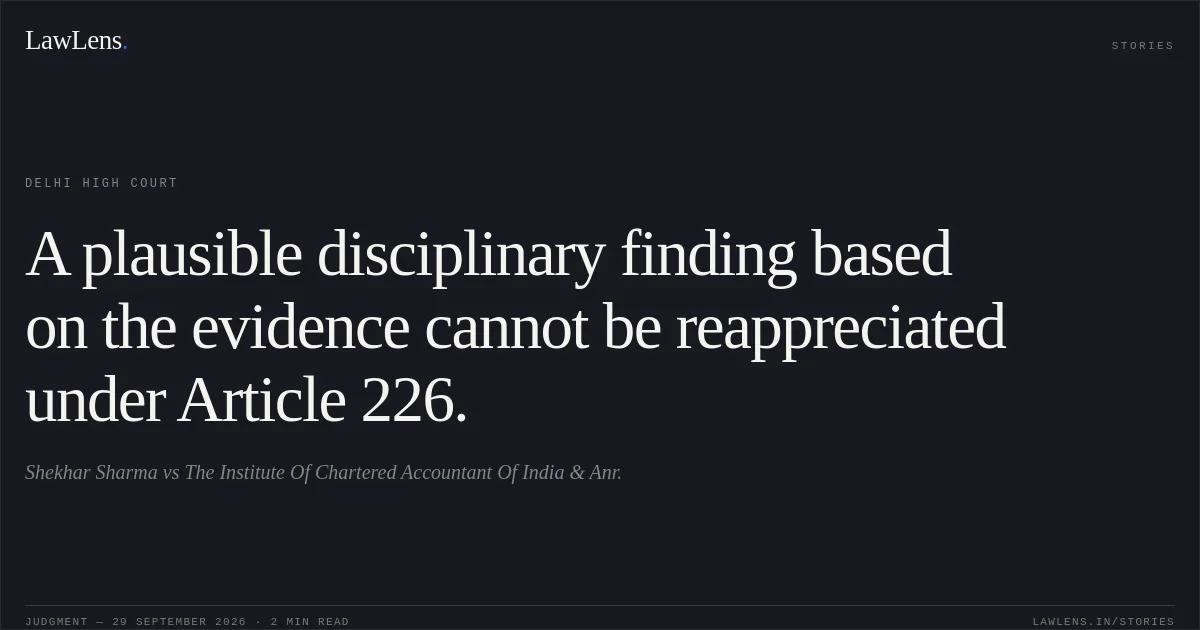
Source reference: p. 3, paras. 7–8; p. 4, para. 14Under Article 226, the High Court reviews the legality of the decision-making process; it does not sit in appeal, substitute its view for that of the statutory authority, or reappreciate evidence merely because another view is possible.
Source reference: p. 3, para. 10; p. 4, para. 12The absence of a fiduciary relationship does not, by itself, exclude Item (2), but may be relevant where the Director’s prima facie opinion proceeded on the mistaken premise that such a relationship existed.
Source reference: p. 4, para. 14Pending criminal proceedings do not, by themselves, oust the Board’s disciplinary jurisdiction.
Source reference: p. 5, para. 15Reasoning
The Court found that the Board had considered the circumstances surrounding use of the laptop and the OTP and had concluded that Respondent No. 2 was unaware of the matrimonial dispute and that the evidence did not establish mala fide intent or deliberate facilitation.
Source reference: pp. 4–5, paras. 11–16The Board also noted that neither party accepted that Respondent No. 2 was the petitioner’s tax consultant, whereas the Director’s prima facie opinion had proceeded on that basis.
Source reference: pp. 4–5, paras. 11–16The Court considered the absence of that relationship relevant to the Director’s premise, while recognising that it did not itself bar application of Item (2).
Source reference: pp. 4–5, paras. 11–16It further found that the Board had not closed the complaint merely because criminal proceedings were pending, but had considered whether cogent evidence supported misconduct.
Source reference: pp. 4–5, paras. 11–16As these were plausible findings based on the material, the Court declined to reappreciate the evidence under Article 226.
Source reference: pp. 4–5, paras. 11–16Holding
The Court held that no ground had been made out for exercising its extraordinary jurisdiction under Article 226 and dismissed the petition.
Pending applications were also disposed of.
Source reference: p. 5, paras. 16–19Acts & Sections Cited
1 provisions across 1 statute referred to in this judgment. Each provision opens on LawLens.
Chartered Accountants Act, 19491
Original Court PDF
Shekhar SharmavsThe Institute Of Chartered Accountant Of India & Anr.
Click to open original judgment
Original judgment, available to read, download and summarize on LawLens.in