Facts
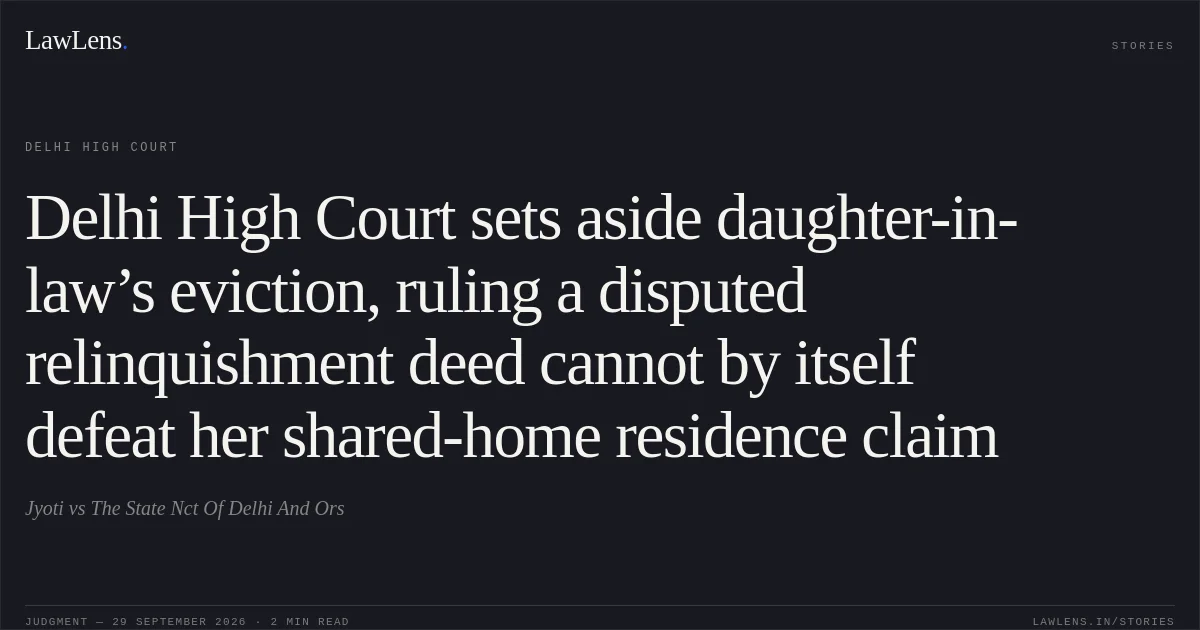
Jyoti, the daughter-in-law of Respondent No. 2 and wife of Respondent No. 3, lived with her minor son in the disputed property, which she claimed was her matrimonial/shared household.
Source reference: paras. 1–5, 10–17; pp. 1–3, 5–7After her father-in-law’s death, her husband and his brother executed a relinquishment deed in favour of Respondent No. 2, who then obtained an eviction order against Jyoti and her husband under the Maintenance and Welfare of Parents and Senior Citizens Act, 2007.
Source reference: paras. 1–5, 10–17; pp. 1–3, 5–7The District Magistrate ordered eviction on 3 March 2025; the Divisional Commissioner dismissed Jyoti’s appeal on 26 September 2025.
Source reference: paras. 1–5, 10–17; pp. 1–3, 5–7Jyoti challenged both orders, asserting a right of residence and disputing the ownership consequences of the relinquishment deed.
Source reference: paras. 1–5, 10–17; pp. 1–3, 5–7Issues
Whether an eviction order under the Senior Citizens Act could be sustained without adequately considering Jyoti’s asserted right of residence in the property as a shared household under the Protection of Women from Domestic Violence Act, 2005
Source reference: paras. 5, 8, 15, 17; pp. 3–4, 6–7Whether the relinquishment deed and Respondent No. 2’s asserted ownership could, in the circumstances, conclusively defeat Jyoti’s claimed right of residence while the deed’s validity and the property’s title remained disputed
Source reference: paras. 15–18; pp. 6–7Law Applied
The Court applied the Maintenance and Welfare of Parents and Senior Citizens Act, 2007, alongside the Protection of Women from Domestic Violence Act, 2005 (“DV Act”), requiring the rights under both statutes to be harmoniously construed.
Source reference: para. 8; pp. 3–4Under S. Vanitha v. Deputy Commissioner, Bengaluru Urban District, (2021) 15 SCC 730, a woman’s claim to a residence order in a shared household under the DV Act cannot be defeated merely by obtaining an eviction order through the summary procedure under the Senior Citizens Act; neither statute automatically overrides the other.
Source reference: para. 8; pp. 3–4The Court also proceeded under Articles 226 and 227 of the Constitution in reviewing the impugned orders.
Source reference: para. 1; p. 1Reasoning
The Court found that Jyoti had specifically claimed the property as her shared household and had resided there since her marriage.
Source reference: paras. 10–15; pp. 5–6A Mahila Court order had recorded the property as the shared household and restrained dispossession from its first floor; although that protection was later vacated, no order had since secured Jyoti’s right of residence.
Source reference: paras. 10–15; pp. 5–6The Appellate Authority had relied principally on Respondent No. 2’s asserted ownership, but the title dispute and the validity and effect of the relinquishment deed remained pending before the civil court.
Source reference: paras. 15–18; pp. 6–7The deed therefore could not, by itself, conclusively extinguish Jyoti’s asserted statutory right, particularly when the minor child’s residence was also involved.
Source reference: paras. 15–18; pp. 6–7The Court recognised Respondent No. 2’s interest as a senior citizen in living peacefully and with dignity, but held that this interest had to be considered alongside—not to the automatic exclusion of—Jyoti’s claimed rights under the DV Act.
Source reference: paras. 15–18; pp. 6–7Holding
The Court allowed the writ petition and set aside both the Divisional Commissioner’s order dated 26 September 2025 and the District Magistrate’s consequential eviction order dated 3 March 2025.
It expressly left title to the property, the validity and legal effect of the relinquishment deed, and the parties’ rights in the pending civil and matrimonial proceedings to be determined by the competent forums.
Source reference: para. 20; p. 8The petition and pending applications were disposed of accordingly.
Source reference: para. 21; p. 8Acts & Sections Cited
2 provisions across 1 statute referred to in this judgment. Each provision opens on LawLens.
Indian Penal Code, 18602
Original Court PDF
JyotivsThe State Nct Of Delhi And Ors
Click to open original judgment
Original judgment, available to read, download and summarize on LawLens.in