01Facts
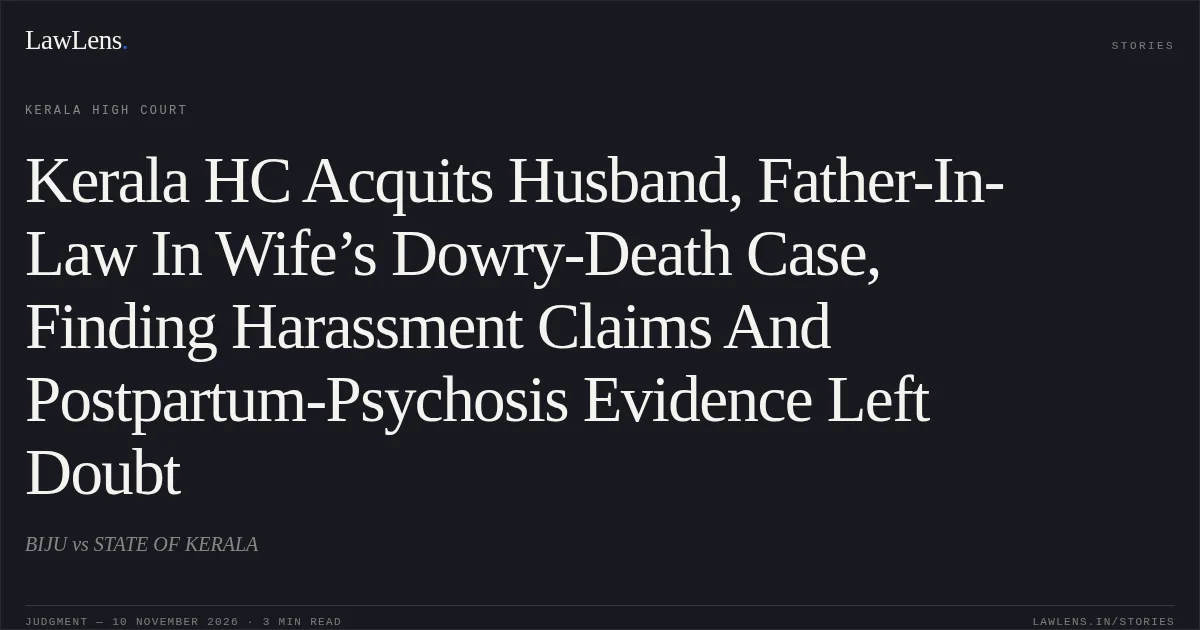
Sheeba married A1, Biju, on 28 August 2005 and died by hanging at the matrimonial home on 11 October 2006.
p. 2, 30The prosecution alleged that her husband and his relatives had harassed her over demands for additional gold and that the cruelty led to her suicide.
p. 2, 30The Sessions Court convicted A1 and A2, Lakshmanan, under Sections 304B and 498A read with Section 34 IPC, sentencing each to seven years’ rigorous imprisonment under Section 304B and three years’ rigorous imprisonment and a fine under Section 498A; A3 and A4 were acquitted.
p. 3A1 and A2 appealed, challenging the reliability of the evidence and the proof of the alleged offences.
pp. 13–1402Issues
i.1. Whether the evidence established that A1 and A2 committed dowry death under Section 304B read with Section 34 IPC
p. 14 · ¶ 9ii.2. Whether the evidence established that A1 and A2 committed cruelty under Section 498A read with Section 34 IPC
p. 14 · ¶ 9iii.3. Whether the convictions and sentences required appellate interference
p. 14 · ¶ 903Law Applied
Section 304B IPC requires proof that a woman died otherwise than under normal circumstances within seven years of marriage and that, soon before her death, she was subjected by her husband or a relative to cruelty or harassment in connection with a dowry demand; “soon before” requires a proximate and live link, but does not mean “immediately before”.
pp. 24–29Under Section 113B of the Evidence Act, the court must presume dowry death only after the prosecution establishes the essential foundational facts; the presumption cannot substitute for proof of cruelty or harassment connected with dowry.
pp. 25–27, 29–30The Court relied on Ajayakumar v. State of Kerala (2022 KHC OnLine 596) and the Supreme Court authorities discussed there, including Baijnath v. State of Madhya Pradesh, Rajeev Kumar v. State of Haryana, and Satbir Singh v. State of Haryana, on these requirements and the proximity test.
pp. 23–29The charges also invoked Sections 498A and 34 IPC; the Court assessed whether the evidence proved the alleged cruelty and the appellants’ shared liability.
p. 2, 14Provisions in the judgment · 10 · Linked ones open on LawLens
Indian Penal Code, 1860 Section 34Section 304Section 306Section 354
Code of Criminal Procedure, 1973 Section 161Section 357Section 428
Dowry Prohibition Act, 1961 Section 2
Narcotic Drugs and Psychotropic Substances Act, 1985 Section 35Section 54
04Reasoning
The Court accepted that Sheeba’s death was unnatural and occurred within seven years of marriage, but found the evidence of dowry-related cruelty insufficiently reliable to establish the remaining requirements of Section 304B.
pp. 31–35The witnesses gave inconsistent accounts of the amount of additional gold allegedly demanded, the visits and events surrounding the marriage and pregnancy, and the timing of Sheeba’s return to her parental home; much of the alleged cruelty was general or hearsay, and the Court noted that earlier police statements had not been produced.
pp. 31–35It also considered the defence evidence that Sheeba had been treated for postpartum psychosis shortly before her death, while noting evidence of continued contact between the families and visits by A1.
pp. 32–35Taken together, the evidentiary inconsistencies and the medical evidence left reasonable doubt as to whether dowry-related cruelty by the appellants led to her death; the Court therefore held that the convictions under both Sections 304B and 498A could not stand.
pp. 34–3605Holding
The High Court answered the issues in favour of A1 and A2, allowed the appeal, and set aside the convictions and sentences under Sections 304B and 498A read with Section 34 IPC.
p. 36 · ¶ 25It acquitted both appellants, directed that they be set at liberty forthwith, and cancelled their bail bonds.
p. 36 · ¶ 25Original Court PDF
BIJUvsSTATE OF KERALA
Click to open original judgment
Original judgment, available to read, download and summarize on LawLens.in