01Facts
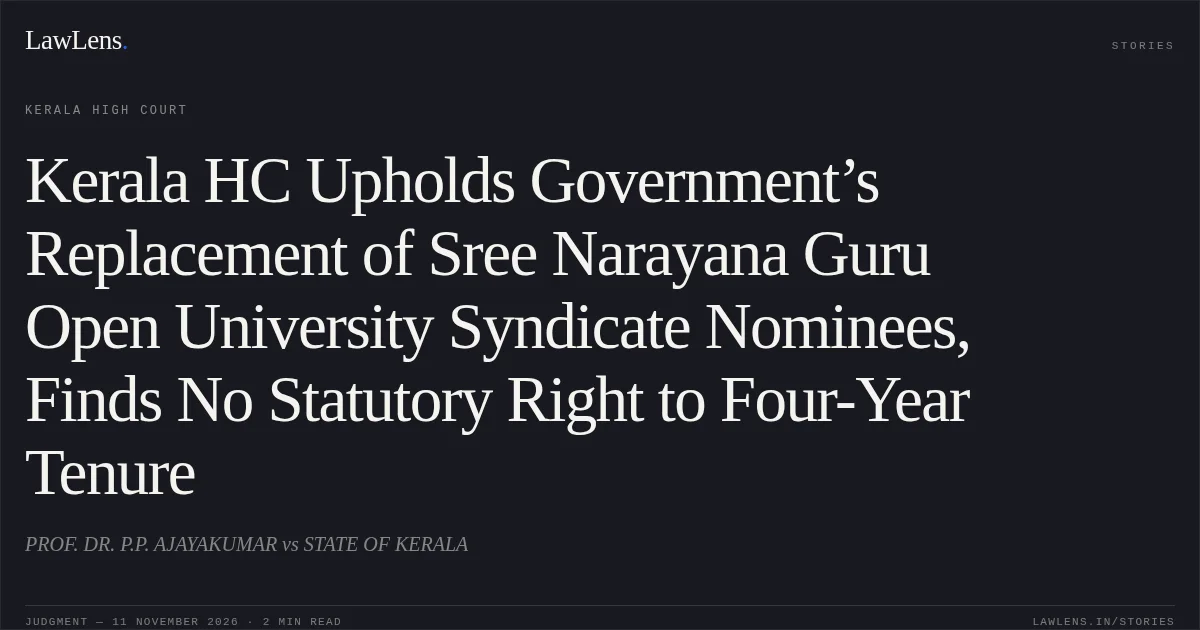
The petitioners were nominated by the Government in March 2025 as eminent-person members of the Syndicate of Sree Narayana Guru Open University under Section 25 of the Sree Narayana Guru Open University Act, 2021.
pp. 4–10In August 2026, the Government withdrew their nominations and nominated others in their place; the University issued a consequential notification.
pp. 4–10The petitioners challenged those orders, arguing that Section 26 entitled them to remain in office for the Syndicate’s four-year term and that the unexplained withdrawals were arbitrary and contrary to Article 14.
pp. 4–10The respondents disputed that the Act guaranteed the nominees a four-year tenure
pp. 17–1802Issues
i.Whether Sections 25 and 26 of the 2021 Act confer on Government-nominated Syndicate members a right to serve for four years
pp. 17, 22–23ii.Whether the Government could withdraw and replace the petitioners’ nominations before reconstitution of the Syndicate, without stating reasons
pp. 17–18, 2903Law Applied
Sections 25 and 26 of the Sree Narayana Guru Open University Act, 2021 provide for the Syndicate’s composition and require its reconstitution every four years; Section 26(2) makes the term of non-ex-officio members co-terminous with the term of the Syndicate.
pp. 18–19, 23The Court treated the Act as not prescribing a specific tenure for Government-nominated members and held that the four-year reconstitution requirement did not itself confer an individual four-year right to continue.
pp. 33–35Section 16 of the General Clauses Act, 1897 concerns the power to suspend or dismiss persons appointed; the Court considered it inapplicable because the case concerned nominations, not appointments.
pp. 35–37The Court also referred to Section 21 of that Act, concerning the power to rescind or vary notifications and orders, but did not need to decide its application.
p. 37It distinguished State of Kerala v. Thiruvanchoor Radhakrishnan and Saji D. Anand because those cases involved statutory protections or fixed terms absent here.
pp. 41–47It further relied on the principle that the doctrine of pleasure may be implied where the statutory scheme so indicates, while noting that it need not reach that question independently.
pp. 50–57Provisions in the judgment · 5 · Linked ones open on LawLens
General Clauses Act, 1897 Section 16Section 21
KARNATAKA NURSES, MIDWIVES AND HEALTH VISITORS ACT, 1961 Section 3
RAJIV GANDHI UNIVERSITY OF HEALTH SCIENCES ACT, 1994 Section 21Section 24
04Reasoning
The Court read Sections 25 and 26 together and contrasted them with other university statutes that expressly prescribe a term for Syndicate members. It concluded that Section 26(1) sets the interval for reconstituting the Syndicate, while Section 26(2) links members’ tenure to the Syndicate’s term; neither provision, in the Court’s view, guaranteed these nominees four years in office.
pp. 33–37As the Act contained no such fixed tenure and the nomination orders themselves specified none, the petitioners had no statutory right to continue for four years. The Court also found that the authorities’ reliance on appointment-related Section 16 did not apply to nominations, and distinguished precedents protecting nominees whose tenure was expressly fixed or whose removal was regulated by statute.
pp. 33–37, 43–47It therefore found no basis to interfere with the withdrawal orders.
p. 5805Holding
The Court held that the petitioners had no legal or statutory right to serve for four years as nominated Syndicate members and found no ground to set aside the withdrawal and replacement orders.
pp. 58–59The writ petition was dismissed.
pp. 58–59Original Court PDF
PROF. DR. P.P. AJAYAKUMARvsSTATE OF KERALA
Click to open original judgment
Original judgment, available to read, download and summarize on LawLens.in