Facts
The appellant, a senior U.P. School Teacher at Thazhuthala Muslim U.P. School, sought promotion to Headmistress upon a vacancy arising on June 1, 2021
Source reference: para. 2The school is a minority institution
Source reference: para. 2.2Following the death of her mother (the former proprietor), the appellant became a member of the Corporate Educational Agency (the management)
Source reference: para. 22The Manager appointed the 2nd respondent (a junior teacher) as Headmistress, a decision later approved by the Assistant Educational Officer (AEO) via Ext.P13
Source reference: para. 2.1, 2.5The appellant challenged this appointment, claiming seniority and exemption from test qualifications due to being over 50 years old
Source reference: para. 2.6A Single Judge dismissed her writ petition, holding that as a member of the management committee, she could not claim the post
Source reference: para. 4Issues
1. Whether a teacher who is also a member of the school's managing body is eligible for promotion to the post of Headmaster/Headmistress under the Kerala Education Rules (KER)
Source reference: para. 23, 252. Whether a writ petition under Article 226 is maintainable when an alternative statutory remedy of revision is available under Rule 8A, Chapter XIVA of the KER
Source reference: para. 16, 183. Whether the management's right to choose a Headmistress in a minority institution overrides the seniority claims of a member of the management committee
Source reference: para. 28, 29Law Applied
Rule 8(1), Chapter III of the KER, which prohibits any member or office bearer of a school's managing body from being eligible for "any appointment" in that school
Source reference: para. 20Division Bench precedent in Unnikrishnan v. DEO, Palakkad [1996 (1) KLT 501], which established that while such a person may continue as a teacher, a promotion to Headmaster constitutes a "fresh appointment" barred by Rule 8
Source reference: para. 24, 25Rule 8A, Chapter XIVA of the KER regarding the Director’s revisional powers
Source reference: para. 14Principle from CIT v. Chhabil Das Agarwal [(2014) 1 SCC 603] that High Courts should not entertain writs where an efficacious alternative remedy exists
Source reference: para. 17Reasoning
The Court reasoned that although the appellant was the senior-most teacher, her status as a member of the Corporate Educational Agency triggered the statutory bar under Rule 8(1), Chapter III of the KER
Source reference: para. 26Citing Unnikrishnan, the Court clarified that "Headmaster" and "Teacher" are distinct for the purpose of new appointments; thus, advancing from teacher to Headmistress requires a fresh appointment order which is prohibited for management members
Source reference: para. 25The Court further found that the appellant’s challenge to the AEO's approval (Ext.P13) was procedurally improper, as she failed to exhaust the statutory revision remedy before the Director of General Education under Rule 8A
Source reference: para. 16, 18The Court noted that the appointment was not a unilateral act of the Manager but a majority decision of the management committee, which is protected under the rights of minority institutions
Source reference: para. 29Holding
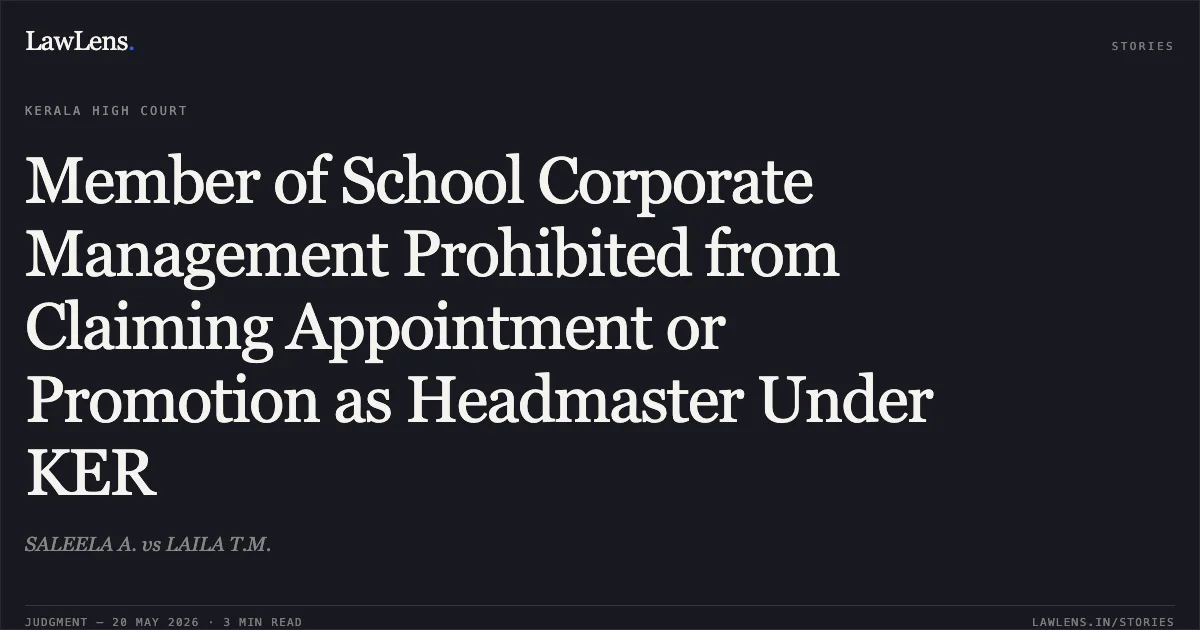
The Court answered the issues in the negative, holding that a member of the management is legally disqualified from being appointed as Headmistress
The Court further held the writ petition was not maintainable due to the availability of an alternative remedy
Source reference: para. 18The Court affirmed the Single Judge's decision, ruling that the appellant had no fundamental right to be considered for promotion because she did not meet the statutory eligibility criteria due to the prohibition in Rule 8(1). The Writ Appeal was dismissed
Source reference: para. 28, 30Original Court PDF
SALEELA A.vsLAILA T.M.
Click to open original judgment
Original judgment, available to read, download and summarize on LawLens.in