Facts
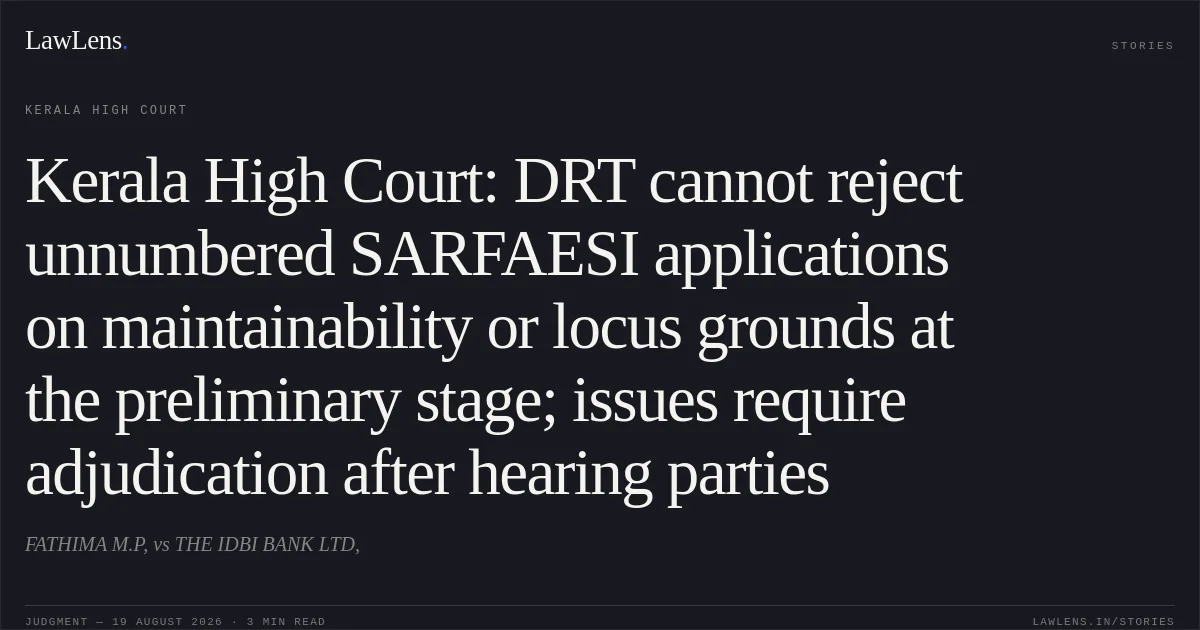
The petitioner challenged coercive measures initiated by respondents 1 and 2 under the SARFAESI Act concerning the alleged secured asset. She filed a Securitisation Application under Section 17 before the DRT-I, Ernakulam, together with an application for stay. The application was defectively and tentatively numbered as NDN(SA) No. 1308 of 2026.
Source reference: para. 1The DRT Registry placed the unnumbered application before the Presiding Officer to consider its maintainability. By order dated 7 July 2026, the DRT examined the merits, held that the petitioner lacked locus standi, and rejected the application as not maintainable without granting her a proper opportunity of hearing. The petitioner therefore approached the High Court under Article 227 of the Constitution.
Source reference: para. 2Issues
1. Whether the Registrar of the DRT could suo motu refer an unnumbered Securitisation Application to the Presiding Officer or Tribunal for deciding questions of maintainability or locus standi.
Source reference: para. 62. Whether the DRT could reject an unnumbered application filed under Section 17 of the SARFAESI Act at the preliminary stage by deciding maintainability or locus standi without formal adjudication and hearing the parties.
Source reference: para. 6Law Applied
The Court applied Rule 5 of the Debts Recovery Tribunal (Procedure) Rules, 1993, which limits the Registrar’s role to endorsing the date of presentation, scrutinising applications, permitting correction of defects, and declining registration by a reasoned order if defects are not cured; it does not authorise the Registrar to reject or dismiss an application or to suo motu refer it to the Tribunal.
Source reference: pp. 7–8The Court relied on Vincent v. Housing and Urban Development Corporation, 2003 (3) KHC 79, holding that the Registrar is only a ministerial officer and cannot exercise judicial powers.
Source reference: pp. 9–11It also relied on Kanigiri Jaya Sri v. The Debts Recovery Tribunal, 2023 Supreme AP 98, for the principle that an application under Section 17 cannot be rejected by the DRT at the preliminary stage merely as not maintainable, and Ameena Salim v. Presiding Officer, DRT-I, Ernakulam, 2024 KHC 886, which held that questions concerning a party’s status, locus standi, or other substantial defects require judicial adjudication after hearing the parties and cannot be treated as formal defects.
Source reference: pp. 12–14Reasoning
Rule 5 required the Registrar first to determine only whether the application contained curable defects. If the application was in order, or if defects were cured within the time granted, it had to be registered and numbered; if defects remained uncured, the Registrar could only decline registration by a reasoned order.
Source reference: paras. 7–9The Registrar had no authority to investigate the merits, raise doubts regarding maintainability, or refer the matter suo motu to the Presiding Officer, since such conduct would involve the exercise of judicial power by a ministerial officer.
Source reference: para. 10The DRT also erred by examining the documents and merits of the petitioner’s claim and deciding that she lacked locus standi while the application remained unnumbered.
Source reference: para. 11Questions of locus standi and maintainability involve substantial issues of fact and law and therefore cannot be decided in chambers through the procedure applicable to formal defects; they must be adjudicated on the judicial side after numbering the application and hearing the concerned parties.
Source reference: paras. 12–13The DRT could reject the application only after a formal defect was established, the applicant was given a reasonable opportunity to cure it, and the defect remained uncured.
Source reference: para. 14(g)–(h)Holding
The High Court held that the Registrar cannot suo motu refer an unnumbered Securitisation Application to the DRT for deciding maintainability or locus standi, and that the DRT cannot reject a Section 17 application at the preliminary stage on such substantive grounds without formal adjudication and hearing the parties.
The order dated 7 July 2026 in NDN(SA) No. 1308 of 2026 was set aside. The matter was remitted to the Registrar, DRT-I, Ernakulam, with directions to scrutinise the application strictly under Rule 5: if defects remained uncured, the Registrar could decline registration by a speaking order; if there were no defects or they were cured within the permitted time, the application had to be numbered and placed before the Tribunal for consideration in accordance with law.
Source reference: pp. 17–18Acts & Sections Cited
1 provisions across 1 statute referred to in this judgment. Each provision opens on LawLens.
Securitisation and Reconstruction of Financial Assets and Enforcement of Security Interest Act, 20021
Original Court PDF
FATHIMA M.P,vsTHE IDBI BANK LTD,
Click to open original judgment
Original judgment, available to read, download and summarize on LawLens.in