Facts
The appellant, Renjin K. Mathew, was the sole accused in Crime No. 519/2026 of Kumarakom Police Station, later numbered as S.C. No. 380/2026 before the Special Court under the Scheduled Castes and Scheduled Tribes (Prevention of Atrocities) Act, 1989.
Source reference: para. 1, para. 3He was accused of offences under Sections 103(1), 238(a), 296(b) and 351(3) of the Bharatiya Nyaya Sanhita, 2023, and Section 3(2)(v) of the SC/ST (Prevention of Atrocities) Act.
Source reference: para. 1, para. 3The prosecution alleged that at approximately 2:00 a.m. on 19 May 2026, the appellant, who did not belong to a Scheduled Caste or Scheduled Tribe, assaulted Murukan, a member of the Hindu Cheramar Scheduled Caste community, with a machete due to prior animosity.
Source reference: para. 4Murukan sustained multiple injuries and died at 6:30 a.m. on 20 May 2026 while undergoing treatment.
Source reference: para. 4The appellant had been in custody since 19 May 2026.
Source reference: para. 5His third regular bail application before the Principal Sessions Court, Kottayam, was dismissed on 1 September 2026.
Source reference: para. 5The Sessions Court’s order merely noted that the investigation had been completed, the final report had been filed, and the case had been taken on file as S.C. No. 380/2026; it did not record the parties’ submissions or reasons for rejecting bail.
Source reference: para. 5, para. 7The deceased’s legal heir, who had been served notice under Section 15A(3) of the SC/ST Act, did not appear.
Source reference: para. 2Issues
Whether the Sessions Court’s order dismissing the appellant’s third bail application was legally sustainable despite failing to record the parties’ submissions and reasons for refusing bail?
Source reference: paras. 7–9Whether the appellant, who had remained in custody since 19 May 2026 and against whom the final report had already been filed, was entitled to regular bail despite the prima facie case involving fatal injuries and an offence under the SC/ST Act?
Source reference: para. 10Law Applied
The Court applied Section 483 of the Bharatiya Nagarik Suraksha Sanhita, 2023, governing the High Court’s and Court of Session’s power to grant bail, along with the offences alleged under Sections 103(1), 238(a), 296(b) and 351(3) of the Bharatiya Nyaya Sanhita, 2023 and Section 3(2)(v) of the SC/ST (Prevention of Atrocities) Act.
Source reference: paras. 1, 3, 7It held that, while deciding a non-bailable offence, the court must consider the submissions of the accused, the prosecution and any other relevant party, examine the prosecution materials, and record valid, analytical and intelligible reasons either for granting or refusing bail.
Source reference: paras. 8–9The Court also recognised that completion of investigation and filing of the final report do not automatically entitle an accused to bail, but they are relevant to determining whether further custodial detention is necessary.
Source reference: paras. 6, 10Notice to the victim or legal heir was considered in accordance with Section 15A(3) of the SC/ST Act.
Source reference: para. 2Reasoning
The High Court found that the Sessions Court’s three-paragraph order did not disclose the appellant’s submissions, the prosecution’s grounds of opposition, or any reasoned assessment of the relevant bail factors.
Source reference: paras. 7–9Merely recording that the investigation was complete and that the final report had been filed could not constitute a judicial determination of why bail should be refused.
Source reference: paras. 7–9The order was therefore held to be cryptic and legally deficient.
Source reference: paras. 7–9On the merits, the High Court examined the autopsy material and noted that the deceased had sustained 27 injuries, including injuries 14, 15 and 19, which the doctor identified as fatal.
Source reference: para. 10Accordingly, the Court found that a prima facie prosecution case existed.
Source reference: para. 10Nevertheless, the appellant had remained in custody since 19 May 2026, the investigation was complete, and the final report had been filed; consequently, his further custody was not required for investigation.
Source reference: para. 10Balancing the prima facie seriousness of the allegations against the absence of any continuing investigative need, the Court considered release on stringent conditions appropriate.
Source reference: para. 10Holding
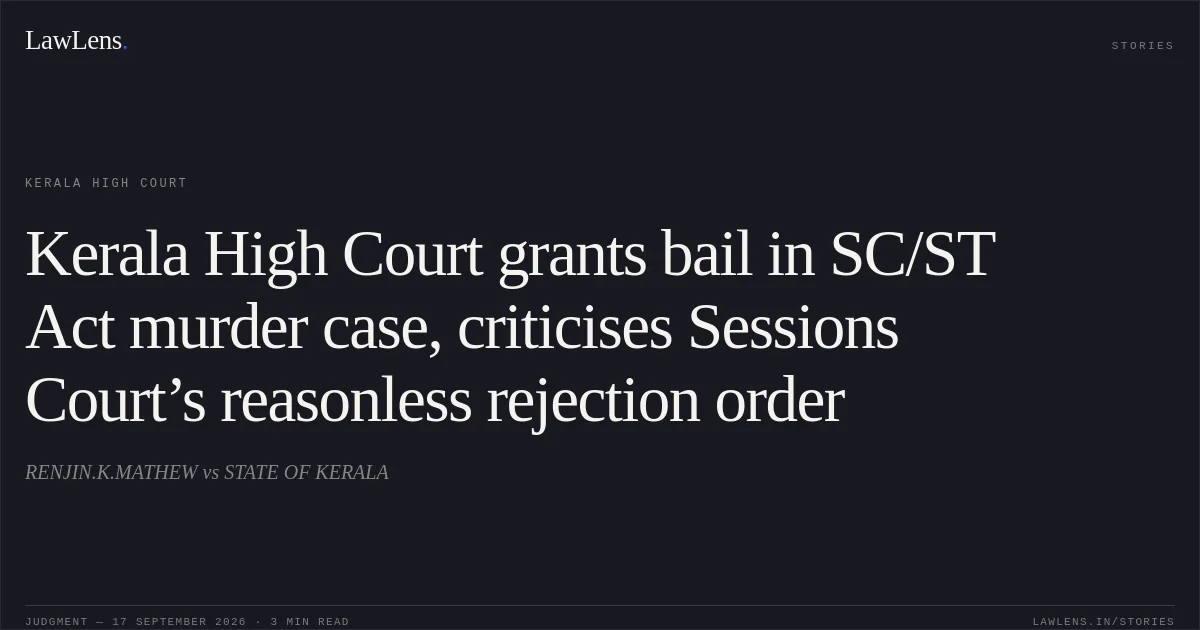
The High Court allowed the appeal, set aside the Sessions Court’s order dated 1 September 2026, and granted the appellant regular bail.
He was directed to execute a bond for ₹1,00,000 with two solvent sureties for the like amount.
Source reference: para. 15The conditions included non-interference with witnesses or evidence, cooperation with the trial, prohibition against inducement, threat or promise to persons acquainted with the facts, prohibition against contacting or harassing the de facto complainant and his family, and a prohibition against involvement in any other offence.
Source reference: para. 15Violation of the conditions could result in cancellation of bail.
Source reference: para. 15Acts & Sections Cited
6 provisions across 3 statutes referred to in this judgment. Each provision opens on LawLens.
Scheduled Castes and the Scheduled Tribes (Prevention of Atrocities) Act, 19891
Bharatiya Nyaya Sanhita, 20234
Bharatiya Nagarik Suraksha Sanhita, 20231
Original Court PDF
RENJIN.K.MATHEWvsSTATE OF KERALA
Click to open original judgment
Original judgment, available to read, download and summarize on LawLens.in