Facts
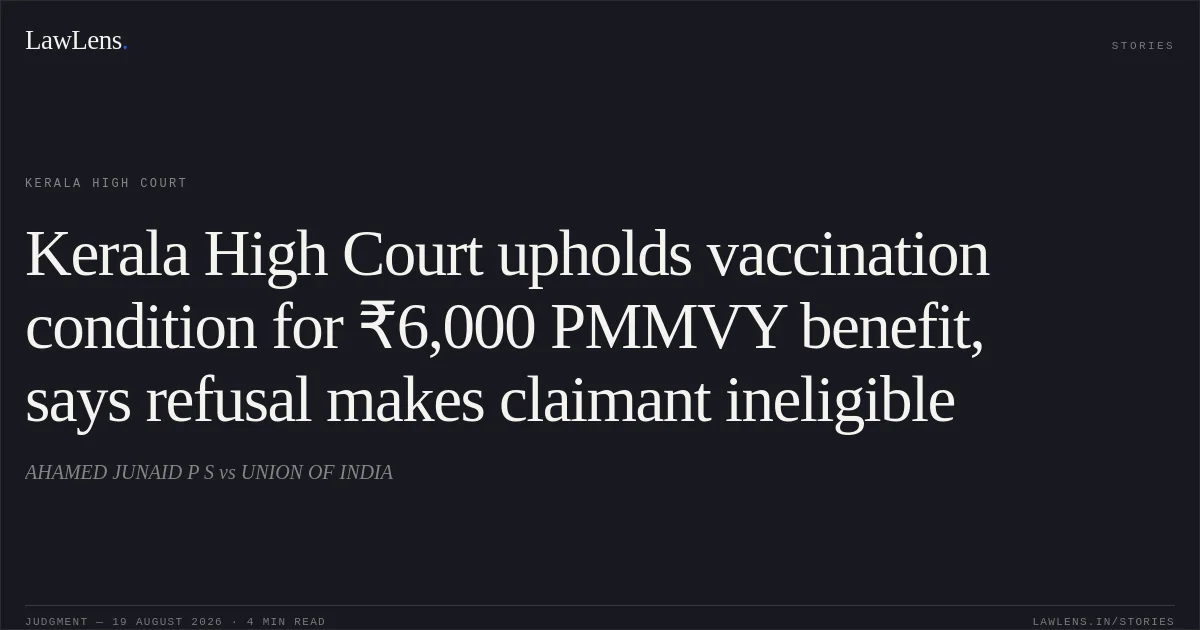
The petitioner, claiming to be the father of the child, sought a direction to sanction and release ₹6,000 payable to his wife under the Pradhan Mantri Matru Vandana Yojana (PMMVY) for the birth of their second girl child on 3 September 2024.
Source reference: paras. 1–2The authorities informed him that the benefit could be released only upon production of a vaccination certificate showing that the child had received the vaccines due under the Universal Immunization Programme up to fourteen weeks of age.
Source reference: paras. 1–2The petitioner challenged the vaccination requirement as unconstitutional and violative of Articles 14 and 21, relying principally on the right to bodily integrity and personal autonomy recognised in Jacob Puliyel v. Union of India.
Source reference: paras. 5, 16–17The Court first considered the maintainability of the petition and thereafter examined the constitutional challenge on merits.
Source reference: paras. 7–8Issues
1. Whether the writ petition was maintainable when the petitioner was not the beneficiary under the PMMVY scheme and the maternity benefit was payable directly to the mother’s bank account?
Source reference: para. 72. Whether the vaccination requirement under Rule 7(2)(ii) of the PMMVY Rules, 2022, as a condition for receiving ₹6,000 for a second living girl child, was unconstitutional, arbitrary, or ultra vires Articles 14 and 21 of the Constitution?
Source reference: paras. 1, 8–133. Whether imposing vaccination as a condition for eligibility amounted to impermissible coercion or violated the right to bodily integrity and personal autonomy recognised in Jacob Puliyel v. Union of India?
Source reference: paras. 16–19Law Applied
The Court applied Section 4(b) of the National Food Security Act, 2013, which confers maternity benefits “subject to such schemes as may be framed by the Central Government,” thereby permitting the benefit to be regulated by prescribed conditions.
Source reference: para. 8It relied on the Pradhan Mantri Matru Vandana Yojana Rules, 2022, particularly Rule 2(f), defining PMMVY as a scheme for partial wage compensation, promotion of health-seeking behaviour, and positive behavioural change towards the girl child; Rule 3, identifying eligible women from socially and economically disadvantaged sections; and Rule 7(2), requiring that, for the benefit relating to a second living child, the child must be a girl, the birth must be registered, and all due vaccines under the Universal Immunization Programme must have been administered up to fourteen weeks.
Source reference: paras. 9–11The Court further applied the principle in Union of India v. Charak Pharmaceuticals (India) Ltd., (2003) 11 SCC 689, that a person seeking benefits under a statutory or governmental scheme must fully comply with its conditions and cannot obtain relaxation on equitable grounds.
Source reference: para. 14From Jacob Puliyel v. Union of India, 2022 SCC OnLine SC 533, the Court recognised that bodily integrity and personal autonomy include the right to refuse medical treatment and that no person may be physically forced to vaccinate; however, such autonomy is not absolute and may be subject to reasonable and proportionate public-health measures.
Source reference: paras. 16–18The Court also relied on the constitutional objective in Article 47 concerning improvement of public health and accepted the Government’s vaccination policy as a legitimate public-health measure.
Source reference: paras. 15, 20–21Reasoning
The Court held that the petition was not maintainable because the petitioner was not the intended beneficiary: the PMMVY benefit was payable to the lactating mother and was to be transferred directly into her bank account, while the mother had not been impleaded as petitioner.
Source reference: para. 7On merits, the Court treated PMMVY as a conditional benefit and not an unconditional statutory entitlement.
Source reference: paras. 11–13Rule 7(2)(ii) expressly made vaccination of the second girl child up to fourteen weeks a prerequisite for payment.
Source reference: paras. 11–13Since the child had admittedly not received the required vaccinations within that period, the eligibility condition was not satisfied.
Source reference: paras. 11–13The Court distinguished physical compulsion from conditional welfare eligibility: the authorities did not force the petitioner or the child to undergo vaccination, but merely declined the scheme benefit when the prescribed condition was not fulfilled.
Source reference: para. 13Applying Jacob Puliyel, the Court concluded that the right to refuse vaccination did not necessarily confer a right to receive a conditional cash incentive notwithstanding non-compliance.
Source reference: paras. 15, 19It also found no material establishing that the vaccines under the Universal Immunization Programme were harmful and accepted that their public-health benefits outweighed alleged side effects.
Source reference: paras. 15, 19, 21Accordingly, the vaccination condition was held neither arbitrary nor disproportionate under Articles 14 and 21.
Source reference: paras. 20–22Holding
The Kerala High Court held that the petition was not maintainable, as the petitioner had no legally enforceable right to claim a benefit payable to his wife under PMMVY.
In any event, the Court upheld the vaccination requirement in Rule 7(2)(ii) of the PMMVY Rules, 2022, holding that it was a valid eligibility condition and did not amount to unconstitutional compulsion or violate Articles 14 or 21.
Source reference: paras. 12–13, 20–22Since the child had not received the required vaccinations within fourteen weeks of birth, the petitioner’s wife was not entitled to the ₹6,000 benefit.
Source reference: para. 22The writ petition was accordingly dismissed.
Source reference: para. 22Acts & Sections Cited
2 provisions across 1 statute referred to in this judgment. Each provision opens on LawLens.
National Food Security Act, 20132
Original Court PDF
AHAMED JUNAID P SvsUNION OF INDIA
Click to open original judgment
Original judgment, available to read, download and summarize on LawLens.in