Facts
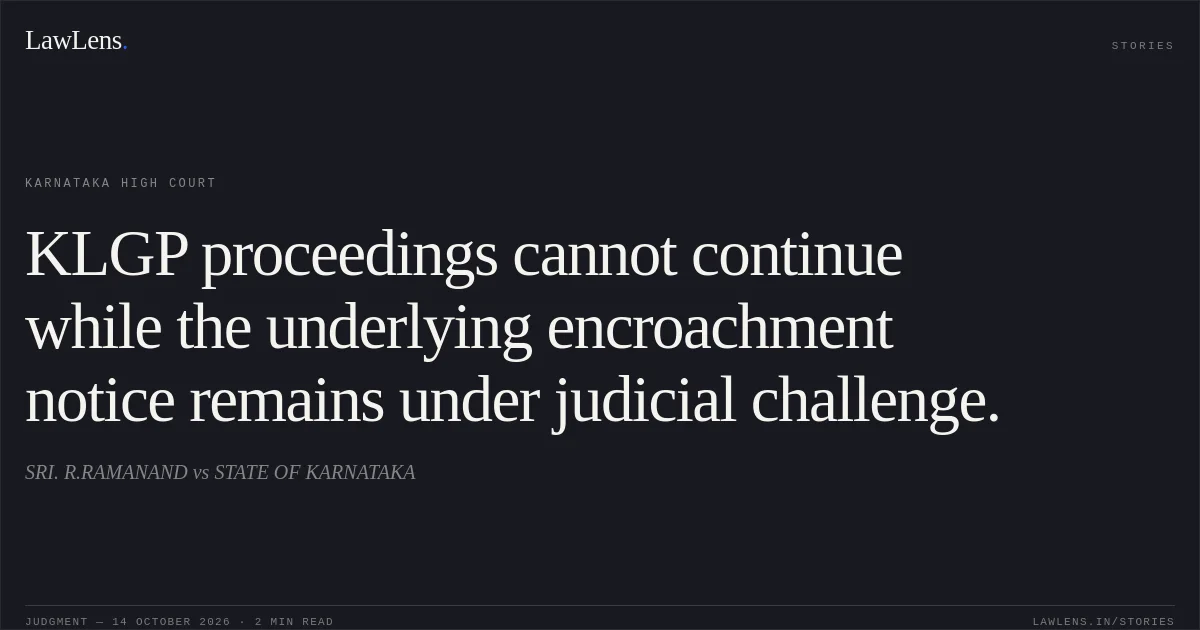
The petitioners challenged the order dated 22 March 2022 of the Karnataka Land Grabbing Prohibition Special Court in LGC(S) No. 246/2016.
Source reference: pp. 4–5, paras. 3, 5The dispute concerned 11,592.72 sq. m. allotted by the Bengaluru Development Authority (BDA) to the petitioners under an agreement dated 31 July 1997 as a civic amenity site for a hospital.
Source reference: pp. 4–5, paras. 3, 5Revenue authorities alleged that the petitioners had encroached on a Raja Kaluve on the site.
Source reference: pp. 5–6, paras. 4, 6The petitioners had separately challenged the notice concerning the alleged encroachment in W.P. No. 64551/2016, in which an interim order had been granted and the petition remained pending.
Source reference: pp. 5–6, paras. 4, 6The High Court considered whether the land-grabbing proceedings could continue while that challenge remained pending.
Source reference: pp. 8–9, paras. 9–10Issues
1. Whether proceedings under the Karnataka Land Grabbing Prohibition Act, 2011, could continue against the petitioners when the notice alleging encroachment on the Raja Kaluve was under challenge in a pending writ petition subject to an interim order.
Source reference: pp. 8–9, paras. 9–102. Whether the Land Grabbing Prohibition Special Court’s order permitting the proceedings to continue should be set aside.
Source reference: p. 9, para. 11Law Applied
Section 2(e) of the Karnataka Land Grabbing Prohibition Act, 2011 defines a “land grabber” to include a person who commits or has committed land grabbing, as well as specified persons who assist, abet, or succeed such a person.
Source reference: pp. 6–7, para. 7Section 2(f) defines “land grabbing” as grabbing land without lawful entitlement and with a view to illegally taking possession, or engaging in specified related conduct involving illegal occupation or unauthorised structures.
Source reference: pp. 7–8, para. 7The Act also prohibits a person from committing or causing land grabbing.
Source reference: p. 8, para. 8The Court referred to proceedings under Section 4(3) and held that, in the circumstances of this case, those proceedings could not continue while the Revenue Authorities’ notice was under challenge in a pending writ petition.
Source reference: p. 9, para. 10Reasoning
The Court noted that the disputed land was the same land allotted to the petitioners by the BDA, and that the allegation of encroachment arose from the Revenue Authorities’ notice already challenged in W.P. No. 64551/2016, where an interim order was in force.
Source reference: p. 8, para. 9Because the validity of the notice and the related dispute were pending before the High Court, the Court held that the Land Grabbing Court’s proceedings under Section 4(3) could not proceed in the meantime.
Source reference: p. 9, para. 10It did not determine whether a Raja Kaluve existed on the site or resolve the parties’ substantive claims, leaving those matters for the pending writ petition.
Source reference: pp. 5–6, para. 6; p. 9, para. 11Holding
The High Court allowed the writ petition and set aside the Land Grabbing Prohibition Special Court’s order dated 22 March 2022 in LGC(S) No. 246/2016.
All parties’ contentions were left open for determination in W.P. No. 64551/2016.
Source reference: p. 9, para. 11Acts & Sections Cited
2 provisions across 1 statute referred to in this judgment. Each provision opens on LawLens.
Original Court PDF
SRI. R.RAMANANDvsSTATE OF KARNATAKA
Click to open original judgment
Original judgment, available to read, download and summarize on LawLens.in