Facts
The respondent, a retired Accounts-cum-Administrative Officer under the Central Reference Library, was initially appointed as a Lower Division Clerk on 3 August 1982 and later became the Drawing and Disbursing Officer (“DDO”).
Source reference: p.2, para. 4; p.9, para. 15His wife, a State Government Staff Nurse, was allotted a dormitory room with a common toilet at Shambhu Nath Pandit Hospital in 1997. Her HRA was discontinued because she occupied the government accommodation.
Source reference: p.2, paras. 5–6; p.4, para. 8The respondent resided with his wife in that accommodation but continued drawing HRA on the basis that the premises were only a dormitory and not a regular residential quarter.
Source reference: p.3, paras. 6–7; p.4, para. 9In 1999, the hospital authorities clarified that the accommodation was a dormitory room and not a regular staff quarter, and the employer did not then object to the respondent’s continued receipt of HRA.
Source reference: p.3, paras. 6–7; p.11, para. 21Although he purchased a flat in 2011, he allegedly continued residing in the accommodation allotted to his wife until retirement on 31 October 2016.
Source reference: p.5, para. 10; p.8, para. 16After his retirement, the employer issued an order dated 21 April 2017 directing recovery of Rs.8,40,795 from his gratuity towards HRA allegedly drawn from 1999 onwards.
Source reference: p.5, para. 11The Central Administrative Tribunal quashed the recovery, relying principally on State of Punjab v. Rafiq Masih (White Washer), (2015) 4 SCC 334, and directed refund with 6% interest.
Source reference: p.5, para. 11Issues
Whether accommodation allotted by the State Government to the respondent’s wife, even though described as a dormitory room rather than a regular residential quarter, constituted government accommodation so as to disentitle the respondent from receiving HRA under the applicable service instructions?
Source reference: p.6–7, paras. 12–14Whether recovery of excess HRA from the respondent’s gratuity was legally permissible, notwithstanding his retirement and the principles laid down in Rafiq Masih and Syed Abdul Qadir v. State of Bihar, (2009) 3 SCC 475?
Source reference: p.8–10, paras. 15–18Whether, in view of the employer’s earlier failure to object and the respondent’s age and medical condition, the equities warranted modification or partial relief against the full recovery?
Source reference: p.10–12, paras. 19–23Law Applied
The Court applied Clause 5.1(iii) of the Ministry of Finance instructions governing HRA, under which a government employee is not entitled to HRA where the employee’s spouse has been allotted government accommodation at the same station and the employee resides in that accommodation.
Source reference: p.7–8, para. 14The Court held that the substance and use of the premises, rather than its description as a dormitory or regular quarter, determine whether it constitutes government accommodation.
Source reference: p.6–7, paras. 12–13It considered State of Punjab v. Rafiq Masih (White Washer), (2015) 4 SCC 334, and Syed Abdul Qadir v. State of Bihar, (2009) 3 SCC 475, which restrict recovery of excess payments in appropriate cases, particularly where the employee is a lower-level employee and was not responsible for the erroneous payment.
Source reference: p.8–9, para. 15The Court distinguished those principles where the employee had knowledge of the relevant rules and was personally responsible for preparing and drawing the salary bills containing the disputed HRA component.
Source reference: p.8–9, para. 15Reasoning
The Court held that the accommodation allotted to the respondent’s wife was government accommodation because it provided government-funded shelter and the wife’s HRA had been discontinued precisely on that basis.
Source reference: p.6–7, paras. 12–14The fact that it was a one-room dormitory with a common toilet did not remove it from the scope of the HRA restriction.
Source reference: p.6–7, paras. 12–14Since the respondent resided there with his wife, he was disentitled to HRA under Clause 5.1(iii).
Source reference: p.7–8, para. 14The Court further found that the respondent was not an uninformed or low-level employee: he was an Accounts-cum-Administrative Officer and DDO, knew that his wife occupied government accommodation, and personally prepared and drew salary bills containing HRA.
Source reference: p.8–9, para. 15His conduct therefore differed materially from the employees protected in Rafiq Masih and Syed Abdul Qadir.
Source reference: p.8–9, para. 15His continued occupation of the accommodation even after purchasing a flat in 2011 was treated as further evidence that he consciously continued to benefit from the government accommodation.
Source reference: p.8–9, para. 16Nevertheless, the Court noted that the employer had examined the issue in 1999, accepted the dormitory explanation, and did not object to the HRA until after retirement.
Source reference: p.11, para. 21Balancing the respondent’s culpability against the employer’s delay and his status as a 70-year-old diabetic senior citizen, the Court considered full recovery inequitable.
Source reference: p.11–12, para. 22Holding
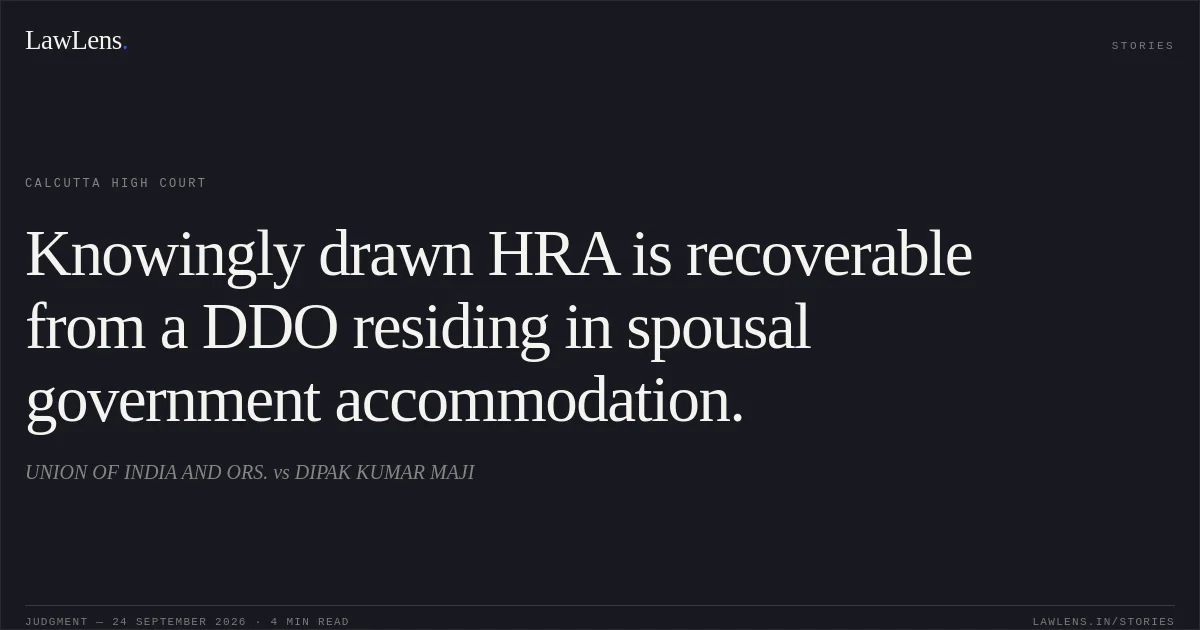
The High Court held that the respondent was not entitled to HRA while residing with his wife in the government accommodation allotted to her, and that the principles against recovery in Rafiq Masih did not bar recovery in view of his role as DDO and personal involvement in drawing the allowance.
Of the recovered amount of Rs.8,40,795, 75% was permitted to be adjusted towards the HRA recovery, while 25% was directed to be returned to the respondent.
Source reference: p.11–12, para. 22The Union of India was directed to pay Rs.2,11,000 on or before 15 October 2026.
Source reference: p.11–12, para. 22The writ petition was accordingly partly allowed, the Tribunal’s order was modified, and the Rule was made partly absolute.
Source reference: p.12, para. 23Acts & Sections Cited
1 provisions across 1 statute referred to in this judgment. Linked provisions open on LawLens.
the Act (alias, unresolved)1
Original Court PDF
UNION OF INDIA AND ORS.vsDIPAK KUMAR MAJI
Click to open original judgment
Original judgment, available to read, download and summarize on LawLens.in