Facts
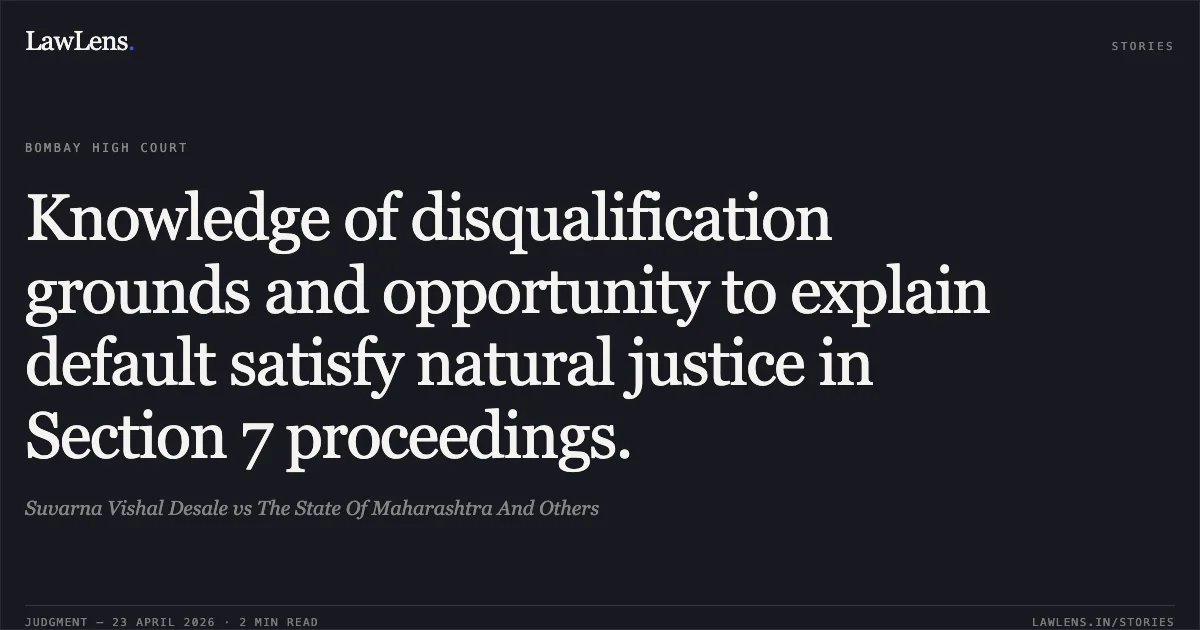
The Petitioner, the directly elected Sarpanch of Village Kasare (term 2022-2027), was disqualified by the District Collector, Dhule, via an order dated 23.01.2026
Source reference: p. 1-2The disqualification followed a complaint by Respondent No. 4 alleging that the Petitioner failed to convene mandatory Gram Sabha meetings as required by law
Source reference: p. 3The Petitioner contended that she was not served with a copy of the complaint, the notice did not specify the exact provision of disqualification, and the hearing via video conferencing was abruptly closed
Source reference: p. 3-4She further argued that the Model Code of Conduct for elections prevented the meetings and that the Gram Sevak had manipulated notices
Source reference: p. 4Issues
1. Whether the Petitioner was given sufficient opportunity to defend the dispute and was properly informed of the charges of proposed disqualification?
Source reference: p. 5 / para. 62. Whether the Petitioner incurred disqualification in terms of Section 7 of the Maharashtra Village Panchayat Act, 1959, for failing to hold the mandatory meetings?
Source reference: p. 5 / para. 6Law Applied
Section 7 of the Maharashtra Village Panchayat Act, 1959, which mandates at least four Gram Sabha meetings every financial year, with no more than four months elapsing between any two meetings. Failure to hold these meetings without "sufficient cause" results in the automatic disqualification of the Sarpanch or Upa-Sarpanch for the remainder of the term
Source reference: p. 7 / para. 8principles of natural justice regarding the adequacy of notice and the right to be heard, weighing them against precedents such as Pratibha v. Additional Collector and Shobhabai Devidas Chavan v. State of Maharashtra
Source reference: p. 4-5Reasoning
The Court found that the Petitioner was served a notice explicitly mentioning Section 7 of the Act, and her subsequent detailed reply—which referenced the Block Development Officer’s (BDO) report—proved she had sufficient knowledge of the charges
Source reference: p. 5-6 / para. 6, 9On the merits, the BDO's report and records from the Village Development Officer showed that the Petitioner was repeatedly prompted to conduct meetings between April 2024 and May 2025 but refused or deferred them indefinitely, citing the "code of conduct" as a pretext
Source reference: p. 6-7 / para. 7The Court determined that the Petitioner failed to provide "sufficient cause" for missing four mandatory meetings. It reasoned that while procedural fairness is required, a Sarpanch cannot avoid statutory consequences for a clear default using technical arguments when the substance of the charge was known and undefended
Source reference: p. 8 / para. 9, p. 9-10 / para. 12Holding
The Court answered the first issue in the affirmative, finding the Petitioner had adequate notice and opportunity, and the second issue in the affirmative, confirming the failure to hold the mandatory meetings
The High Court upheld the District Collector’s order, holding that the Petitioner had incurred disqualification under Section 7. The Writ Petition was rejected, and the rule was discharged
Source reference: p. 10 / para. 13-14Acts & Sections Cited
2 provisions across 1 statute referred to in this judgment. Each provision opens on LawLens.
Maharashtra Village Panchayats Act.2
Original Court PDF
Suvarna Vishal DesalevsThe State Of Maharashtra And Others
Click to open original judgment
Original judgment, available to read, download and summarize on LawLens.in