Facts
The prosecutrix, a minor school-going girl, alleged that respondent no. 2 forcibly took her on a motorcycle, transferred her to a car driven by respondent no. 3, compelled her to consume beer, and thereafter respondent no. 2 raped her. She further alleged that respondent no. 3 attempted to rape her and recorded a video of the incident.
Source reference: paras. 2–7An FIR was registered under Sections 376, 365, 506 and 34 IPC and Sections 6 and 8 of the POCSO Act. The first chargesheet invoked, inter alia, Sections 363, 328, 376(2)(g), 506, 120B and 34 IPC and Sections 6, 12 and 17 of the POCSO Act. Following a complaint to the SC/ST Commission, a supplementary chargesheet also invoked Sections 3(1)(e), (r) and (w) of the SC/ST Act.
Source reference: paras. 6–8The Trial Court framed charges under Sections 363, 366 and 506 IPC read with Section 120B IPC, Section 6 read with Section 5(g) of the POCSO Act, and alternatively Section 376D IPC, but declined to frame charges under Section 328 IPC, Section 14(3) of the POCSO Act and Sections 3(1)(e), (r) and (w) of the SC/ST Act.
Source reference: para. 9The prosecutrix challenged that order in revision under Sections 397/401/407 read with Section 482 CrPC.
Source reference: para. 1Issues
Whether the Trial Court lacked jurisdiction to frame charges because it was allegedly not a notified Special Court under the SC/ST Act?
Source reference: paras. 11, 26Whether charges under Sections 3(1)(e), (r) and (w) of the SC/ST Act ought to have been framed against respondents nos. 2 and 3, notwithstanding the absence of caste-related allegations in the initial complaint, FIR and Section 164 CrPC statement?
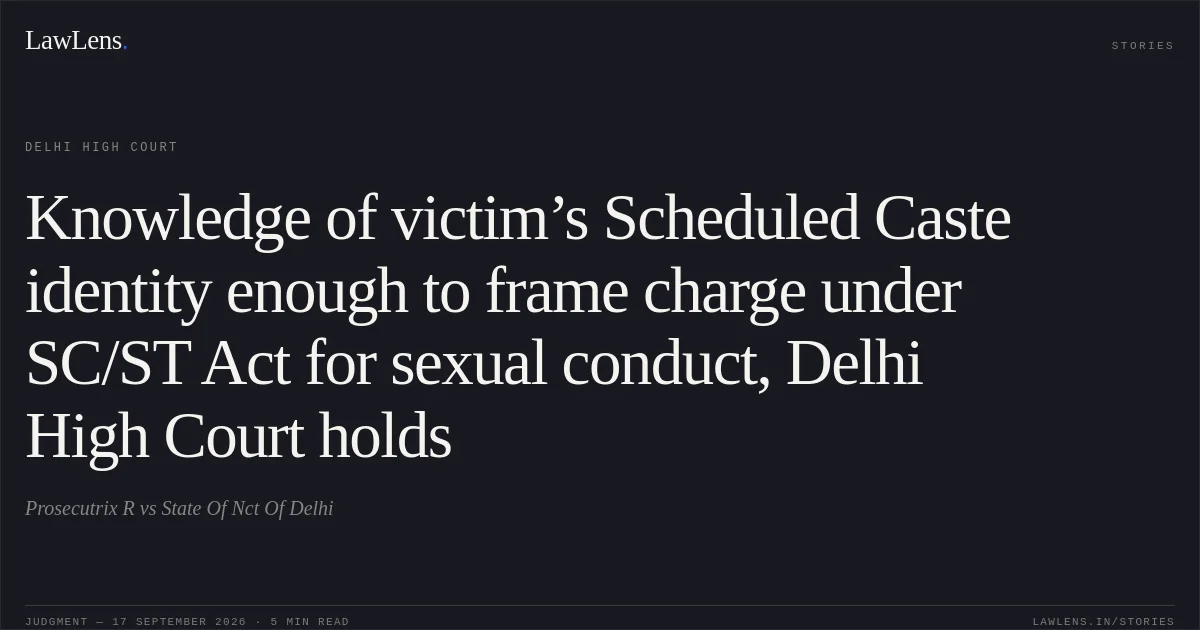
Source reference: paras. 13–15, 27–29Whether the material on record disclosed the requisite knowledge of the prosecutrix’s caste identity, particularly for the offence under Section 3(1)(w) of the SC/ST Act?
Source reference: paras. 28–35Whether charges under Section 328 IPC were warranted on the allegation that the prosecutrix was forcibly made to consume beer mixed with a stupefying or intoxicating substance?
Source reference: para. 38Whether charges under Section 14(3) of the POCSO Act were warranted on the allegation that respondent no. 3 recorded a video of the sexual incident?
Source reference: para. 39Law Applied
The Court applied the provisions of Sections 3(1)(e), 3(1)(r), 3(1)(w) and 8(c) of the SC/ST Act.
Source reference: paras. 23–29Sections 3(1)(e) and 3(1)(r) require proof of the specific statutory intent contemplated therein, including an act derogatory to human dignity or intentional insult/intimidation with intent to humiliate on the ground of caste; by contrast, Section 3(1)(w) requires that the accused knowingly engage in sexual touching or sexual words, acts or gestures towards a woman belonging to a Scheduled Caste or Scheduled Tribe, without requiring proof that the act was committed exclusively because of her caste.
Source reference: paras. 23–29Section 8(c) permits a presumption of knowledge of the victim’s caste or tribal identity where the accused had personal knowledge of the victim or her family.
Source reference: para. 14The Court relied on Ashabai Machindra Adhagale v. State of Maharashtra for the principle that omission of every detail from the FIR is not necessarily fatal, and on Hitesh Verma v. State of Uttarakhand and Shajan Skaria v. State of Kerala for the requirement of caste-based intent under Section 3(1)(r).
Source reference: paras. 13, 37Section 328 IPC requires material indicating administration or causing consumption of poison, a stupefying, intoxicating or unwholesome substance with the requisite intent.
Source reference: para. 38Section 14(3) of the POCSO Act applies where a person using a child for pornographic purposes directly participates in pornographic acts, requiring prima facie supporting material of such pornographic use or recording.
Source reference: para. 39Reasoning
The Court held that the objection to the Trial Court’s competence was raised belatedly, after the prosecutrix had participated in proceedings before that court on numerous occasions and nearly nine years after the framing order; it therefore declined to entertain the objection.
Source reference: para. 26The delayed introduction of SC/ST Act allegations, and their absence from the FIR and Section 164 statement, were not by themselves sufficient to reject the allegations, particularly given the prosecutrix’s minority and the trauma associated with the alleged gang rape.
Source reference: para. 27In relation to respondent no. 2, the material showed that he and the prosecutrix knew each other, lived in the same locality, and that he had allegedly made a caste-based taunt. His own statement also supported an inference that he knew her caste identity. This was sufficient to invoke the presumption under Section 8(c) and to frame a charge under Section 3(1)(w).
Source reference: paras. 30–32No comparable material established that respondent no. 3 knew the prosecutrix or her caste; she had stated that she met him for the first time on the date of the incident, and he lived in a different locality. The charge under Section 3(1)(w) was therefore unwarranted against him.
Source reference: paras. 33–35The allegations did not show that the rape was committed with the object of publicly humiliating the prosecutrix as required by Section 3(1)(e), nor that either accused intended to insult or intimidate her solely because of her caste as required by Section 3(1)(r).
Source reference: paras. 36–37Finally, the allegation regarding consumption of beer lacked corroboration: no bottle or stupefying substance was recovered and the medical record disclosed no such administration.
Source reference: para. 38Similarly, the alleged video recording was unsupported by recovery of the mobile phone or other electronic evidence.
Source reference: para. 39Holding
The revision petition was partly allowed.
The impugned order dated 4 March 2017 was modified only to direct framing of an additional charge under Section 3(1)(w) of the SC/ST Act against respondent no. 2.
Source reference: paras. 40–42The refusal to frame charges under Sections 3(1)(e) and 3(1)(r) of the SC/ST Act, and against respondent no. 3 under Section 3(1)(w), was upheld.
Source reference: paras. 40–42The Court also upheld the Trial Court’s refusal to frame charges under Section 328 IPC and Section 14(3) of the POCSO Act.
Source reference: paras. 40–42The Court clarified that its observations would not prejudice the parties at trial.
Source reference: para. 41Acts & Sections Cited
20 provisions across 4 statutes referred to in this judgment. Each provision opens on LawLens.
Code of Criminal Procedure, 19735
Protection of Children from Sexual Offences Act, 20126
Indian Penal Code, 18607
Original Court PDF
Prosecutrix RvsState Of Nct Of Delhi
Click to open original judgment
Original judgment, available to read, download and summarize on LawLens.in