Facts
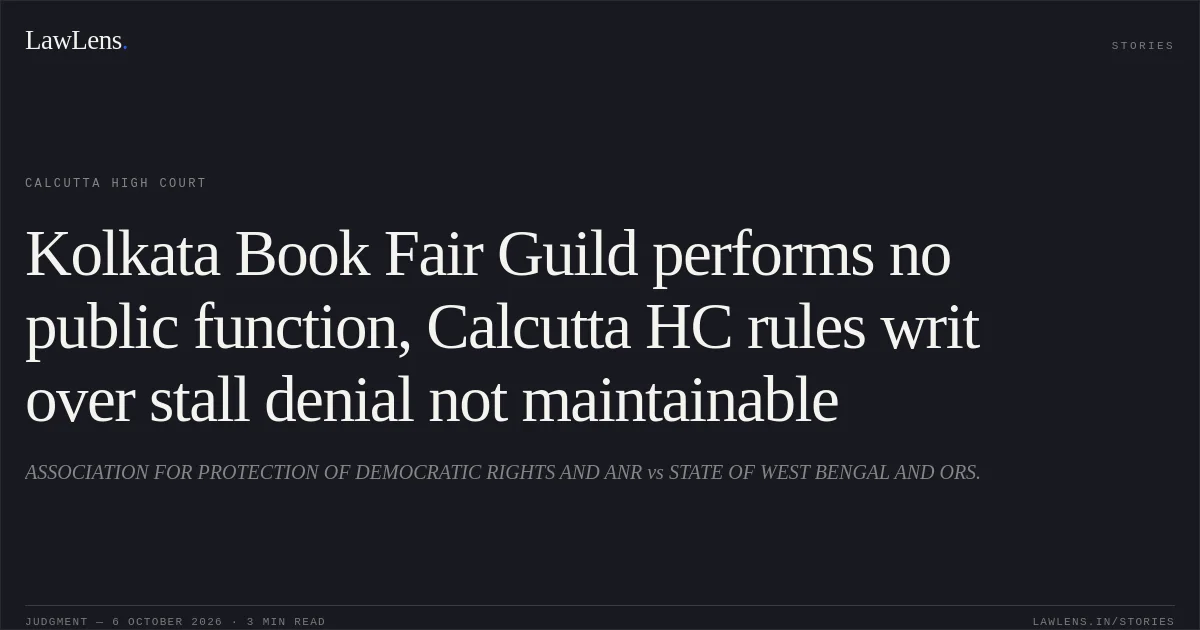
The appellant organisation had participated in earlier editions of the International Kolkata Book Fair. For the 48th edition, organised by the Publishers and Booksellers Guild (the “Guild”), the Guild refused to allot it a stall, prompting a writ petition under Article 226 of the Constitution. A Single Judge dismissed the petition as not maintainable, holding that the Guild was a private body not performing a public duty by conducting the fair. The appellants challenged that decision in this intra-court appeal.
Source reference: para. 1–2The Guild was a society registered under the West Bengal Societies Registration Act, 1961; its memorandum included an object of encouraging literacy and education, and it earned profit from the fair. The State provided support for the event, but the Guild controlled stall allocation and the conditions for allotment.
Source reference: para. 37, 62Issues
Whether the Guild performs a “public function” when organising or conducting the Book Fair.
Source reference: para. 40(i)If so, whether the Guild is amenable to writ jurisdiction under Article 226.
Source reference: para. 40(ii)Whether the Guild’s stall-allotment decisions are amenable to judicial review under Article 226.
Source reference: para. 40(iii)Law Applied
Article 226 extends beyond statutory authorities and bodies qualifying as “State” under Article 12: under Andi Mukta Sadguru (1989) 2 SCC 691, mandamus may issue to a person or body performing a public duty, where a positive obligation is owed to the affected party.
Source reference: para. 45The inquiry focuses on the nature of the function and whether it has a public-law element; purely private contractual matters are not ordinarily enforceable through Article 226 (Binny Ltd. v. V. Sadasivan, (2005) 6 SCC 657).
Source reference: para. 50BCCI v. Cricket Association of Bihar, (2015) 3 SCC 251, treated the BCCI’s functions as public in view of its pervasive control and effective monopoly over cricket, together with State support.
Source reference: para. 48By contrast, the Article 12 test in Pradeep Kumar Biswas v. Indian Institute of Chemical Biology, (2002) 5 SCC 111, concerns pervasive State control and does not, by itself, determine whether a private body is amenable to Article 226.
Source reference: para. 47, 58The Court also relied on K.K. Saxena v. International Commission on Irrigation and Drainage, (2015) 4 SCC 670, and St. Mary’s Education Society v. Rajendra Prasad Bhargava, (2023) 4 SCC 498, for the requirement of a public duty or public-law element.
Source reference: para. 52, 58The Court distinguished precedents concerning the provision of education by educational institutions: organising a commercial book fair was not, in its view, equivalent to imparting education as a public function.
Source reference: para. 43–44, 61Reasoning
The Court treated the decisive question as whether the Guild owed a public duty connected to the appellants’ claimed right to participate, rather than whether the fair served a beneficial educational or cultural purpose.
Source reference: para. 39–41, 62It found that the Guild was a private society acting for its members, that other bodies also organised book fairs, and that the Guild neither exercised a monopoly nor had State-delegated or statutory responsibility for conducting the fair. State patronage and the Guild’s stated educational objective did not establish the necessary public-law obligation; the fair remained a platform for exhibiting and selling books on a commercial basis.
Source reference: para. 37, 58, 61–63The Court therefore distinguished BCCI, whose effective monopoly and pervasive control supported a finding of public function, and concluded that the Guild’s stall-allotment decisions fell within its private domain.
Source reference: para. 48, 58, 66Because the appellants had not obtained a stall in the completed 48th edition, the third issue was also described as presently moot.
Source reference: para. 66Holding
The Court held that the Guild did not perform a public function or owe a public duty in organising the Book Fair, and was therefore not amenable to writ jurisdiction under Article 226 in relation to the dispute.
It did not decide the merits of the stall-allotment issue, noting that the relevant fair had already taken place and that the allocation was a private matter.
Source reference: para. 66The appeal was dismissed, the Single Judge’s order was upheld, CAN 1 of 2025 was disposed of, and no order as to costs was made.
Source reference: para. 67–70Acts & Sections Cited
1 provisions across 1 statute referred to in this judgment. Each provision opens on LawLens.
Banking Regulation Act, 19491
Original Court PDF
ASSOCIATION FOR PROTECTION OF DEMOCRATIC RIGHTS AND ANRvsSTATE OF WEST BENGAL AND ORS.
Click to open original judgment
Original judgment, available to read, download and summarize on LawLens.in