01Facts
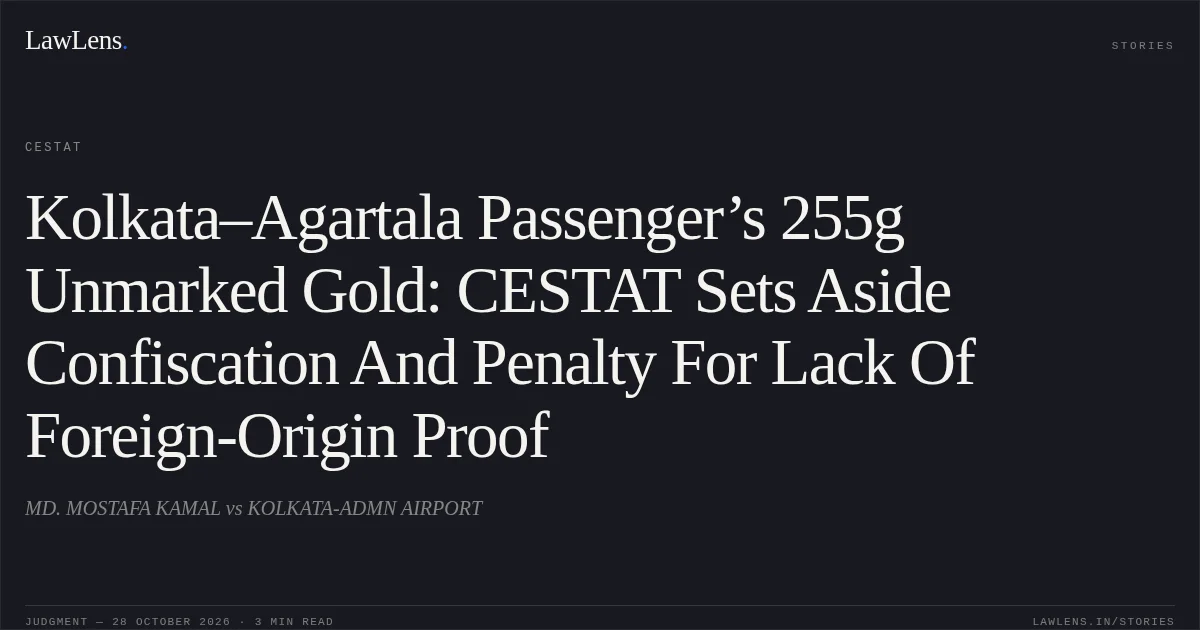
On 25 July 2022, CISF personnel at Kolkata Airport detected an unmarked gold strip weighing 255.210 grams in the appellant’s baggage while he was travelling on a domestic flight from Kolkata to Agartala.
p. 1Customs seized the strip and, by Order-in-Original dated 28 June 2024, absolutely confiscated it under Sections 111(d), 111(l) and 111(m) of the Customs Act, 1962, and imposed a penalty of ₹4,00,000 under Section 112(b).
pp. 5–6The Commissioner (Appeals) dismissed the appellant’s appeal as time-barred.
p. 2, 5The appellant maintained that he first received the Order-in-Original through an RTI response dated 30 October 2024 and filed his appeal on 25 November 2024.
p. 2, 5The Tribunal found that the Department had not established earlier service and held the appeal to the Commissioner (Appeals) timely.
p. 5On the merits, the appellant claimed the gold was family property, that his initial statement had been retracted, and that there was no evidence of foreign origin.
pp. 5–702Issues
i.1. Whether the appeal before the Commissioner (Appeals) was filed within time, given the evidence concerning receipt of the Order-in-Original.
p. 2, 5ii.2. Whether seizure and confiscation of the unmarked gold were sustainable absent evidence that it was of foreign origin or smuggled, including whether the burden under Section 123 had shifted to the appellant.
pp. 6–7, 14–15iii.3. Whether the retracted statement, without corroborating evidence, could sustain confiscation and the penalty under Section 112(b).
pp. 6, 8, 14–15iv.4. Whether confiscation under Sections 111(d), 111(l) and 111(m), and the penalty under Section 112(b), were legally justified in the circumstances.
pp. 6–7, 14–1503Law Applied
Section 110(1) of the Customs Act requires a proper officer to have a reasonable belief, founded on relevant material, before seizing goods; suspicion alone is insufficient.
pp. 7–10The Tribunal applied Section 123 on the basis that the burden to prove that goods are not smuggled arises only where the statutory condition for its operation is met—here, the Tribunal found no prima facie evidence that the unmarked gold was foreign or smuggled.
pp. 6–7, 14–15Sections 111(d), 111(l) and 111(m) provide for confiscation in their respective statutory circumstances, while Section 112(b) provides for penalty for the specified dealings with goods liable to confiscation.
pp. 6–7, 14–15The Tribunal relied on Gian Chand v. State of Punjab and Union of India v. Mahesh Raj concerning the need for evidence of foreign origin and the operation of the burden of proof; on D. Bhoormull concerning proof in customs matters; and on Om Sai Trading Company v. Union of India, affirmed by the Supreme Court, and Tata Chemicals Ltd. v. Commissioner of Customs (Preventive) concerning the requirement that “reason to believe” rest on material and not mere suspicion.
pp. 7–10It also relied on Tribunal decisions addressing unmarked gold and the insufficiency of uncorroborated or retracted statements to establish smuggling.
pp. 8–14Provisions in the judgment · 6 · Linked ones open on LawLens
Customs Act,1962 Section 111Section 112Section 110Section 123Section 77
Central Excise Act, 1944 Section 14
04Reasoning
The Tribunal found that the gold was unmarked, was carried openly in hand luggage on a domestic journey, and had a purity of 99.7%; the record contained no independent evidence establishing foreign origin or smuggling.
pp. 7–8, 14–15The appellant’s initial statement was retracted within days, and the case was substantially founded on that statement, without corroboration.
p. 6, 8, 14In those circumstances, the Department had not established the factual basis necessary to shift the burden under Section 123 or to sustain confiscation under the invoked provisions.
pp. 13–15The Tribunal also held that the domestic journey did not involve the baggage-declaration circumstances contemplated by Section 77, and that the essential ingredients of Sections 111(l) and 111(m) were absent.
p. 15Separately, because the Department produced no evidence of service of the Order-in-Original before the RTI response, the Commissioner (Appeals) had wrongly dismissed the appeal as delayed.
p. 505Holding
The Tribunal held that the appeal before the Commissioner (Appeals) was timely and that confiscation of the gold and the penalty were not sustainable on the evidence.
pp. 5, 14–15It set aside the Order-in-Original, vacated the absolute confiscation and the penalty, and allowed the appeal with consequential relief, if any, according to law.
p. 15Original Court PDF
MD. MOSTAFA KAMALvsKOLKATA-ADMN AIRPORT
Click to open original judgment
Original judgment, available to read, download and summarize on LawLens.in