01Facts
The petitioner, a former director and Chairman of M/s. Achievers Vidya Kendra Foundation, sought quashing of the Principal District and Sessions Judge's order dated 09.01.2026 (Spl. C No. 56/2019), which rejected his discharge application under ss. 227 and 239 Cr.P.C.
¶ 1The case arises from Crime No. 359/2018, registered on a complaint by Respondent No. 2 for offences under s. 9 of the KPDE Act, 2004 and s. 420 IPC. Twenty persons were named in the FIR; the petitioner was not among them.
¶ 2A preliminary charge sheet dated 01.02.2019 named six accused, not the petitioner. He was later arrayed as Accused No. 8 after further investigation.
¶ 2The prosecution alleges that several hundred persons deposited money with M/s. Achievers Agri India Pvt. Ltd. on a promise of 3% monthly interest, and that these funds were transferred to the Foundation and used for its school construction.
¶ 10, 18, 26The petitioner contends that he was only a lessor of land, leased for 99 years at ₹1,500 per annum, and had no role in the company or the collection of deposits.
¶ 3–7The prosecution relies on the petitioner's status as director, Chairman and promoter (200 shares) of the Foundation.
¶ 9, 20The prosecution relies on minutes of meetings dated 16.06.2014 and 17.07.2014 recording the petitioner's questioning of Accused No. 1 about collected funds and unpaid teacher salaries.
¶ 22–24The prosecution relies on bank statements showing transfers from the company to the Foundation.
¶ 26The prosecution relies on a surrender-of-lease deed dated 23.11.2015 executed by the Foundation through the petitioner in favour of his family.
¶ 2802Issues
i.1. Whether the material collected during investigation discloses sufficient grounds to proceed against the petitioner for offences under the KPDE Act and ss. 120B, 406 and 420 IPC, or whether his implication is without supporting material.
¶ 13ii.2. Whether the petitioner, not being a director, manager or employee of the company that collected deposits, can be made liable under s. 9 of the KPDE Act as a person responsible for the management or conduct of a Financial Establishment.
¶ 6, 16, 31iii.3. Whether the petitioner's later inclusion as an accused after further investigation renders the proceedings invalid.
¶ 3403Law Applied
Section 2(2) of the KPDE Act, 2004 defines "deposit" as any receipt of money or valuable commodity by a Financial Establishment, repayable after a specified period or otherwise, with or without promised benefit, subject to enumerated exclusions.
¶ 15, 18Section 2(4) of the KPDE Act, 2004 defines a "Financial Establishment" as any person or group accepting deposits under a scheme or arrangement, without requiring registration or incorporation under any particular enactment.
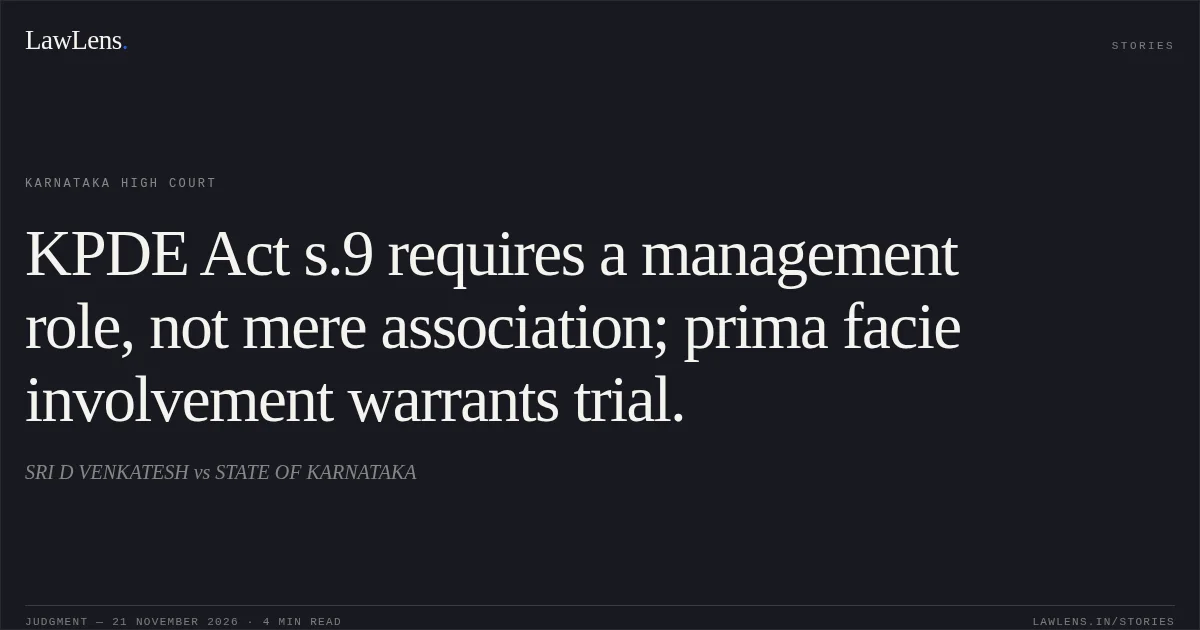
¶ 14Section 9 of the KPDE Act imposes liability for fraudulent default not only on the entity but on every person, including a promoter, director, partner, manager or employee, responsible for the management or conduct of its business or affairs. Liability is not limited to the person who physically receives deposits, but mere association with a connected person or institution is insufficient without material showing responsibility for or involvement in management.
¶ 16The ingredients of ss. 120B, 406 and 420 IPC (conspiracy, entrustment and dishonest misappropriation, or dishonest inducement) are matters for trial.
¶ 32–33On discharge, the accused cannot succeed by offering an alternative interpretation of prosecution material, and the Court need not evaluate evidence in detail or determine likely conviction.
¶ 36Provisions in the judgment · 10 · Linked ones open on LawLens
Code of Criminal Procedure, 1973 Section 482Section 227Section 239
Bharatiya Nagarik Suraksha Sanhita, 2023 Section 528
Indian Penal Code, 1860 Section 406Section 420Section 34
KARNATAKA PROTECTION OF INTEREST OF DEPOSITORS IN FINANCIAL ESTABLISHMENTS ACT, 2004 Section 9Section 2
Banking Regulation Act, 1949 Section 5
04Reasoning
The prosecution's case is not confined to the petitioner's directorship in the collecting company. It rests on his role in the Foundation, which allegedly received the diverted funds.
¶ 19–20The minutes of 16.06.2014 and 17.07.2014 prima facie show that the petitioner participated in the Foundation's affairs, knew of its financial difficulties, and questioned Accused No. 1 about the collection and use of funds, which takes him beyond a mere lessor.
¶ 22–25, 30Read with the bank transfers and the surrender-of-lease deed, this material supplies a prima facie link to the alleged utilisation of depositors' money.
¶ 26–28The lease, directorship, or receipt of funds by an institution cannot by itself create criminal liability.
¶ 35The prosecution relies on a combination of circumstances. Whether the petitioner was responsible for management under s. 9, whether the Foundation was used in a diversion arrangement, and whether he knowingly participated are questions for evidence.
¶ 31, 35, 37Late inclusion after further investigation does not invalidate the proceedings, since the test is whether there is a prima facie basis to proceed.
¶ 3405Holding
The material disclosed a prima facie case requiring trial. The Court answered Issue 1 in the affirmative, finding sufficient grounds to proceed under the KPDE Act and ss. 120B, 406 and 420 IPC.
¶ 31–33, 37The Court answered Issue 2 by holding that s. 9 liability extends to persons responsible for management beyond the collecting entity, and that the petitioner's role is a question for trial.
¶ 16, 31, 37The Court answered Issue 3 by holding that late arraignment is not per se invalid where subsequent investigation provides a prima facie basis.
¶ 34The petition was dismissed.
¶ 38The Trial Court is directed to assess the evidence independently and proceed in accordance with law, uninfluenced by the observations in the order.
¶ 39Original Court PDF
SRI D VENKATESHvsSTATE OF KARNATAKA
Click to open original judgment
Original judgment, available to read, download and summarize on LawLens.in