Facts
The petitioner was appointed as a Rural Agriculture Extension Officer (RAEO) on February 5, 1983
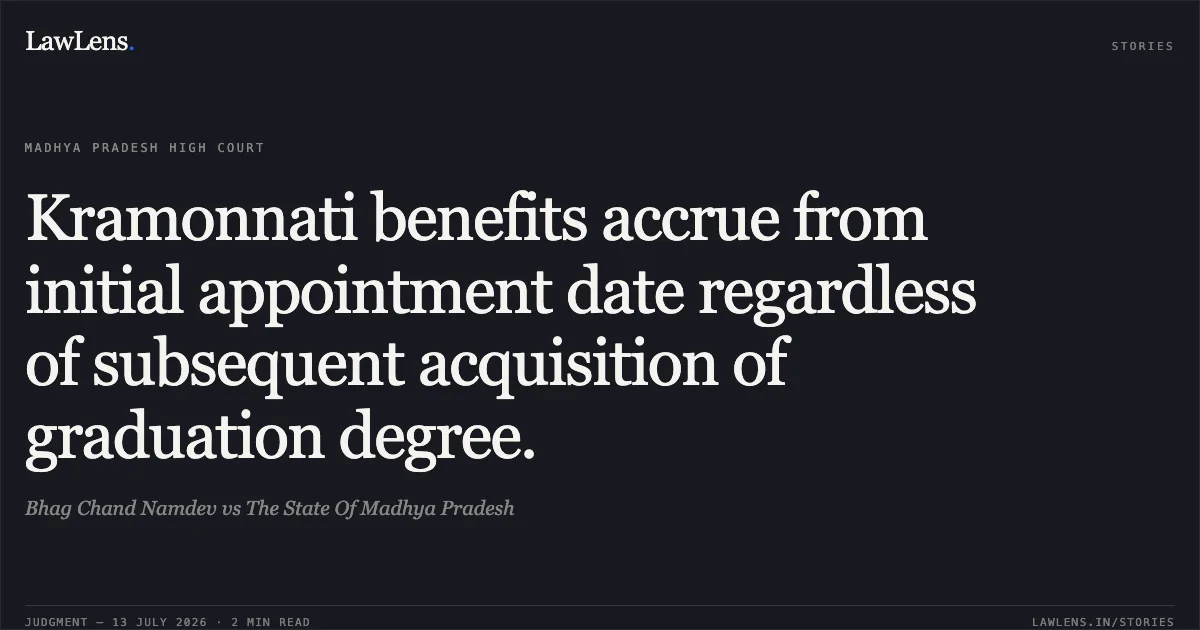
Source reference: para. 2Per the State’s 1999 circular, employees completing 12 years of service were entitled to the first higher pay scale (Kramonnati). The petitioner was granted this benefit effective September 28, 1998, based on his 1983 appointment date
Source reference: para. 2While in service, the petitioner obtained a graduation degree in 1994, leading to a regular pay scale enhancement
Source reference: para. 2On January 28, 2013, the respondents issued an order withdrawing the 1998 Kramonnati benefit and initiating recovery, contending that because the petitioner became a "Graduate RAEO" in 1994, his 12-year period for Kramonnati should only be reckoned from 1994 onwards
Source reference: para. 3The petitioner challenged these recovery and withdrawal orders as being issued without a show-cause notice and in violation of established law
Source reference: para. 3Issues
1. Whether the service rendered by the petitioner prior to obtaining a graduation degree (1983–1994) could be excluded for the purpose of calculating the 12-year eligibility period for Kramonnati
Source reference: para. 2 & 62. Whether the recovery of salary from a Class-III employee is legally permissible in the absence of misrepresentation
Source reference: para. 3Law Applied
State Government Circular dated April 19, 1999, which mandates the grant of Kramonnati after 12 and 24 years of service
Source reference: para. 4Hon’ble Apex Court in State of Punjab and Ors. v. Rafiq Masih (2015) 4 SCC 334, which prohibits recovery from Class-III employees where the payment was not due to the employee's fraud or misrepresentation
Source reference: para. 3H.L. Trehan v. Union of India (1989) 1 SCC 764, requiring a detailed inquiry before initiating recovery
Source reference: para. 3Reasoning
The court found that the petitioner’s 1983 appointment order did not distinguish between graduate and non-graduate categories; he remained in the same cadre throughout his service
Source reference: para. 6The court noted that the petitioner's Kramonnati granted in 1998 was calculated based on his original 1983 pay scale, not the enhanced "graduate" scale he received in 1994; thus, there was no "double benefit" or error in calculation
Source reference: para. 7The court further reasoned that the 2013 circular, which categorized graduate and non-graduate RAEOs for the purpose of pay advancement, could not be applied retrospectively to take away benefits granted in 1998
Source reference: para. 6Since the petitioner never misrepresented his qualifications and is a Class-III employee, the court held that the respondents committed a grave error of law by attempting recovery and withdrawing benefits without following due process or the Rafiq Masih guidelines
Source reference: para. 3 & 8Holding
The High Court quashed the impugned orders dated January 28, 2013, and December 23, 2015
It held that the petitioner is entitled to the first pay advancement (Kramonnati) as per the 1999 policy based on his initial joining date. The court further directed the respondents to consider the petitioner’s representation for the second Kramonnati in accordance with the law within three weeks of its filing. The petition was disposed of in favor of the petitioner
Source reference: para. 8 & 9Original Court PDF
Bhag Chand NamdevvsThe State Of Madhya Pradesh
Click to open original judgment
Original judgment, available to read, download and summarize on LawLens.in