Facts
The petitioners were daily wagers engaged by the respondent Nagarpalika. Through various Labour Court awards, later confirmed by the High Court, their services were ordered to be made permanent.
Source reference: para. 6.1While they received the benefits of the Fifth Pay Commission, the respondent-Nagarpalika denied them the Sixth Pay Commission benefits, citing an order dated 06.04.2018 from the Director of Municipality which restricted such benefits to employees on posts duly sanctioned by the State.
Source reference: para. 6.2, 6.3The Nagarpalika claimed that since the petitioners were appointed without prior sanction, they were ineligible.
Source reference: para. 8.2Despite seeking guidance from the Regional Commissioner of Municipality in 2011 regarding regularization, no response was received.
Source reference: para. 6.4Issues
1. Whether the Nagarpalika can deny Sixth Pay Commission benefits to employees whose services were made permanent by a judicial award on the grounds that their initial appointment lacked State sanction.
Source reference: para. 112. Whether the petitioners are entitled to regularization of services and higher pay scales based on their permanent status.
Source reference: para. 16, 17Law Applied
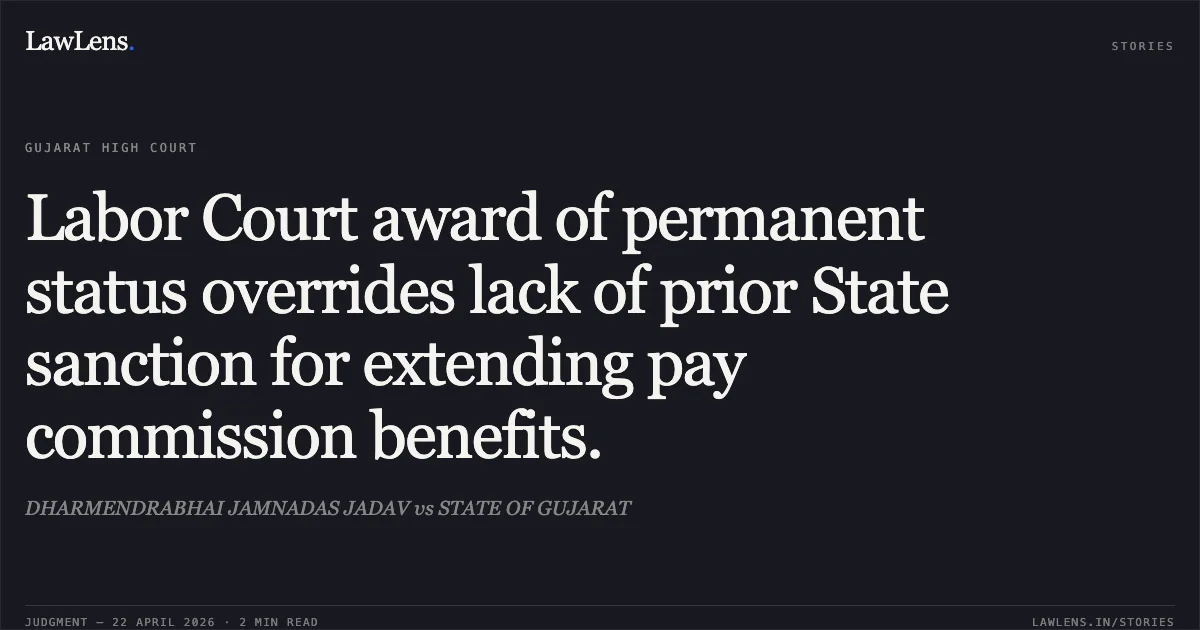
The court applied the principle of judicial finality, holding that a binding award of a competent Labour Court or High Court granting permanent status overrides administrative requirements for prior sanction.
Source reference: para. 11, 13The court further relied on the doctrine of consistency/non-discrimination, noting that since the respondents had already extended Fifth Pay Commission benefits to these permanent employees, they could not arbitrarily withhold Sixth Pay Commission benefits.
Source reference: para. 11The court interpreted the restrictive conditions of the Director of Municipality’s order dated 06.04.2018 as inapplicable to employees who achieved permanency through judicial decree.
Source reference: para. 15Reasoning
The court reasoned that once a judicial award declares an employee’s service as permanent, they must be treated at par with other permanent employees of the Nagarpalika.
Source reference: para. 11The Nagarpalika’s defense—that the posts were not "duly sanctioned"—pales into insignificance because the awards are binding.
Source reference: para. 11The court observed that the Nagarpalika had previously recognized this status by granting Fifth Pay Commission benefits, making the current denial contradictory.
Source reference: para. 11Regarding the lack of response from the Regional Commissioner, the court noted that the Nagarpalika did not technically need "guidance" to implement a court order, and the State was duty-bound to provide formal approval to facilitate the judicial mandate.
Source reference: para. 13Holding
The court held that the petitioners are entitled to the Sixth Pay Commission benefits as per the 06.04.2018 order.
The Nagarpalika was directed to pay arrears by 31.07.2026, failing which a 6% p.a. interest would apply; the State was directed to provide any necessary formal sanctions by 31.05.2026; the Nagarpalika must pass formal regularization orders by 30.06.2026 and decide on the higher pay scale claims within eight weeks; and the respondents were directed to ensure Seventh Pay Commission benefits are also extended.
Source reference: para. 18.2, 18.3, 18.4, 16, 19Original Court PDF
DHARMENDRABHAI JAMNADAS JADAVvsSTATE OF GUJARAT
Click to open original judgment
Original judgment, available to read, download and summarize on LawLens.in