Facts
The petitioners were employees of Naidunia Media Limited, which merged with Jagran Prakashan Limited on April 1, 2012
Source reference: para 1Following notifications issued by the Ministry of Labour in 2008 and 2011 regarding interim relief and wage fixation for newspaper employees under the Working Journalists Act, 1955, the petitioners sought benefits based on the Majithia Wage Board recommendations
Source reference: para 1When the respondent failed to extend these benefits, the petitioners approached the Assistant Labour Commissioner
Source reference: para 1A reference was made to the Labour Court on December 13, 2017, specifically to determine the amount payable to the employees under the recommendations
Source reference: para 1, 6However, the Labour Court framed a different issue regarding the petitioners' entitlement to the benefits and subsequently answered the reference in the negative
Source reference: para 2The petitioners challenged these awards via writ petitions
Source reference: para 2Issues
Whether the Labour Court erred in law by deciding the "entitlement" of the petitioners instead of determining the "amount payable" as framed in the original reference by the competent Government?
Source reference: para 3, 7Law Applied
The Court applied Section 10 of the Industrial Disputes Act, 1947, which governs the reference of disputes to Boards, Courts, or Tribunals.
Source reference: para 1, 7Sections 9 and 13(C) of the Working Journalists and other Newspaper Employees (Conditions of Service) and Miscellaneous Provisions Act, 1955, regarding the constitution and implementation of Wage Board recommendations.
Source reference: para 1, 7The core principle applied is that a Labour Court must adjudicate upon the specific question referred to it by the competent Government and cannot deviate to substitute its own issues.
Source reference: para 7Reasoning
The High Court observed that the reference made by the competent Government under Section 10 of the Industrial Disputes Act explicitly directed the Labour Court to determine the specific amount payable to the petitioners as per the Majithia Wage Board recommendations.
Source reference: para 6, 7However, the Labour Court failed to address this specific question and instead focused on the petitioners' threshold entitlement to receive such benefits.
Source reference: para 7The High Court reasoned that because the Labour Court deviated from the mandate of the reference and failed to decide the actual question referred (the quantum of payment), the resulting awards were legally unsustainable.
Source reference: para 7Holding
The High Court answered the issue in the affirmative, holding that the Labour Court failed to decide the question for determination framed by the competent Government.
Consequently, the impugned awards were set aside. The matters were remitted back to the concerned Labour Court with directions to decide the original reference (determination of amount) within 180 days, providing sufficient opportunity for hearing to both parties.
Source reference: para 7, 8Acts & Sections Cited
3 provisions across 2 statutes referred to in this judgment. Linked provisions open on LawLens.
Working Journalists And Other Newspaper Employees (Conditions Of Service) And Miscellaneous Provisions Act, 19552
Industrial Disputes Act, 19471
Original Court PDF
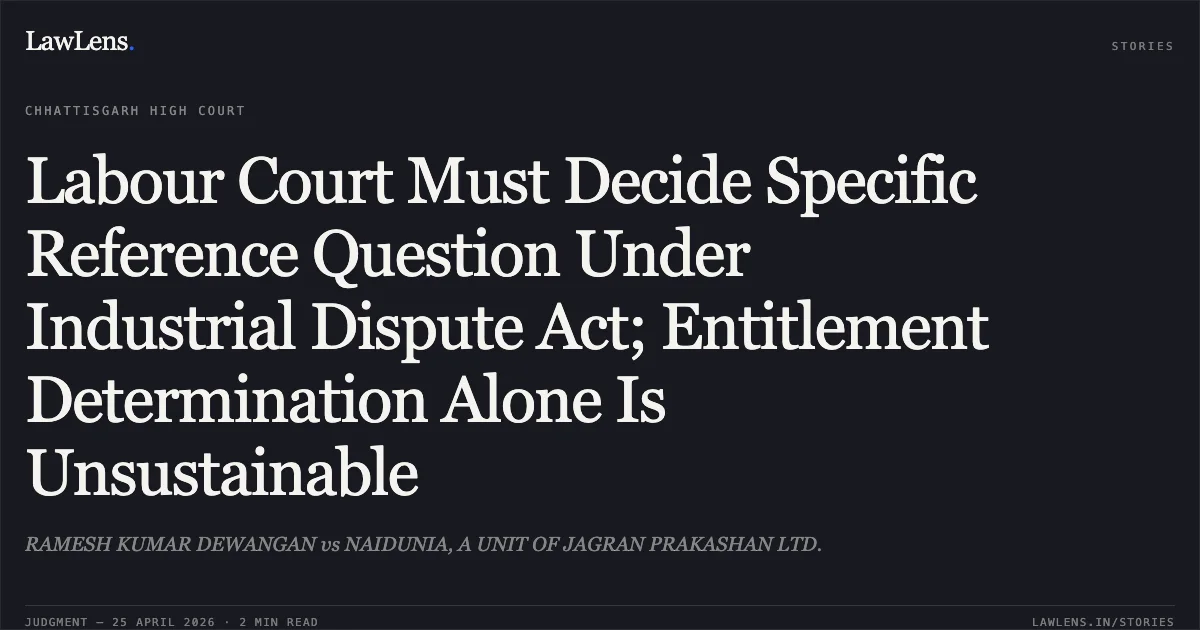
RAMESH KUMAR DEWANGANvsNAIDUNIA, A UNIT OF JAGRAN PRAKASHAN LTD.
Click to open original judgment
Original judgment, available to read, download and summarize on LawLens.in