Facts
The deceased workman was employed as a conductor with the Delhi Transport Corporation since 1983.
Source reference: pp. 1–2; paras. 2–3The Corporation alleged that he remained absent without sanctioned leave for approximately 207 days between June and December 1991 and issued him a chargesheet on 19 September 1991.
Source reference: pp. 1–2; paras. 2–3Following a domestic enquiry, his services were terminated on 20 February 1992.
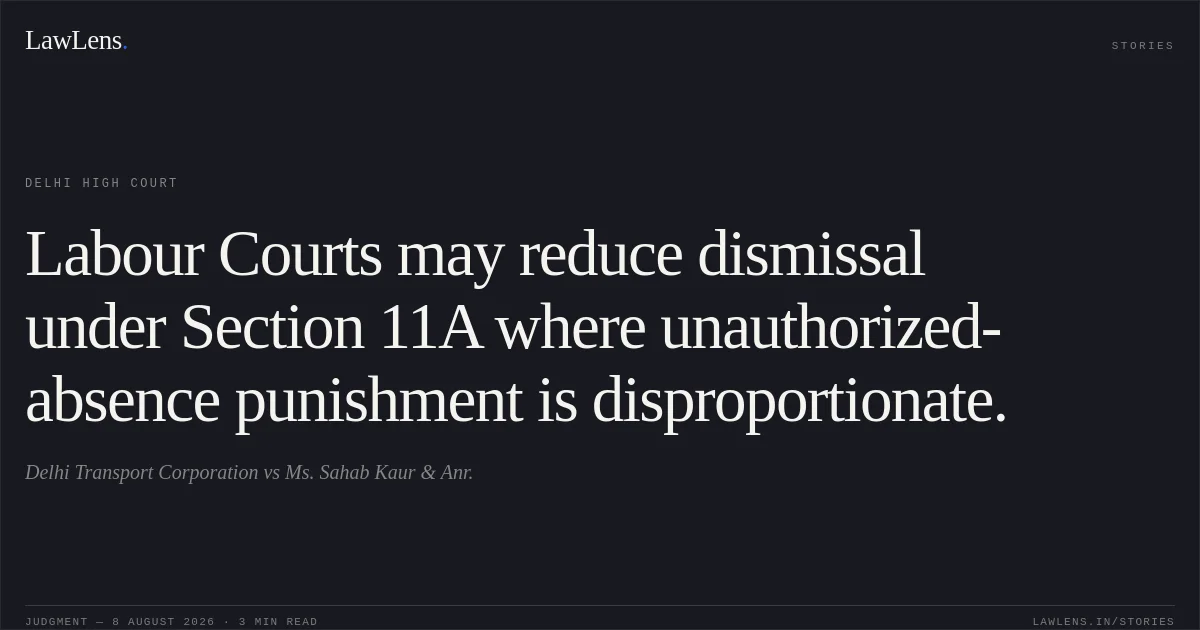
Source reference: p. 2; para. 4In the industrial dispute, the Labour Court held that the unauthorised absence and misconduct were proved, but exercised its powers under Section 11A of the Industrial Disputes Act, 1947 (“ID Act”) to modify the punishment from termination to compulsory retirement.
Source reference: p. 2; para. 5The DTC challenged only the reduction of punishment, contending that prolonged unauthorised absence justified termination.
Source reference: p. 2; para. 6The workman’s wife and son represented him before the High Court, and the workman had died during the proceedings.
Source reference: pp. 1, 8; paras. 2, 26Issues
Whether the Labour Court was justified in exercising its power under Section 11A of the ID Act to reduce the punishment from termination to compulsory retirement after upholding the charge of prolonged unauthorised absence?
Source reference: p. 3; paras. 12–15, 23Whether the Labour Court’s modification of punishment was arbitrary, perverse, or otherwise liable to interference under Article 226 of the Constitution?
Source reference: p. 3; para. 12; p. 9, para. 28Law Applied
Section 11A of the ID Act empowers a Labour Court, Tribunal, or National Tribunal to grant appropriate relief, including substituting a lesser punishment, where discharge or dismissal is found unjustified in the circumstances of the case.
Source reference: p. 4; para. 14This power is discretionary but not unbridled, and may be exercised where the punishment is disproportionate to the misconduct or mitigating circumstances justify interference.
Source reference: p. 4; para. 15Under Article 226, the High Court exercises supervisory rather than appellate jurisdiction and should not substitute its own view for that of the Labour Court unless the decision is arbitrary or perverse.
Source reference: p. 3; para. 12DTC v. Sardar Singh, (2004) 7 SCC 574 establishes that habitual and prolonged unauthorised absence constitutes misconduct, but does not prescribe a uniform punishment or conclusively determine proportionality in every case.
Source reference: pp. 5–6; para. 21Mahindra & Mahindra Ltd. v. N.B. Narawade, (2005) 3 SCC 134 holds that punishment cannot be reduced solely on vague compassionate grounds, particularly where the gravity of the misconduct and past misconduct have not been properly considered.
Source reference: pp. 7–8; paras. 24–25Reasoning
The High Court accepted that the charge of unauthorised absence for 207 days had been proved and that the workman had not established a valid justification for the absence.
Source reference: p. 4; para. 18However, the question was not whether the absence constituted misconduct, but whether termination was a proportionate punishment.
Source reference: no citationThe Labour Court had considered that the workman had served the Corporation for over eight years without any prior chargesheet for misconduct, had produced an uncontested medical certificate relating to his absence, and had died during the proceedings due to illness; it also noted the Corporation’s failure to produce his attendance record.
Source reference: pp. 4–5, 8; paras. 16–18, 26These factors constituted relevant mitigating circumstances rather than mere sympathy.
Source reference: no citationThe High Court distinguished Sardar Singh because that decision concerned the characterisation of prolonged unauthorised absence as misconduct and did not establish termination as the mandatory punishment.
Source reference: pp. 5–6; para. 21It also distinguished Mahindra & Mahindra because, unlike that case, the Labour Court here had assessed proportionality and relevant mitigating circumstances.
Source reference: pp. 7–8; paras. 24–26Since the Labour Court’s view was plausible and neither arbitrary nor perverse, the High Court declined to interfere under Article 226.
Source reference: p. 9; para. 28Holding
The High Court held that the Labour Court was justified under Section 11A of the ID Act in modifying the punishment from termination to compulsory retirement, notwithstanding the finding that the misconduct was proved.
The punishment of termination was considered harsh and disproportionate in light of the workman’s length of service, absence of prior disciplinary action, medical material, illness, and other surrounding circumstances.
Source reference: p. 8; para. 26The writ petition was accordingly dismissed as devoid of merit, and the Labour Court’s award was left undisturbed.
Source reference: p. 9; para. 29Acts & Sections Cited
2 provisions across 1 statute referred to in this judgment. Linked provisions open on LawLens.
Industrial Disputes Act, 19472
Original Court PDF
Delhi Transport CorporationvsMs. Sahab Kaur & Anr.
Click to open original judgment
Original judgment, available to read, download and summarize on LawLens.in