Facts
The workman (Respondent No. 1) was employed as a watchman by the petitioner from 23.01.1991. He alleged illegal termination on 24.07.2004 without compliance with the Industrial Disputes Act.
Source reference: para. 3.1The Labour Court, Vadodara, in Reference (LCV) Case No. 619 of 2004, held the termination illegal and directed reinstatement with 30% back-wages via an award dated 24.11.2016.
Source reference: para. 3.1The petitioner failed to contest the proceedings effectively; though an affidavit was filed, the petitioner’s witness did not appear for cross-examination, leading the evidence to be discarded.
Source reference: para. 4, 6Following non-compliance, the Labour Court issued orders in Recovery Applications (C-2 and C-1) in 2022 and 2026, respectively.
Source reference: para. 4The petitioner challenged the original 2016 award and the subsequent recovery orders via this writ petition in 2026.
Source reference: para. 1Issues
1. Whether the High Court should exercise its extraordinary jurisdiction under Articles 226 and 227 of the Constitution to set aside an award and recovery orders despite a gross delay in approaching the court.
Source reference: para. 62. Whether the Labour Court’s findings regarding illegal termination and the grant of reinstatement with back-wages were perverse or lacked evidentiary merit.
Source reference: para. 4, 6Law Applied
The Court applied the principles governing the High Court's supervisory jurisdiction under Articles 226 and 227 of the Constitution of India, which restrict the court from re-appreciating or reassessing evidence unless the lower court's findings are perverse or illegal.
Source reference: para. 6The Court further applied the principle of laches (delay), under which the Court may refuse to exercise its discretionary jurisdiction if a party has been negligent or slept over their rights for an unreasonable period.
Source reference: para. 6The substantive dispute was governed by the Industrial Disputes Act, 1947, specifically regarding the continuous service (240 days) requirement for protection against termination.
Source reference: para. 3.1, 6Reasoning
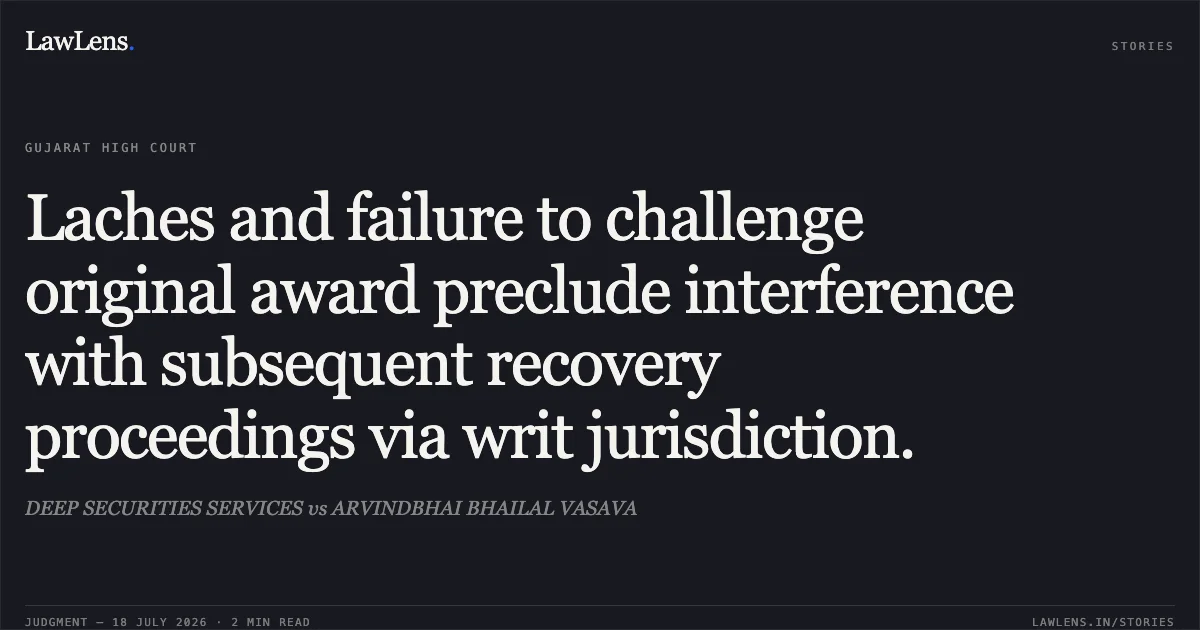
The Court observed that the petitioner was "slumbering" for nearly a decade, as the award for reinstatement was passed in 2016 and only challenged in 2026 after the issuance of a Recovery Certificate.
Source reference: para. 6The Court reasoned that Articles 226 and 227 cannot be invoked to entertain petitions marked by such gross delay.
Source reference: para. 6The Court found that the petitioner had failed to properly contest the Reference proceedings at the trial stage, leading to their evidence being discarded.
Source reference: para. 6Since the Labour Court had arrived at a factual finding of illegal termination based on the available evidence, the High Court held it could not disturb such findings by re-evaluating the merits, as the findings were neither perverse nor illegal.
Source reference: para. 6Holding
The High Court dismissed the petition, holding that it lacked merit due to the petitioner’s gross delay and the absence of any perversity in the Labour Court’s findings.
The Court upheld the 2016 award and the subsequent recovery orders. The petitioner was directed to comply with the Labour Court’s award within four weeks from the date of receipt of the order.
Source reference: para. 6Acts & Sections Cited
2 provisions across 1 statute referred to in this judgment. Linked provisions open on LawLens.
Industrial Disputes Act, 19472
Original Court PDF
DEEP SECURITIES SERVICESvsARVINDBHAI BHAILAL VASAVA
Click to open original judgment
Original judgment, available to read, download and summarize on LawLens.in