Facts
The respondent-workman was employed as a watchman by the petitioner (a contractor) from June 1, 1999.
Source reference: p. 2His services were terminated on July 24, 2004, allegedly without compliance with the Industrial Disputes Act, 1947.
Source reference: p. 2The workman initiated a reference (LCV No. 621 of 2004). Although the petitioner was served, they failed to file a written statement, and their evidence was discarded as they failed to appear for cross-examination.
Source reference: p. 5On November 24, 2016, the Labour Court, Vadodara, held the termination illegal and ordered reinstatement with 30% back-wages.
Source reference: p. 2The petitioner did not comply with the award. Consequently, the workman filed Recovery Applications (C-2) in 2017 and (C-1) in 2023, resulting in orders for payment of Rs. 2,06,566/- and Rs. 2,99,823/- respectively.
Source reference: p. 5The petitioner challenged the original 2016 award and the subsequent 2022 and 2026 recovery orders via the present writ petition.
Source reference: p. 1-2Issues
1. Whether the findings of the Labour Court regarding illegal termination and the grant of back-wages warrant interference under the extraordinary jurisdiction of the High Court.
Source reference: p. 62. Whether the petition is maintainable despite a gross delay of approximately ten years in challenging the original award.
Source reference: p. 6Law Applied
Articles 226 and 227 of the Constitution of India regarding the High Court's power of judicial review and superintendence.
Source reference: p. 1The settled principle that High Courts cannot re-appreciate or reassess evidence to disturb findings of fact by a lower forum unless such findings are perverse or illegal.
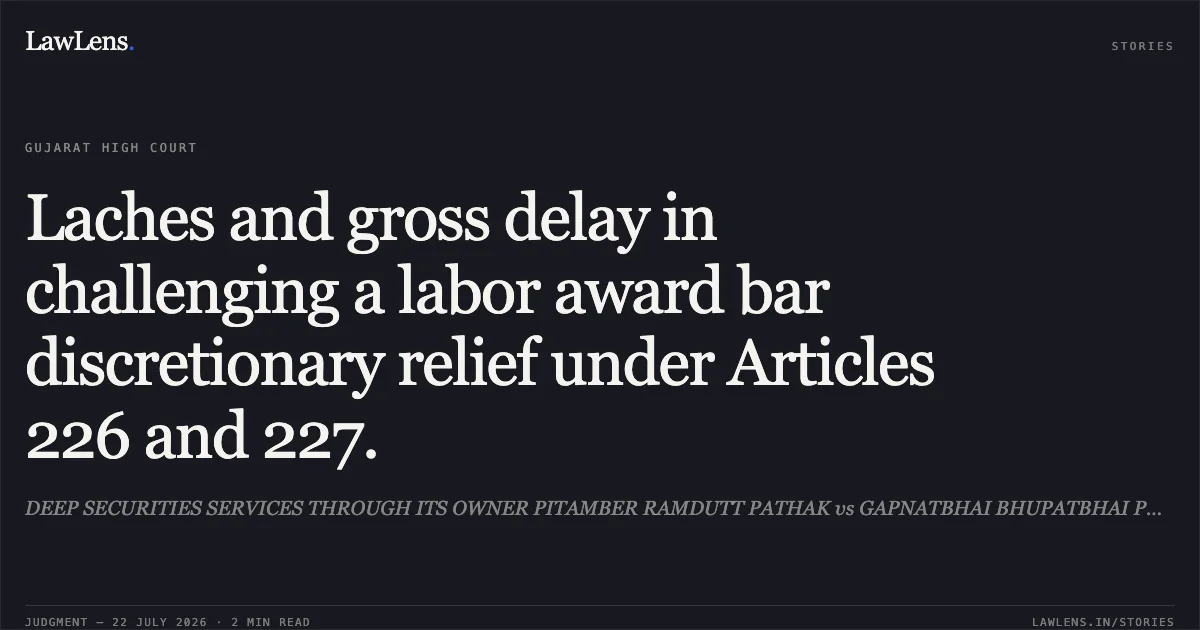
Source reference: p. 6Doctrine of laches, holding that discretionary relief under writ jurisdiction cannot be granted when there is unexplained gross delay or "slumber" on the part of the petitioner.
Source reference: p. 5-6Reasoning
The court observed that the petitioner participated in the Reference proceedings only minimally and failed to effectively contest the claim, leading to an unchallenged award in 2016.
Source reference: p. 5The petitioner’s argument—that the contract with respondent No. 2 had ended—was not supported by evidence before the Labour Court because the petitioner’s examination-in-chief was discarded after they failed to appear for cross-examination.
Source reference: p. 5The Court found that the petitioner "woke up from the slumber" only after Recovery Certificates were issued in 2026.
Source reference: p. 5-6Applying the limitations of Articles 226 and 227, the High Court held that it cannot act as an appellate body to re-examine facts where the Labour Court had already found the termination to be illegal based on the evidence available.
Source reference: p. 6The Court specifically noted that the challenge to an award ten years after its passing, following the issuance of recovery certificates, constitutes a gross delay that precludes the exercise of discretionary jurisdiction.
Source reference: p. 6Holding
The High Court dismissed the petition, holding that it lacked merit and was barred by gross delay.
The court upheld the Labour Court’s findings, stating they were neither perverse nor illegal.
Source reference: p. 6The petitioner was directed to comply with the original award and the recovery orders within four weeks from the date of receipt of the judgment.
Source reference: p. 6Acts & Sections Cited
1 provisions across 1 statute referred to in this judgment. Linked provisions open on LawLens.
Industrial Disputes Act, 19471
Original Court PDF
DEEP SECURITIES SERVICES THROUGH ITS OWNER PITAMBER RAMDUTT PATHAKvsGAPNATBHAI BHUPATBHAI PARMAR
Click to open original judgment
Original judgment, available to read, download and summarize on LawLens.in