Facts
The Applicant (N.F. Railway) filed an interlocutory application seeking condonation of a 264-day delay in preferring an appeal against a judgment and award dated 16.12.2024 passed by the Land Acquisition, Rehabilitation and Resettlement Authority, Tripura
Source reference: para. 2The prescribed limitation period for filing the appeal was 60 days, expiring on 14.02.2025
Source reference: para. 3The Applicant contended that the delay occurred because the concerned panel advocate returned the case file only on 28.04.2025, and the certified copy of the judgment was obtained on 06.05.2025
Source reference: para. 5Subsequently, the file underwent multiple levels of administrative vetting and legal opinion cycles between offices in Maligaon (Guwahati) and Agartala, further delayed by the High Court's Puja vacation from September to October 2025
Source reference: para. 3, 5The Respondent (Claimant) opposed the application, arguing that the delay was inordinate and the explanation for the period between May and September 2025 was insufficient
Source reference: para. 4, 10Issues
1. Whether the Applicant demonstrated "sufficient cause" under Section 5 of the Limitation Act to condone the 264-day delay in filing the appeal
Source reference: para. 2, 162. Whether the laches of a panel advocate and the procedural delays inherent in government decision-making justify the exercise of discretionary power for condonation
Source reference: para. 16, 18Law Applied
The court applied Section 74(1) of the Right to Fair Compensation and Transparency in Land Acquisition, Rehabilitation and Resettlement Act, 2013, which mandates a 60-day limitation for appeals
Source reference: para. 2It further applied Section 5 of the Limitation Act, 1963, which allows for the extension of the prescribed period if "sufficient cause" is shown
Source reference: para. 9The court considered the principles from Shivamma (Dead) by Lrs v. Karnataka Housing Board (2025), which emphasizes that condonation is a matter of judicial discretion and requires a "sufficient cause" that is not the result of negligence or inaction
Source reference: para. 11.IIt also referenced Postmaster General v. Living Media India Ltd. (2012), which cautions that government departments cannot claim mechanical condonation based solely on bureaucratic methodology
Source reference: para. 11.IIReasoning
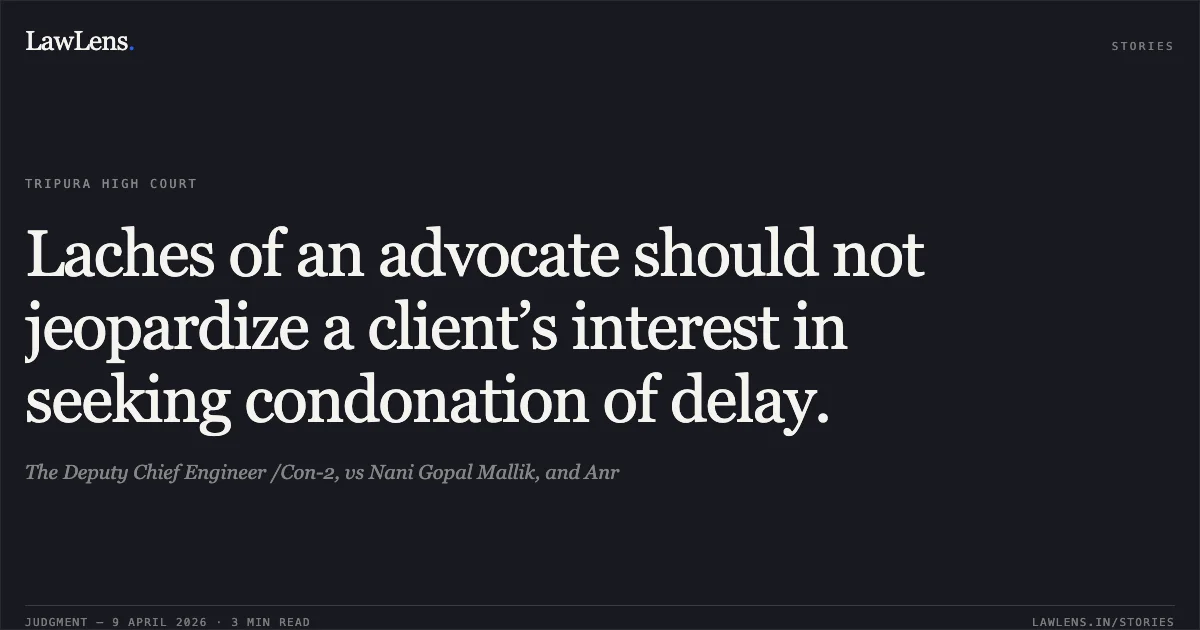
The Court scrutinized the timeline provided in the Applicant's additional affidavit. It noted that while a significant portion of the delay (140 days) was caused by the panel advocate failing to return the file promptly, the client's interest should not be jeopardized by the advocate's laches
Source reference: para. 16, 18For the remaining 124 days, the Court found the administrative correspondence between the Law Officer in Guwahati and the Deputy SGI in Agartala, coupled with logistical factors and the High Court vacation, to be a plausible explanation
Source reference: para. 16, 17The Court distinguished the present case from the precedents cited by the Respondent, noting that those cases involved far more massive delays (e.g., 3,966 days in Shivamma) compared to the 264 days here
Source reference: para. 13, 18It concluded that the delay was not intentional but was a result of the running administrative process and the professional default of the previous counsel
Source reference: para. 16, 18Holding
The High Court held that the ends of justice would be served by condoning the delay to allow the appeal to be heard on its merits
The court found the explanation offered in the additional affidavit to be satisfactory and not indicative of inordinate or deliberate inaction
Source reference: para. 18Accordingly, IA No. 1 of 2025 was allowed, and the 264-day delay in preferring the appeal was condoned
Source reference: para. 19, 20Acts & Sections Cited
2 provisions across 2 statutes referred to in this judgment. Each provision opens on LawLens.
Right to Fair Compensation and Transparency in Land Acquisition, Rehabilitation and Resettlement Act, 20131
Limitation Act, 19631
Original Court PDF
The Deputy Chief Engineer /Con-2,vsNani Gopal Mallik, and Anr
Click to open original judgment
Original judgment, available to read, download and summarize on LawLens.in