Facts
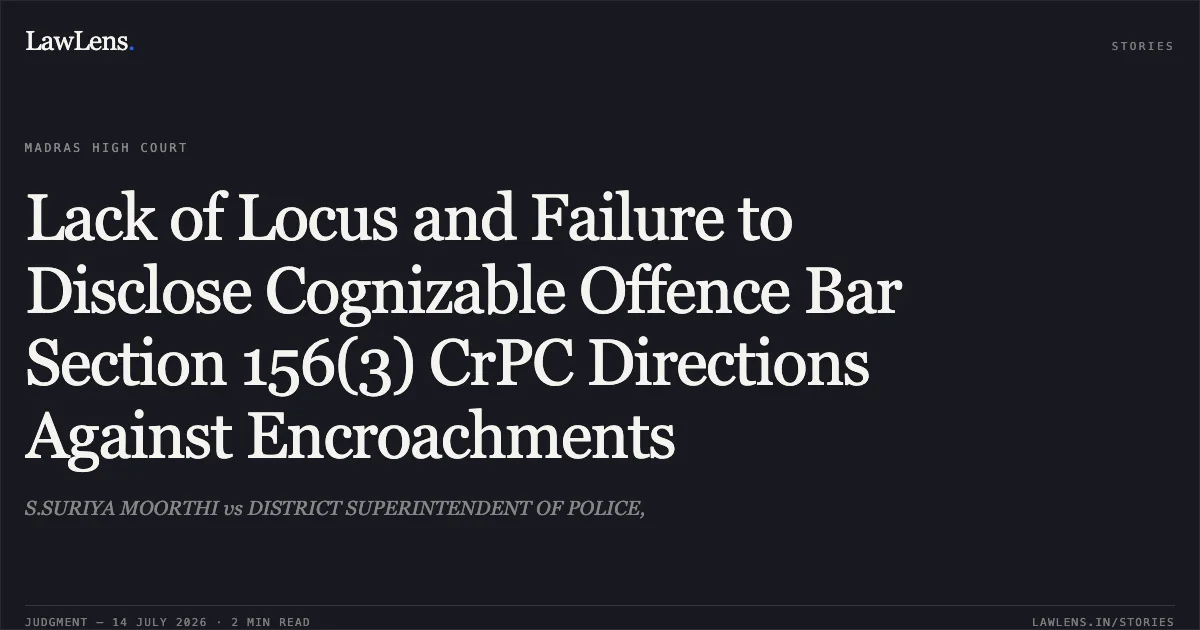
The petitioner, a self-proclaimed social activist, filed an application under Section 156(3) of the Cr.P.C. before the Judicial Magistrate II, Chengalpattu.
Source reference: p.2He alleged that Vidyasagar College had encroached upon 8,165 sq. ft. of Government land and a water body in Survey No. 64.
Source reference: p.2Despite a complaint dated 30.06.2024 to the Superintendent of Police, no FIR was registered.
Source reference: p.2The Judicial Magistrate dismissed the application on 12.08.2024, citing a lack of documentary evidence to prove the encroachment or the commission of a cognizable offence.
Source reference: p.2-3The petitioner moved the High Court in revision to set aside this dismissal.
Source reference: p.1Issues
1. Whether the Magistrate committed a jurisdictional error or perversity in dismissing the Section 156(3) Cr.P.C. application for want of foundational evidence.
Source reference: p.4 / para. 72. Whether a third-party "social activist" has an unfettered right to invoke Section 156(3) Cr.P.C. to register an FIR for alleged encroachment of Government property.
Source reference: p.4-5 / para. 9-10Law Applied
The court applied Section 156(3) of the Cr.P.C. regarding the Magistrate's power to order an investigation.
Source reference: p.2It relied on the precedent Sharif Ahmed v. State of Uttar Pradesh (2024 SCC Online SC 726), which dictates that criminal law cannot be set in motion unless factual allegations disclose the essential ingredients of a cognizable offence.
Source reference: p.4 / para. 8It further observed that the removal of encroachments is governed by specific tax/revenue statutes and the authority of the State, rather than private criminal complaints by third parties.
Source reference: p.3-4 / para. 6Reasoning
The Court observed that the petitioner is neither the owner nor in possession of the subject property, and no personal or proprietary rights of his were infringed.
Source reference: p.3 / para. 5The Court reasoned that the protection of Government lands is a statutory duty of Revenue authorities, and a direction under Section 156(3) cannot be issued as a matter of course for simple allegations of encroachment.
Source reference: p.3-4 / para. 6Applying the Sharif Ahmed principle, the Court found the complaint "bereft of the necessary factual foundation" as the petitioner failed to produce any documents showing that a cognizable offence had been committed.
Source reference: p.4 / para. 8The Court further noted that observations from other benches regarding the prosecution of encroachers do not grant "every third party" an unfettered right to bypass statutory administrative remedies in favor of criminal proceedings.
Source reference: p.4-5 / para. 9Holding
The Court held that the Magistrate’s order was neither perverse nor suffered from jurisdictional infirmity.
It concluded that the petitioner lacked the locus standi for the relief prayed for and that the complaint lacked bona fides.
Source reference: p.5 / para. 10The Criminal Revision Case was dismissed, and the dismissal of the Section 156(3) application was upheld.
Source reference: p.5 / para. 11Acts & Sections Cited
3 provisions across 1 statute referred to in this judgment. Each provision opens on LawLens.
Code of Criminal Procedure, 19733
Original Court PDF
S.SURIYA MOORTHIvsDISTRICT SUPERINTENDENT OF POLICE,
Click to open original judgment
Original judgment, available to read, download and summarize on LawLens.in