01Facts
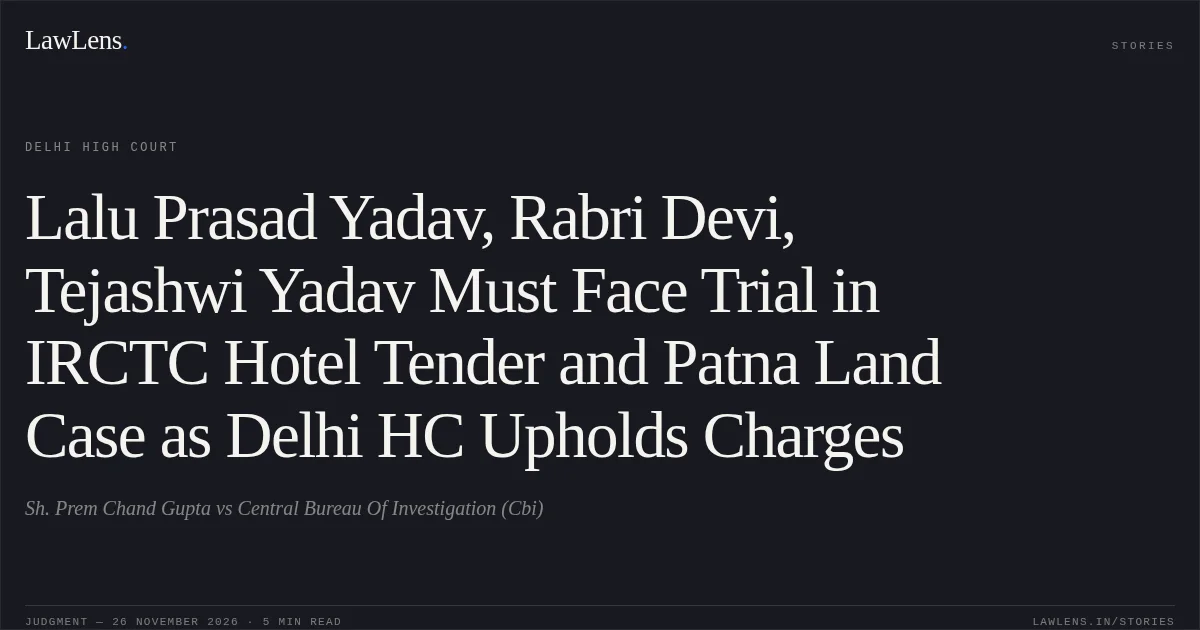
The CBI alleges that Sh. Lalu Prasad Yadav (A-1), as Union Railway Minister, abused his office to favour M/s Sujata Hotel Pvt. Ltd. (A-14) in the award of contracts for the BNR Hotels at Ranchi and Puri, which were transferred to IRCTC.
¶ 3, 12In return, the Kochhar brothers (A-5, A-6) allegedly sold 358 decimals of Bailey Road, Patna land to M/s DMCPL (A-4) on 25.02.2005 at below circle rate, with stamp duty short-paid by about ₹6.13 lakh.
¶ 8, 22M/s DMCPL, allegedly controlled by Smt. Sarla Gupta (A-7) and Sh. P.C. Gupta (A-9), had its shares transferred to Smt. Rabri Devi (A-2) and Sh. Tejashwi Prasad Yadav (A-3) between 2010 and 2014 at allegedly undervalued prices.
¶ 25–27Two Railway Board notes (31.08.2004 and 26.09.2006) record oral directions attributed to A-1.
¶ 6, 10The tender conditions were relaxed by A-10 on 13.11.2006, and the bids were evaluated by a Tender Committee of A-11, A-12 and A-13.
¶ 17, 208–210A chargesheet was filed in April 2018. The Special Court took cognizance on 30.07.2018 and framed charges under Section 120B read with Section 420 IPC and Section 13(2) read with Section 13(1)(d) PC Act, by order dated 13.10.2025.
¶ 29–32Fourteen revision petitions challenged that order.
¶ 1–202Issues
i.1. Whether prior sanction under amended Section 19 of the PC Act, 1988 (post-2018 Amendment) was required for taking cognizance of an offence under the erstwhile Section 13(1)(d) read with Section 13(2).
¶ 64–74ii.2. Whether the absence of sanction under Section 19 vitiated cognizance, and whether a subsequently obtained sanction can cure the defect.
¶ 75–85iii.3. Whether sanction under Section 197 Cr.P.C. was required for the IPC offences against the public servants.
¶ 86–105iv.4. Whether the earlier Railway Vigilance and CBI verification exercises bar the present prosecution or amount to an impermissible de novo investigation.
¶ 112–127v.5. Whether the material discloses a prima facie criminal conspiracy and grave suspicion against each petitioner so as to warrant framing of charges.
¶ 128–175, 176–26603Law Applied
The Court applied Section 19 of the PC Act as amended in 2018, read with the unamended Section 13(1)(d), relying on the Division Bench decision in Court on its Own Motion v. State (Crl. Ref. No. 1 of 2019) that cognizance taken before 26.07.2018 is not reopened.
¶ 70The Court relied on Syed Zameer Pasha v. State of Karnataka that the amended Section 19 does not cover the omitted Section 13(1)(d).
¶ 72–73On the effect of late sanction, the Court relied on State of Goa v. Babu Thomas, Deepak Khinchi, and Shivendra Nath Verma that absence of sanction is not incurable where no prejudice is shown.
¶ 79–81For Section 197 Cr.P.C., the Court applied Om Prakash Yadav v. Niranjan Kumar Upadhyay (2024) on the "reasonable connection" test and Harihar Prasad v. State of Bihar that criminal conspiracy is not an official duty.
¶ 90, 97On conspiracy, the Court applied the principles that conspiracy may be inferred from circumstances, needs no direct evidence, and that each accused must have a prima facie connection with the common design.
¶ 129–143For the stage of charge, the Court applied The Karnataka Lokayukta v. Chandrashekar (2026 INSC 31) that departmental exoneration does not quash a criminal case.
¶ 118Provisions in the judgment · 16 · Linked ones open on LawLens
Prevention of Corruption Act, 1988 Section 3Section 4Section 7Section 10Section 11Section 13Section 15Section 19
Indian Penal Code, 1860 Section 415Section 420
Code of Criminal Procedure, 1973 Section 2Section 161Section 173Section 197Section 207Section 468
04Reasoning
On sanction, the Court held that amended Section 19 refers to amended Section 13. Because the offence charged was under the omitted Section 13(1)(d) and the allegations related to the period when it was in force, no fresh sanction was needed.
¶ 73–74Even if sanction had been required, the Court found that sanctions obtained in 2020 for A-1, A-8, A-10, A-12 and A-13 cured the defect, as no substantive trial step had occurred and no prejudice was shown.
¶ 82–85On Section 197, the Court held that the nature of the alleged conspiracy and cheating could not be conclusively classified as official acts at this stage, and the question was left open for trial, with liberty to raise it later.
¶ 99–105On the earlier inquiries, the Court found that the Vigilance report was confined to the tender process and expressly left the land-to-tender nexus to the CBI, and that the CBI's 2009–2010 exercise was only verification, not an FIR-based investigation, so the present case was not a de novo investigation.
¶ 114–127On the merits, the Court held that the notes, the timing of the land sale relative to the Railway Board communication, the share consolidation in A-7 shortly before the sale, the cash-based transfers to A-2 and A-3 at disparate prices, and the appointment of A-1's family as directors together raised grave suspicion of a quid pro quo.
¶ 186–190, 240, 261Against the Tender Committee members, the Court relied on the acceptance of A-14's bid without a star-classification certificate and the evaluation of competing bids on an undisclosed marking scheme.
¶ 207–210Disputes on valuation, belting, witness credibility and source of funds were held to be matters for trial.
¶ 213–216, 26205Holding
The Court held that prior sanction under amended Section 19 was not required for the unamended Section 13(1)(d) charge.
¶ 74Any sanction defect stood cured by the subsequent sanctions, which caused no prejudice.
¶ 85Sanction under Section 197 Cr.P.C. was not an impediment at the charge stage, without prejudice to raising it at trial.
¶ 104–105The Court found grave suspicion against all petitioners and held that the material supports the charges.
¶ 266, 271The impugned order dated 13.10.2025 was upheld, and all 14 revision petitions along with pending applications were dismissed. The Court clarified that its observations do not express an opinion on the merits.
¶ 271–274Original Court PDF
Shri Lalu Prasad YadavvsCentral Bureau Of Investigation
Click to open original judgment
Original judgment, available to read, download and summarize on LawLens.in