01Facts
Baljeet Kaur married Surinder Pal Singh on 21.12.1992.
¶ 2The prosecution alleged that the husband and in-laws made repeated dowry demands from the start of the marriage: Rs. 5,000 (January 1993), a further Rs. 5,000 with Rs. 1,000 travel expenses (July 1993), and a demand for Rs. 1 lakh and a scooter.
¶ 2 · ¶ 73, 81The deceased was allegedly beaten, and an abortion in the fifth month of pregnancy was attributed to a kick by the husband.
¶ 2 · ¶ 79–80She was sent to her parental home in January 1994 and returned to the matrimonial home in March 1994.
¶ 17–20 · ¶ 90On 09.05.1994 she was found hanging from a ceiling fan in a room locked from outside, with the father-in-law standing outside.
¶ 2 · ¶ 9The police registered FIR No. 173/94 under Sections 498-A/304-B IPC only after the SDM's proceedings on 10.05.1994.
¶ 9The photographs of the body and scene are not on record.
¶ 9 · ¶ 53Several prosecution witnesses turned hostile.
¶ 17–21 · ¶ 72The trial court convicted all four appellants under Sections 498-A and 304-B IPC on 21.03.2002 and sentenced Harbhajan Singh and Harpreet Kaur to 7 years' RI under s. 304-B; Surinder Pal Singh to life imprisonment under s. 304-B; and all to 3 years' RI under s. 498-A, with concurrent running of sentences.
¶ 1–4The mother-in-law died during trial.
¶ 97The charge under s. 406 IPC (criminal breach of trust) is framed but the judgment does not address it.
¶ 1602Issues
i.1. Whether, soon before her death, the deceased was subjected to cruelty or harassment by her husband or his relatives for or in connection with a demand for dowry, so as to attract Section 304-B IPC.
¶ 70–71ii.2. Whether the payments of Rs. 5,000 made by the parents constituted dowry demands or customary gifts (shagun).
¶ 73–88iii.3. Whether Harpreet Kaur (sister-in-law) and Amardeep Singh (brother-in-law) are liable, given the omnibus nature of the allegations against them.
¶ 99–10103Law Applied
Section 304-B IPC (dowry death): death otherwise than under normal circumstances within seven years of marriage, with cruelty or harassment for dowry "soon before" death.
¶ 70–71, 96Section 498-A IPC (cruelty).
¶ 96Section 113-B of the Indian Evidence Act, 1872, on the statutory presumption, as explained in Sher Singh v. State of Haryana (2015), under which the prosecution must first prove the foundational facts and the burden then shifts to the accused.
¶ 54, 95On the meaning of "dowry," Rajinder Singh v. State of Punjab (2015) expressly disapproved Appasaheb v. State of Maharashtra (2007) and held that any demand "reasonably connected" to the death or marriage is dowry unless facts clearly point otherwise, as reaffirmed in State of M.P. v. Jogendra (2022).
¶ 86–87On "soon before," the proximity and live-link test of M. Srinivasulu v. State of A.P. (2007) and Sher Singh applies, under which the term is relative and fact-specific and not measured in fixed time.
¶ 56, 95On hostile witnesses, Selvamani v. State (2024) permits reliance on the creditworthy part of a hostile witness's testimony.
¶ 72On admissibility, Amar Singh v. State of Rajasthan (2010) and Section 32 of the Evidence Act apply to the deceased's statements to her parents.
¶ 68Section 161 CrPC statements and SDM inquest statements serve as corroborative and contemporaneous records.
¶ 91–92On omnibus allegations, Kans Raj v. State of Punjab (2000) and Monju Roy v. State of West Bengal (2015) hold that allegations against distant relatives require specific proof, and that the husband and parents are ordinarily the persons who benefit from dowry.
¶ 99–100Provisions in the judgment · 8 · Linked ones open on LawLens
Indian Penal Code, 1860 Section 34Section 406
Code of Criminal Procedure, 1973 Section 160Section 161Section 176Section 313Section 428
Dowry Prohibition Act, 1961 Section 2
04Reasoning
The court first held that the deceased's unnatural death within seven years of marriage was established.
¶ 70The court declined to decide whether the death was suicide or homicide, reasoning that the charge was under s. 304-B and only the dowry-harassment question was determinative.
¶ 95On cruelty, the court accepted the parents' testimony, corroborated by the SDM-recorded statement of PW-7, which recorded a demand for Rs. 1 lakh and a scooter. It treated the discrepancies as minor given the six-year gap before deposition and the witnesses' limited literacy.
¶ 73, 90, 92The Rs. 5,000 payments were held to be dowry, not shagun: the court reasoned that the demands came from the in-laws, that the family was of modest means, and that Rajinder Singh required an expansive reading.
¶ 75–76, 81–88The in-laws' conduct, including calling the family kangle and the January 1994 incident, was treated as evidence that the demands were continuing.
¶ 89The explanations for the death (the husband's neglect of the deceased, and her infertility) were rejected. The court found no medical record of infertility and held that the in-laws' account was disproved on the whole evidence.
¶ 94The letters exchanged between the deceased's parents and the in-laws were held not to show good conduct. They reflected the family's hope for reconciliation and its reluctance to escalate the dowry issue.
¶ 93The court found the presumption under s. 113-B applicable and treated the proximity requirement as satisfied by the March–May 1994 demand.
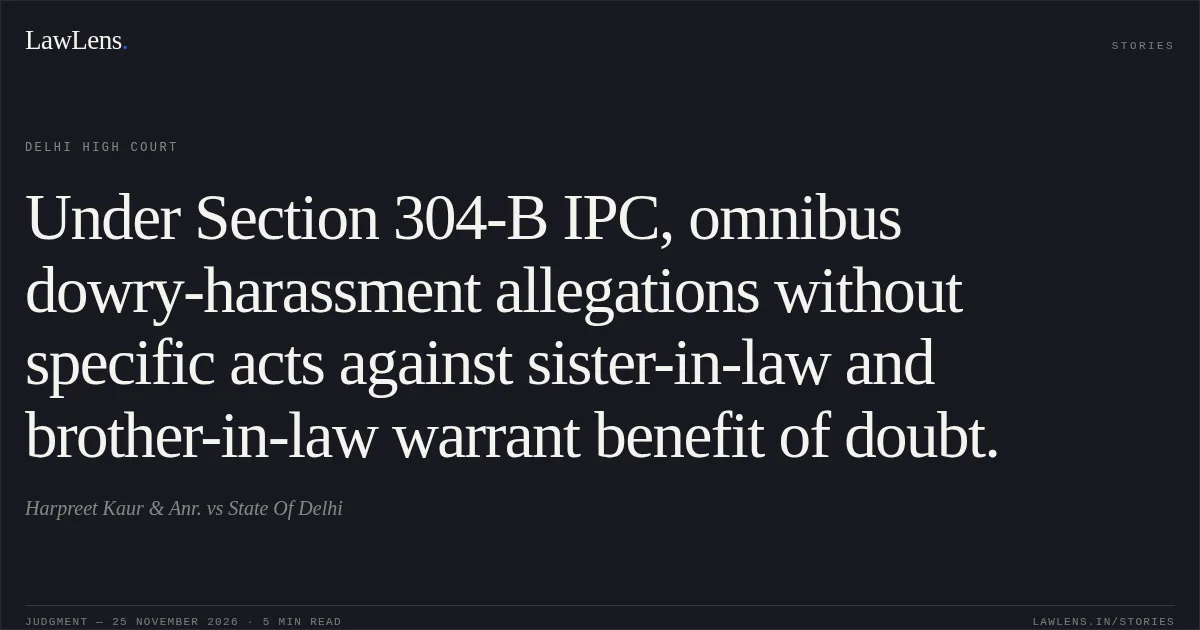
¶ 95–96As to Harpreet Kaur and Amardeep Singh, the court found no specific allegation against them. It noted that Harpreet Kaur had given birth about 30 days before death, and held that the omnibus allegations required the benefit of the doubt.
¶ 10105Holding
The Court held that the prosecution proved that, soon before her unnatural death within seven years of marriage, the deceased was subjected to cruelty and harassment for dowry by the husband, mother-in-law and father-in-law.
¶ 96The appeals of Harbhajan Singh (CRL.A. 341/2002) and Surinder Pal Singh (CRL.A. 347/2002) are dismissed, and their convictions under Sections 304-B and 498-A IPC and the sentences are upheld. The appellants are directed to surrender within two weeks. The name discrepancy "Surinder Pal Singh" / "Surinder Singh" was held to refer to the same person.
¶ 98, 103The appeal of Harpreet Kaur and Amardeep Singh (CRL.A. 258/2002) is allowed on the benefit of the doubt, and their bail bonds are discharged. Crl.M.A. 41879/2019 is dismissed as not pressed.
¶ 101–103 · ¶ 105Original Court PDF
Harpreet Kaur & Anr.vsState Of Delhi
Click to open original judgment
Original judgment, available to read, download and summarize on LawLens.in