01Facts
The subject land was granted to the original grantee in 1979.
p. 7A portion was sold through a registered sale deed in 1994.
p. 7The petitioners' father purchased the land in 2004.
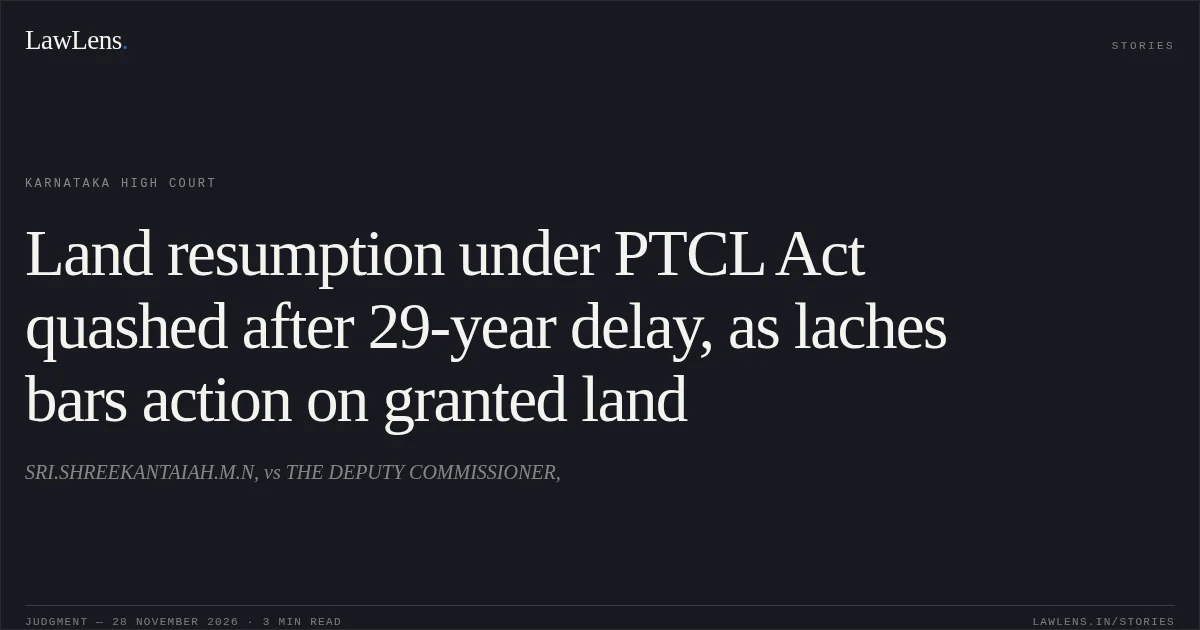
p. 7Resumption proceedings under the PTCL Act were initiated in 2023, roughly 29 years after the 1994 sale.
p. 7The Assistant Commissioner allowed the resumption claim, and the Deputy Commissioner confirmed that order on appeal.
pp. 7–8The petitioners challenged both orders under Articles 226 and 227, and also sought to quash the Tahsildar's mutation entry.
pp. 3–4Respondent No. 4 contended that prior Government permission was not obtained, that the PTCL Act is social welfare legislation, that the 2023 amendment rendered delay and laches inapplicable, and that the Division Bench decision in Nekkanti predated the amendment.
pp. 6–7Respondent No. 4 sought deferment pending the challenge to the amendment and relied on Bhemanna v. Deputy Commissioner, Chitradurga (W.P. No. 10496/2003).
pp. 6–7The petitioners argued that the authorities ignored their plea of unreasonable delay and laches.
p. 802Issues
i.1. Whether the resumption proceedings, initiated nearly 29 years after the 1994 sale, were barred by delay and laches, and whether the authorities erred in failing to consider that plea.
p. 8 · ¶ 6ii.2. Whether the pendency of a constitutional challenge to the PTCL Act amendment warranted deferment of the resumption proceedings.
p. 10 · ¶ 603Law Applied
The PTCL Act's core purpose is protecting Scheduled Castes and Scheduled Tribes by prohibiting alienation of granted land without prior permission, and the Act provides a resumption remedy against unauthorised transfers.
pp. 8–9A grantee or heirs who voluntarily execute a registered sale deed cannot later invoke the Act to nullify their own transaction, and courts apply estoppel against the grantee in such cases.
p. 9Limitation is a strict statutory bar, whereas laches is an equitable doctrine under Article 226 based on unreasonable delay and resulting prejudice to the opposing party.
p. 9The Division Bench in Nekkanti observed that laches is the primary requirement in resumption matters and that a restoration action filed after significant delay may be barred.
p. 9The mere pendency of a constitutional challenge to a statutory provision does not justify postponing proceedings absent an interim order staying them.
p. 10Bhemanna, cited by Respondent No. 4, was not treated by the Court as altering this position.
04Reasoning
The Court found that both the Assistant Commissioner and the Deputy Commissioner overlooked the approximately 29-year delay between the 1994 registered sale and the 2023 initiation of proceedings, and failed to examine laches despite the petitioners raising it.
p. 8Because the rights in the land had been settled by the 1994 sale deed, the authorities were required to assess whether it was equitable to proceed after such a lapse. Their failure to address this "crucial and relevant issue" rendered the resumption orders legally unsustainable.
p. 8The Court noted the limited scope of the grantee's right to challenge a transaction the grantee's own family voluntarily executed, reflecting the estoppel principle.
p. 9The Court rejected the deferment plea because the constitutional challenge to the 2023 amendment was pending without any stay or interim order, so the PTCL proceedings could not be held in abeyance on that ground alone.
p. 10The Court rejected the argument that the amendment removed the delay and laches defence, treating laches as a live consideration even after the amendment, consistent with Nekkanti.
pp. 6, 9–1005Holding
The resumption orders dated 02.12.2025 (Assistant Commissioner) and 14.08.2026 (Deputy Commissioner) could not be legally sustained because the authorities failed to consider the 29-year delay and laches, and the pendency of the constitutional challenge to the PTCL amendment did not warrant deferment.
p. 10The writ petition was allowed, and the Court issued a writ of certiorari quashing both orders. The revenue authorities were directed to mutate and restore the petitioners' names in the revenue records of the subject land.
p. 11 · ¶ 8Any interim orders stood discharged, and pending interlocutory applications were disposed of.
p. 11 · ¶ 9The Court did not expressly decide the M.R.T. 3/2025-26 challenge (prayer (c)) in its operative directions.
Original Court PDF
SRI.SHREEKANTAIAH.M.N,vsTHE DEPUTY COMMISSIONER,
Click to open original judgment
Original judgment, available to read, download and summarize on LawLens.in