Facts
The Respondent (original writ petitioner) owned land classified as "paddy land" in revenue records.
Source reference: para 2In 2012, he obtained an order under Section 9 of the Kerala Conservation of Paddy Land and Wetland Act, 2008 ("Paddy Land Act"), permitting him to reclaim the land to construct a residential building.
Source reference: para 2After the 2017 amendment introducing Sections 27A to 27C, the Respondent applied under Section 27C(2) for reassessment of land tax and a change in category in revenue records.
Source reference: para 3The High Court previously directed the Tahsildar (Land Records) to consider this application.
Source reference: para 3Following reassessment, the property description remained "Nilam" (paddy land) in tax receipts, leading to contempt proceedings.
Source reference: para 3The State filed this Review Petition, contending that: (i) the Respondent was ineligible for Section 9 benefits as he purchased the land post-2008; and (ii) Section 27C(2) reassessment applies only to Section 27A conversions (unnotified land), not Section 9 reclamations (paddy land).
Source reference: para 4, 5Issues
1. Whether the reassessment and record-update procedure under Section 27C(2) of the Paddy Land Act is applicable to lands reclaimed for residential purposes under Section 9.
Source reference: para 52. Whether a permission granted and acted upon under Section 9 in 2012 can be invalidated in a review petition on the grounds of the owner's date of purchase.
Source reference: para 13Law Applied
The court applied Section 27C of the Paddy Land Act, which mandates the Tahsildar to reassess land tax under Section 6A of the Kerala Land Tax Act, 1961, when land is "duly converted as per the provisions of this Act".
Source reference: para 6It interpreted "reclamation" under Section 2(xv) to include "conversion" as defined in Section 2(iii).
Source reference: para 10The Court relied on The Tahsildar & Anr v. Renjith George (Civil Appeal No. 14732/2024), which established that the Act treats "paddy land" and "unnotified land" at par for conversion purposes.
Source reference: para 9It further invoked the principle from Sonia Bhatia v. State of U.P. [(1981) 2 SCC 585] that the legislature does not waste words and every term must be given significance.
Source reference: para 12Reasoning
The Court rejected the State's restrictive interpretation of Section 27C(2).
Source reference: para 7-9It noted that while Section 27C(1) explicitly references Sections 8, 9, 10, and 27A, Section 27C(2) uses the phrase "paddy land or unnotified land".
Source reference: para 7-9If the legislature intended to limit reassessment to Section 27A (which deals only with unnotified land), the term "paddy land" in sub-section (2) would be redundant.
Source reference: para 9Regarding the terminology, the Court found that "reclamation" under Section 9 is effectively an irreversible "conversion" as defined in Section 2, and the statute uses these terms interchangeably in Section 27C(1).
Source reference: para 10-11On the State's challenge to the Respondent's eligibility (based on the purchase date), the Court held that since the 2012 permission was acted upon and construction completed, it cannot be revisited a decade later in a review petition, especially since the order was never previously challenged or set aside.
Source reference: para 14-15Holding
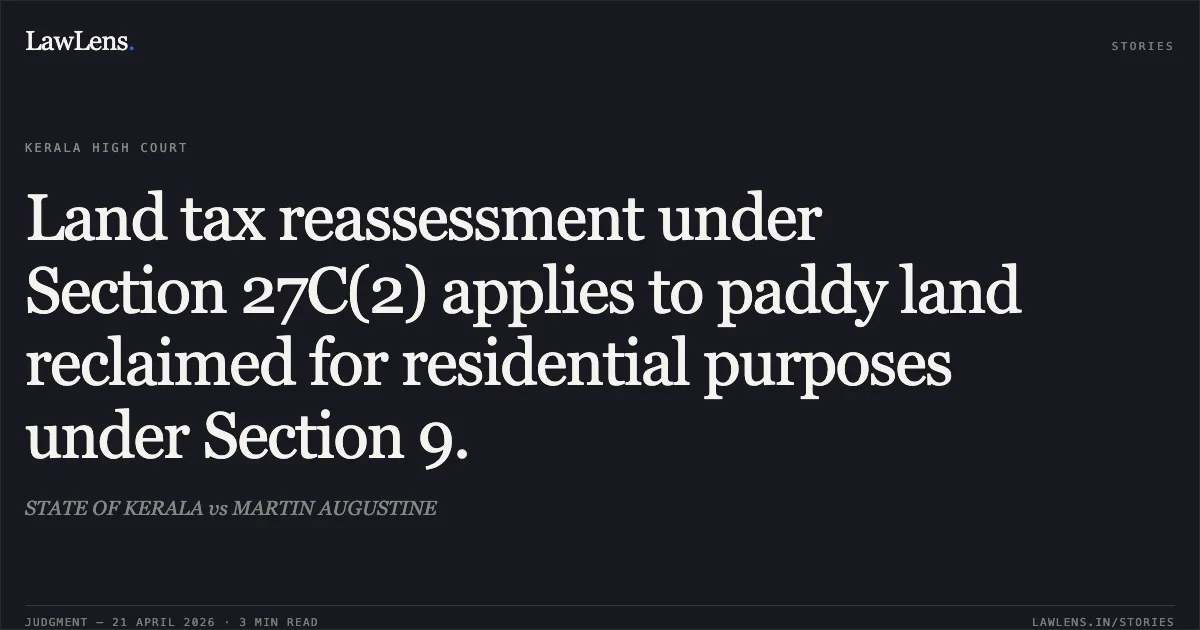
The High Court dismissed the Review Petition, holding that Section 27C(2) applies to lands converted/reclaimed under Section 9.
The Court clarified that once a property is reclaimed via the legal procedure under Section 9, the owner is entitled to the same reassessment and record-updating benefits as those under Section 27A. The Tahsildar (Land Records) is the proper authority to effect these changes in the revenue records.
Source reference: para 16Acts & Sections Cited
8 provisions across 2 statutes referred to in this judgment. Linked provisions open on LawLens.
Kerala Conservation of Paddy Land and Wetland Act, 20086
Kerala Land Tax Act, 19612
Original Court PDF
STATE OF KERALAvsMARTIN AUGUSTINE
Click to open original judgment
Original judgment, available to read, download and summarize on LawLens.in