01Facts
The petitioners challenged the Land Tribunal, Kalaghatagi's order dated 23.03.2018 (Annexure-J), which rejected the predecessor's application for occupancy rights over 11 acres 39 guntas in Survey No. 43/2 of Devalingikoppa Village.
¶ 1The application was filed on 23.08.1974 by Bharamappa Talawar, who died during its pendency.
¶ 4Revenue records showed the original applicant as tenant in cultivation from 1967–68 to 1973–74, including on the operative date of 01.03.1974.
¶ 12On 09.07.1981, the Tribunal recorded statements from Smt. Fakkirawwa, who stated that only about 6 acres were under her cultivation and that she had surrendered the balance about 12 years earlier.
¶ 6A handwritten record of the same date, bearing thumb impressions of the parties, noted that the tenant sought occupancy over only half the land, to which the owner had no objection.
¶ 7The Tribunal registered the tenant as occupant of 6 acres.
¶ 8The owner's widow, Smt. Shankrawwa, challenged this order, and this Court remitted the matter in WP No. 25773 of 1993 for fresh evidence and disposal according to law.
¶ 9On 29.08.2001, Smt. Fakkirawwa made a further statement that she had no knowledge of the Form No. 7 application and that neither she nor her husband had cultivated the land.
¶ 5, 15On 26.08.2001, the Tribunal adjourned the matter for the statements of the other legal representatives, and LR Maruti sought time.
¶ 16–17Without recording those statements, the Tribunal rejected the application on 23.03.2018.
¶ 15, 17A statement dated 13.03.2018 filed by Smt. Fakkirawwa's children, describing the holding and cultivation, was not considered.
¶ 1702Issues
i.1. Whether entries in the revenue records showing the tenant in cultivation of the entire extent as on 01.03.1974 are conclusive of the extent of cultivation, or are rebuttable under Section 133 of the Karnataka Land Reforms Act, 1961.
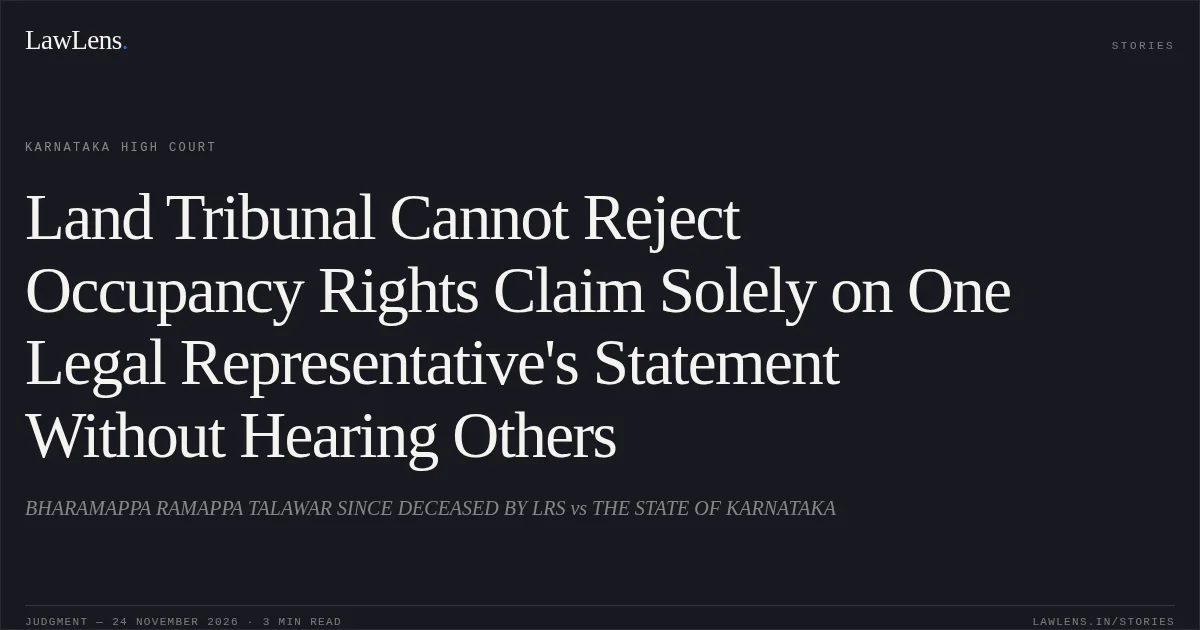
¶ 13–14ii.2. Whether the Land Tribunal could reject the application for occupancy rights solely on the statement of one legal representative without recording the statements of the other legal representatives, who are vital stakeholders.
¶ 16–1803Law Applied
Section 133 of the Karnataka Land Reforms Act, 1961 raises a presumption of correctness in favour of entries in revenue records, and this presumption is rebuttable and may be contested by the parties.
¶ 13The Act's operative date of 01.03.1974 is the reference point for the tenant's cultivation.
¶ 12Rule 17 of the Karnataka Land Reform Rules, 1974 governs the procedure for fresh consideration on remand and requires adequate opportunity to all concerned parties.
¶ 19A decision affecting multiple stakeholders must rest on the entire material on record, after hearing all interested parties.
¶ 18–19The earlier remand orders in WP Nos. 25770 and 25773 of 1993 provided the procedural background.
¶ 9Provisions in the judgment · 1 · Linked ones open on LawLens
KARNATAKA LAND REFORMS ACT, 1961 Section 133
04Reasoning
Although the revenue entries showed full cultivation as on 01.03.1974, the presumption under Section 133 was displaced in part by the wife's own statements that she cultivated only about half the land, so the entries could not be relied upon alone to fix the actual extent.
¶ 14The Tribunal erred by rejecting the application on the basis of a single statement from Smt. Fakkirawwa, despite its own adjournment for the statements of the other LRs and the pending request for time.
¶ 16–17The 13.03.2018 statement by the children was not addressed in the impugned order, which rendered the decision unreliable.
¶ 17Because the LRs were "vital stakeholders" in the outcome, their omission made the order unsustainable and failed to satisfy the requirement of adequate opportunity under Rule 17.
¶ 18The Court acknowledged the matter's 1975 vintage but held that remand was unavoidable because of the Tribunal's erroneous approach.
¶ 1905Holding
Revenue entries are rebuttable under Section 133 and cannot alone determine the extent of cultivation where contrary statements exist.
¶ 14The Tribunal's rejection of the application without recording the statements of all legal representatives, and without considering the 13.03.2018 statement, was unsustainable.
¶ 17–18The writ petition is allowed; the Tribunal's order at Annexure-J is set aside; and the matter is remitted to the Land Tribunal for fresh consideration on the entire material record, including revenue entries, the parties' statements at various stages, and surrounding circumstances, in strict compliance with Rule 17 of the Karnataka Land Reform Rules, 1974, after giving adequate opportunity to all concerned parties. No order as to costs. The Court expressed no final view on the merits of the extent of occupancy.
¶ 19Original Court PDF
BHARAMAPPA RAMAPPA TALAWAR SINCE DECEASED BY LRSvsTHE STATE OF KARNATAKA
Click to open original judgment
Original judgment, available to read, download and summarize on LawLens.in