01Facts
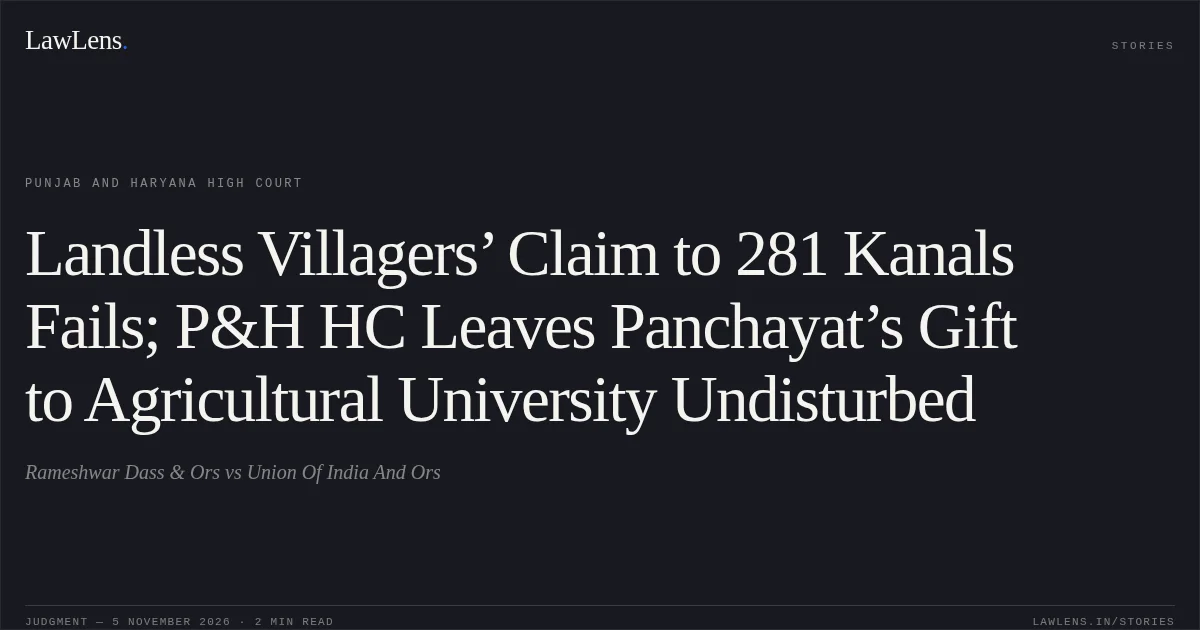
The plaintiffs sought a declaration and consequential relief concerning 281 kanals 12 marlas at village Damla, claiming that the land had belonged to Muslims who migrated to Pakistan and thereafter vested in the Union of India.
pp. 3–6 · ¶ 3–5They asserted that, as landless Harijans, they were entitled to its allotment under a Government scheme, and challenged the Gram Panchayat’s transfer of the land to the university and agricultural college.
pp. 3–6 · ¶ 3–5The Trial Court dismissed the suit, and the First Appellate Court affirmed that decision, relying, among other things, on prior proceedings concerning the land and the absence of evidence establishing the plaintiffs’ rights.
pp. 6–11 · ¶ 8–13In the second appeal, the plaintiffs sought to introduce RTI information stating that the land was not owned by the Gram Panchayat.
pp. 11–14 · ¶ 15–18The applications to implead the legal representatives of deceased appellants Nos. 3–6 were allowed for the purpose of pursuing the appeal.
pp. 1–302Issues
i.Whether the concurrent findings dismissing the plaintiffs’ suit disclosed a substantial question of law warranting interference in second appeal.
pp. 11, 14–15 · ¶ 14, 19–21ii.Whether the RTI information could be admitted as additional evidence under Order 41 Rule 27 CPC.
pp. 11–14 · ¶ 15–1803Law Applied
Order 41 Rule 27 CPC permits additional evidence in appeal only in the specified circumstances: where evidence was wrongly excluded by the court below; where, despite due diligence, it was unavailable or could not have been produced earlier; or where the appellate court requires it to pronounce judgment or for another substantial cause.
pp. 12–13 · ¶ 16Additional evidence cannot be used merely to fill gaps or repair weaknesses in a party’s case.
p. 13 · ¶ 17Under Section 100 CPC, a second appeal lies only where a substantial question of law arises; the High Court generally cannot reappreciate facts or substitute its view for that of the first appellate court unless the findings are legally impermissible, based on inadmissible evidence, or unsupported by evidence.
pp. 14–15 · ¶ 20, citing Jaichand v. SahnulalThe judgment also referred to Gobind Singh v. Union of India on the limited grounds for admitting additional evidence.
pp. 12–13 · ¶ 16.1Provisions in the judgment · 1 · Linked ones open on LawLens
Code of Civil Procedure, 1908 Section 100
04Reasoning
The Court found that the RTI information did not identify the revenue record or year on which it was based and did not refer to a khewat number.
pp. 13–14 · ¶ 18.1–18.4The appellants had not produced the underlying revenue record at trial or before the First Appellate Court, and the information alone was insufficient to establish the Gram Panchayat’s lack of ownership.
pp. 13–14 · ¶ 18.1–18.4The concurrent factual findings were not shown to be illegal, perverse, or founded on a misreading or misappreciation of evidence; nor did the appellants demonstrate a substantial question of law.
p. 11, 15 · ¶ 14, 19–2105Holding
The Court dismissed the application to lead additional evidence and dismissed the regular second appeal, finding no substantial question of law or other basis for interference with the concurrent judgments.
pp. 14–15 · ¶ 18.4, 21–23The applications to implead the legal representatives of deceased appellants Nos. 3–6 were allowed for the purpose of pursuing the appeal.
pp. 1–3Pending applications were closed.
p. 15 · ¶ 23Original Court PDF
Rameshwar Dass & OrsvsUnion Of India And Ors
Click to open original judgment
Original judgment, available to read, download and summarize on LawLens.in