Facts
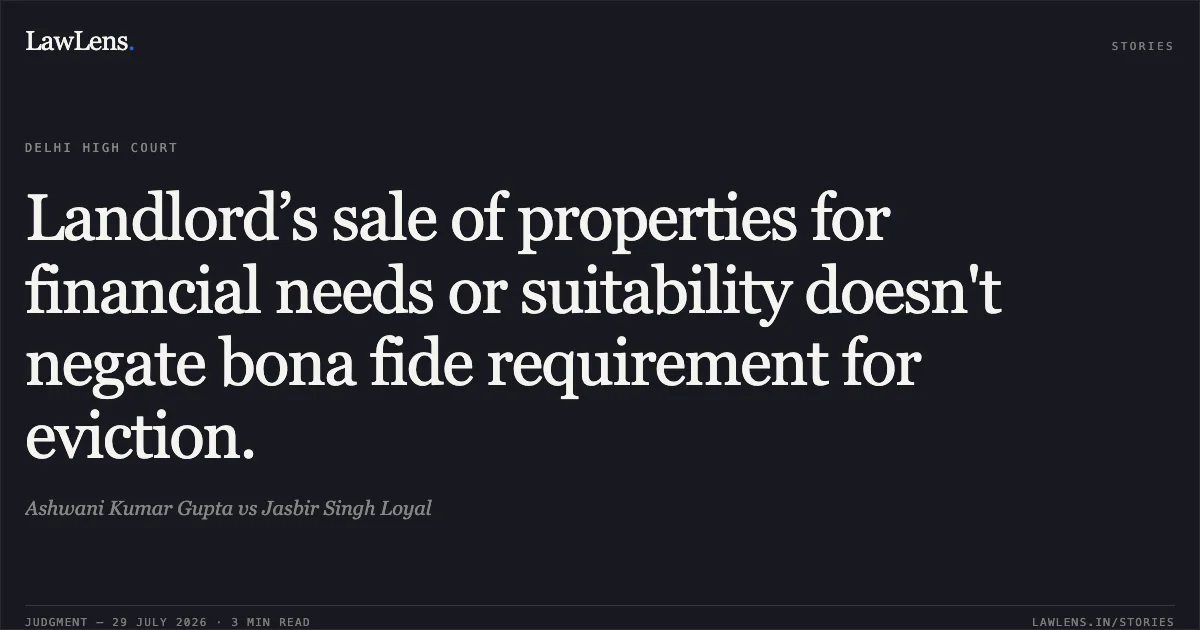
The Petitioner (tenant) challenged an order dated 25.04.2026 passed by the learned ARC, which dismissed his application for leave to defend in an eviction petition filed by the Respondent (landlord) under Section 14(1)(e) of the Delhi Rent Control (DRC) Act.
Source reference: para. 1The Respondent sought eviction to establish a restaurant.
Source reference: para. 2The Petitioner contended that the requirement was not bona fide because the Respondent had sold two other portions of the same property: Shop No. II-40/3 (sold shortly before filing the petition) and Shop No. II-40/9A (sold during the pendency of the litigation).
Source reference: paras. 2-4The ARC rejected these contentions, holding that the sales did not negate the landlord's genuine need.
Source reference: para. 12Issues
1. Whether the sale of Shop No. II-40/3 prior to the filing of the eviction petition constitutes a triable issue regarding the bona fide requirement of the landlord.
Source reference: para. 12 / ARC para. 352. Whether the sale of Shop No. II-40/9A during the pendency of the petition, allegedly due to financial constraints, creates a triable issue.
Source reference: para. 12 / ARC para. 423. Whether the High Court, in its revisional jurisdiction under Section 25B(8), can re-appreciate evidence or substitute its view for that of the Rent Controller.
Source reference: paras. 7-9Law Applied
The court primarily applied Section 25B(8) of the DRC Act, which provides for limited revisional jurisdiction rather than full appellate review.
Source reference: paras. 6-7It relied on Abid-Ul-Islam v. Inder Sain Dua (2022), which clarifies that the High Court’s role is supervisory and confined to the decision-making process to detect jurisdictional errors or manifest illegalities.
Source reference: para. 9Regarding the sale of property, it applied the principle from Shyam Sunder Ahuja v. Sushil Kumar (2017) that past sales do not automatically disqualify a landlord from seeking eviction for self-requirement.
Source reference: para. 12 / ARC para. 35It further applied the principle that the landlord is the "best judge" of their requirement and suitability of premises, as established in Praveen v. Mulak Raj.
Source reference: para. 12 / ARC para. 44Reasoning
The Court observed that its jurisdiction is limited to ensuring the ARC's decision does not suffer from perversity or an error on the face of the record.
Source reference: paras. 10-11Regarding Shop No. II-40/3, the Court affirmed the ARC's finding that since the sale occurred prior to the petition and "time is not static," old needs may change.
Source reference: para 12 / ARC para 35The Court found the Petitioner’s claims regarding this shop contradictory, as he simultaneously alleged the shop was sold and later let out to new tenants.
Source reference: para 12 / ARC para 36Regarding Shop No. II-40/9A, the Court upheld the ARC's reasoning that the sale was justified by financial constraints during the COVID-19 pandemic and the need to raise capital for the proposed business.
Source reference: para 14The Court emphasized that a tenant cannot dictate how a landlord utilizes or disposes of their property, especially where the other shop was significantly smaller than the tenanted premises.
Source reference: para 12 / ARC para 44Holding
The Court answered the issues in the negative, holding that the Petitioner failed to raise any triable issues.
The High Court affirmed that the ARC’s decision-making process was sound and free from jurisdictional error and dismissed the petition and the application for stay.
Source reference: para. 17The court maintained that the landlord’s prerogative to choose the most suitable premises for a business cannot be interfered with by the court or the tenant.
Source reference: para 12 / ARC para 44Acts & Sections Cited
1 provisions across 1 statute referred to in this judgment. Linked provisions open on LawLens.
Delhi Rent Control Act, 19581
Original Court PDF
Ashwani Kumar GuptavsJasbir Singh Loyal
Click to open original judgment
Original judgment, available to read, download and summarize on LawLens.in