01Facts
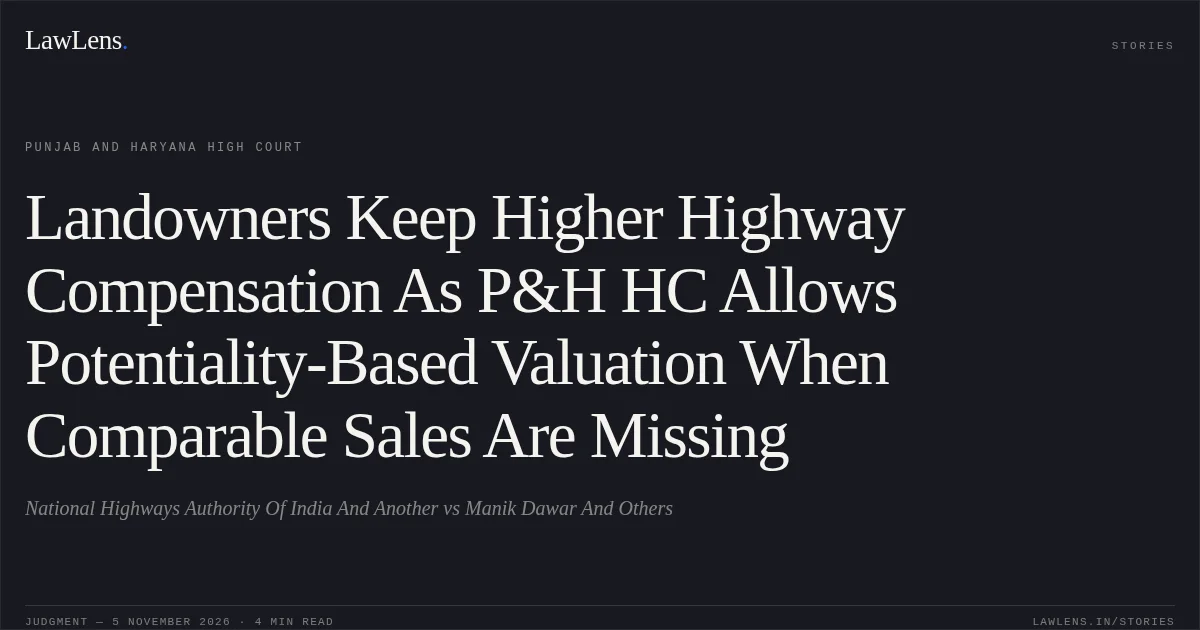
The appeals concerned compensation for land acquired in Village Malakpur, Tehsil and District Ludhiana, under the National Highways Act, 1956.
p. 8Following the Section 3-A notification dated 18 September 2015 and Section 3-D notification dated 12 May 2016, the Competent Authority for Land Acquisition (CALA) made its award on 26 April 2017.
pp. 10–11The arbitrator enhanced compensation in an award dated 13 January 2021, and the Additional District Judge dismissed NHAI’s Section 34 challenge on 1 March 2023.
pp. 10–11The arbitrator considered revenue records, a Town and Country Planning Department site plan, the land’s surroundings and potential, and a Tehsildar’s report of sale-deed values.
p. 13He fixed compensation for gair mumkin land at ₹4,255.37 per sq. metre and for agricultural land with residential potential at ₹2,836.92 per sq. metre; severance compensation was made subject to verification.
p. 18, 20NHAI challenged, among other things, the treatment of the land, the use of potentiality and nearby values, the failure to rely on its sale deeds, and the arbitrator’s handling of its cross-examination request.
pp. 8–902Issues
i.Whether the arbitrator could consider the land’s potentiality and use valuation material beyond a strict application of Section 26 of the 2013 Act when suitable comparable sale deeds were unavailable.
pp. 15–18, 19–27ii.Whether the arbitrator’s findings on the character and potential of the acquired land, and the resulting enhancement of compensation, were perverse or otherwise liable to be set aside under Section 34 of the Arbitration and Conciliation Act, 1996.
pp. 15–18, 28–29iii.Whether the arbitrator’s failure to allow NHAI to cross-examine the landowners required the award and the Section 34 decision to be set aside.
p. 9, 28, 3303Law Applied
Section 26 of the Right to Fair Compensation and Transparency in Land Acquisition, Rehabilitation and Resettlement Act, 2013 (the 2013 Act) prescribes criteria for the Collector’s determination of market value, including specified market value and average sale price for similar land; the judgment held that those criteria need not strictly bind the arbitrator or court where suitable sale deeds are unavailable and may serve as guidance in assessing fair compensation.
pp. 12–15, 23–27Section 34 of the Arbitration and Conciliation Act, 1996 provides limited grounds for setting aside an arbitral award; the court stated that reappreciation of evidence is not permissible absent patent illegality.
p. 15The court relied on Madhya Pradesh Road Development Corporation v. Vincent Daniel, (2025) 7 SCC 798, for the view that Section 26 is a guiding factor rather than a binding computation method for courts.
p. 17New Okhla Industrial Development Authority v. Harnand Singh, 2024 SCC OnLine SC 1691, for the principle that land valuation may require informed estimation where direct evidence is insufficient.
pp. 19–20Associate Builders v. Delhi Development Authority, (2015) 3 SCC 49, on the limited scope of interference under Sections 34 and 37.
p. 17The court also followed the coordinate Bench’s reasoning in Jaharvir Goga Samiti v. State of Haryana, RFA No. 1182 of 2024 (12 May 2026), that rigid application of Section 26’s averaging methodology may fail to produce just compensation.
pp. 17–18It distinguished Project Director, NHAI v. Alfa Remidis Ltd., Civil Appeal No. 7847 of 2026 (12 May 2026), because that case involved reliance on a single sale deed concerning land of a different character.
p. 16Provisions in the judgment · 5 · Linked ones open on LawLens
Arbitration and Conciliation Act, 1996 Section 34Section 37
Right to Fair Compensation and Transparency in Land Acquisition, Rehabilitation and Resettlement Act, 2013 Section 2Section 11Section 26
04Reasoning
The court found that the arbitrator had evidentiary material for assessing both the land’s character and its potential: the landowners’ Jamabandis and a genuine site plan issued by the Town and Country Planning Department, which indicated nearby residential development and was consistent with a 2013 map.
pp. 11–12, 18–19The arbitrator had considered sale deeds produced by both sides and the Tehsildar’s report, while finding the available deeds unsuitable as direct comparables for the acquired land.
p. 13, 16In those circumstances, the court held that strict reliance on Section 26’s prescribed methodology would not ensure fair compensation and that consideration of potentiality and informed estimation was permissible.
pp. 16–20It found no perversity in the arbitrator’s assessment and concluded that the unresolved cross-examination request did not warrant setting aside the award, given the public nature of the site plan and the record considered by the arbitrator.
pp. 18–19, 2005Holding
The court answered the issues against NHAI.
pp. 18–20It held that the arbitrator could consider the land’s potential and use informed estimation where suitable sale deeds were unavailable; the compensation findings disclosed no perversity warranting interference; and the cross-examination issue did not justify setting aside the award in the circumstances.
pp. 18–20All listed appeals were dismissed, and any connected applications were disposed of.
p. 21Original Court PDF
National Highways Authority Of India And AnothervsManik Dawar And Others
Click to open original judgment
Original judgment, available to read, download and summarize on LawLens.in