01Facts
The appellant’s father purchased a shop in a 1980 public auction for Rs.85,000 and paid 25% of the bid amount. Under the allotment letter, the balance was payable in a lump sum or instalments, with interest accruing from the offer of possession; possession was delivered only in 1991.
¶ 2, 17–18In 1994, its Administrator waived interest and penalty subject to payment within 30 days, but the Estate Officer issued a fresh demand before that period expired.
¶ 3, 23The appellant later made further payments, but HUDA resumed the shop in 2001 for alleged arrears.
¶ 10, 25The trial court set aside the resumption order but did not declare the appellant owner; the first appellate court reversed that decree, prompting this appeal.
¶ 7–8, 2802Issues
i.Whether HUDA could charge interest on the outstanding sale price before offering or delivering possession, and whether the demands based on interest and penalty were lawful
¶ 14, 18–22ii.Whether the resumption order was sustainable in light of the Administrator’s waiver, the payments made, and the alleged non-compliance with statutory notice requirements
¶ 23–27iii.Whether the civil court had jurisdiction to examine the challenge to the resumption order despite Section 50(2) of the HUDA Act, 1977
¶ 1603Law Applied
Section 50 of the HUDA Act, 1977 does not bar civil-court jurisdiction where an impugned order is challenged on grounds such as gross illegality, irrationality, mala fides, breach of natural justice, or perversity; Section 17 governs the statutory procedure for resumption.
¶ 16, 26Under the allotment terms, interest accrued from the date possession was offered, and HUDA could not charge interest for a period in which it had not offered possession because development was incomplete.
¶ 18–21HUDA v. Manoj Kumar, (2005) 9 SCC 541, applied that principle to materially identical allotment terms; M/s R.S. Builders (India) Pvt. Ltd. v. State of Haryana, 1997(2) RCR (Civil) 504, addressed the interaction between possession and payment obligations; and Roochira Ceramics v. HUDA, 2002 (9) SCC 599, held that the applicable interest rate was 10%, not 18%.
¶ 19–22Resumption is a drastic measure to be used as a last resort, with statutory procedure and an effective opportunity of hearing observed, as stated in M/s Teri Oat Estates (P) Ltd. v. U.T., Chandigarh, 2004 (2) SCC 130.
¶ 26–27Under Section 41 of the Punjab Courts Act, 1918, framing a substantial question of law is not mandatory for a second appeal.
¶ 15Provisions in the judgment · 5
Haryana Urban Development Authority Act, 1977 Section 18Section 17Section 50Section 50
Punjab Courts Act, 1918 Section 41
04Reasoning
The court found that possession was delivered about ten years after allotment, no earlier offer of possession was shown, and HUDA produced no evidence establishing when development was completed. Applying the allotment terms and Manoj Kumar, it held that interest could accrue only from the offer or delivery of possession; the 18% compound-interest demand was also inconsistent with the allotment and Roochira Ceramics.
¶ 18–22HUDA had not explained its fresh demand issued before the Administrator’s 30-day payment period expired, and the evidence contradicted the first appellate court’s finding that no further payments had been made.
¶ 23–25The long gap between notices and the disputed service of notices undermined the resumption process; the court concluded that resumption was not shown to be a last resort or to comply with the required procedure.
¶ 26–27Given the pleaded challenge to the legality of the demand and resumption, the civil court could examine the matter notwithstanding Section 50.
¶ 1605Holding
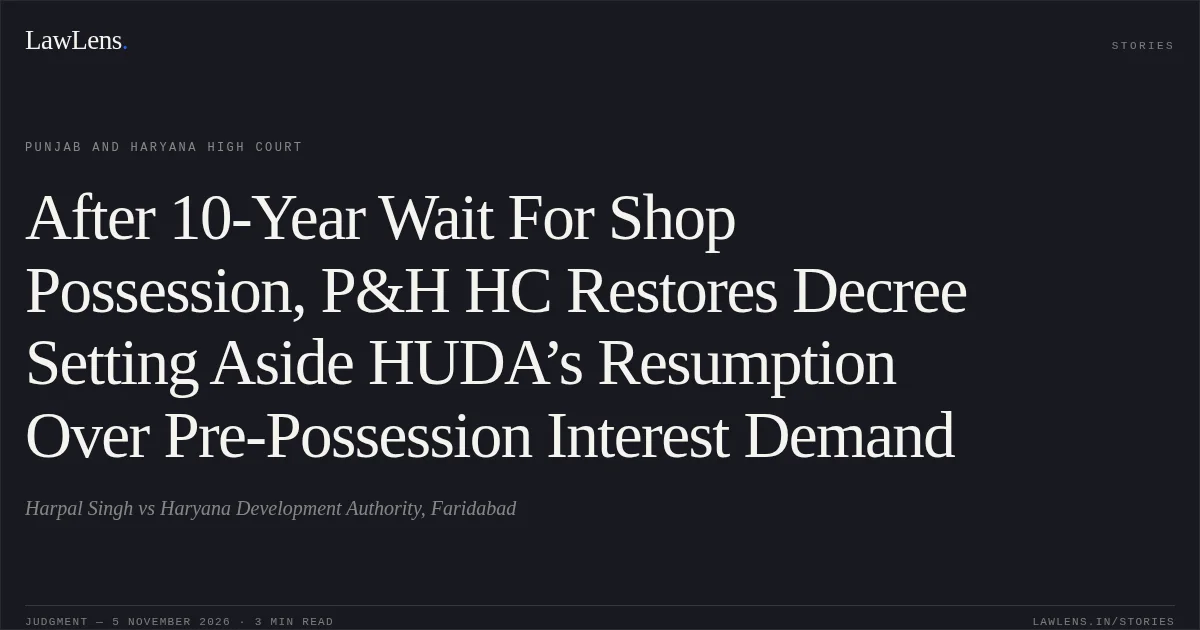
The High Court allowed the appeal, set aside the first appellate court’s judgment and decree, and restored the trial court’s decree setting aside the resumption order and restraining dispossession on its basis.
¶ 28, 31–33The trial court had not declared the appellant owner, and the High Court likewise made no declaration of ownership.
¶ 28, 31–33Original Court PDF
Harpal SinghvsHaryana Development Authority, Faridabad
Click to open original judgment
Original judgment, available to read, download and summarize on LawLens.in