01Facts
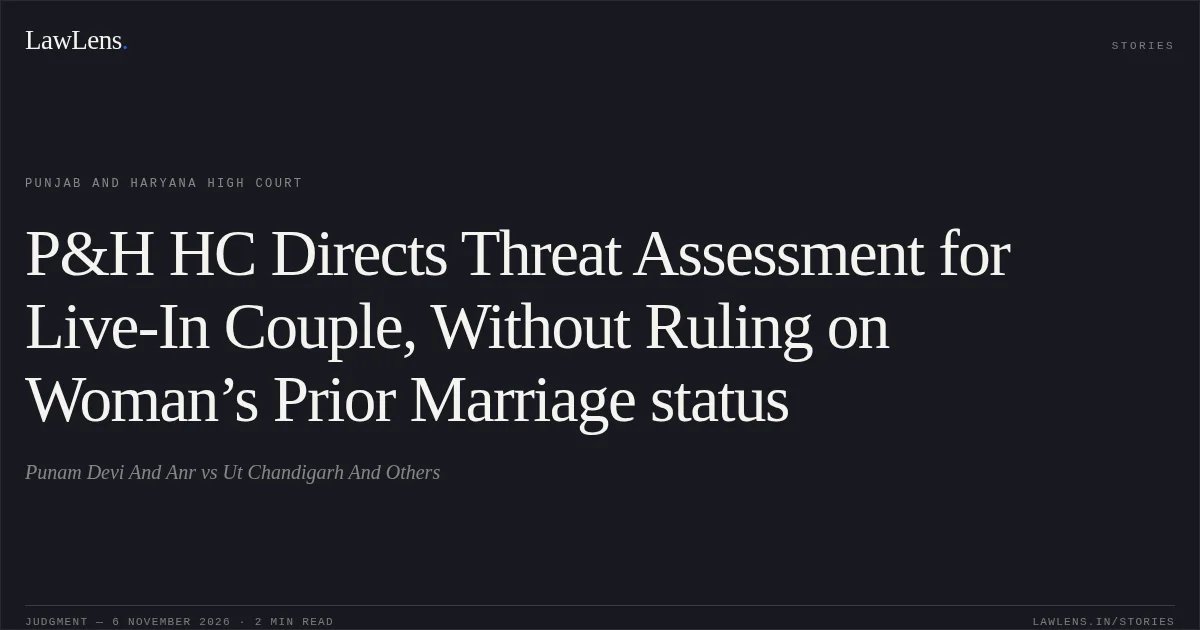
The petitioners filed a petition under Article 226 seeking protection of their life and liberty.
p. 1They asserted that they were majors, living together in a live-in relationship by choice, and apprehended harm.
pp. 1–2 · ¶ 1–2Petitioner No. 1 stated that she had previously married respondent No. 4, but that they were living separately despite there being no legal divorce.
pp. 1–2 · ¶ 1–2The petitioners had submitted a representation dated 30 October 2026 to the Senior Superintendent of Police, U.T., Chandigarh
pp. 1–2 · ¶ 1–2The State did not object to the Senior Superintendent of Police considering the representation and taking action in accordance with law
p. 2 · ¶ 602Issues
i.1. Whether the petitioners, who claimed to be majors in a live-in relationship, were entitled to protection of their life and liberty notwithstanding the disputed legality of their relationship
pp. 3–7 · ¶ 8–13ii.2. Whether the Senior Superintendent of Police should be directed to consider the petitioners’ representation and assess their threat perception
p. 7 · ¶ 1303Law Applied
Article 226 empowers the High Court to issue appropriate directions to protect life and liberty.
pp. 3–4 · ¶ 8The Court applied the constitutional principle that every person’s life and liberty must be protected and that a major is entitled to live with a person of their choice; a live-in relationship, not being prohibited by law, does not by itself exclude the persons concerned from equal protection of law
pp. 3–4 · ¶ 8 · p. 7 · ¶ 12Relying on Pardeep Singh and another v. State of Haryana and others, CRWP-4521-2021, and the Division Bench decision in Ishrat Bano and another v. State of Punjab and others, LPA-769-2021, the Court held that protection of life and liberty may be considered independently of the legality of the relationship, without preventing lawful proceedings against the petitioners
pp. 3–4, 6 · ¶ 8–1104Reasoning
The petitioners alleged a threat to their life and liberty and had already approached the Senior Superintendent of Police by written representation.
pp. 6–7 · ¶ 11–13The Court considered the authorities establishing that the claimed live-in relationship, or uncertainty about its legality, did not justify withholding consideration of a request for protection.
pp. 6–7 · ¶ 11–13Consistent with Ishrat Bano, the Court left the legality of the relationship and the merits of any other proceedings undecided, while directing the competent police official to assess the threat and act in accordance with law
pp. 6–7 · ¶ 11–1305Holding
The Court disposed of the petition and directed respondent No. 2, the Senior Superintendent of Police, U.T., Chandigarh, to consider the representation dated 30 October 2026, assess the petitioners’ threat perception, and take appropriate action in accordance with law
p. 7 · ¶ 13–14The Court expressed no opinion on the legality of the relationship or the merits of the case and clarified that the order would not prevent the State from proceeding against the petitioners if they were involved in any other case
p. 7 · ¶ 13, 15Original Court PDF
Punam Devi And AnrvsUt Chandigarh And Others
Click to open original judgment
Original judgment, available to read, download and summarize on LawLens.in