01Facts
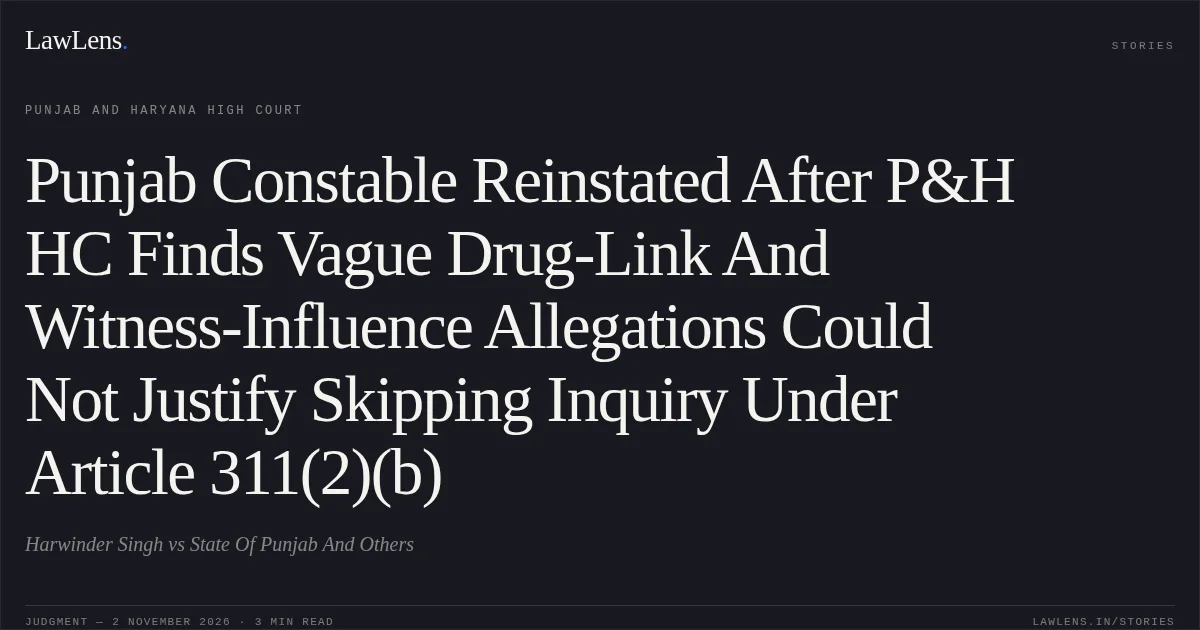
The petitioner, a Punjab Police constable, was arrested in connection with an FIR under Section 21(b) of the NDPS Act and later released on bail. While departmental proceedings concerning his absence from duty and alleged involvement in the FIR were pending, the Commissioner of Police dismissed him under Article 311(2)(b) of the Constitution, read with Rule 16.1 of the Punjab Police Rules, 1934.
pp. 2–5The stated basis was that the petitioner had links with persons involved in the drug trade and was influencing prosecution witnesses, making a departmental inquiry impracticable. The petitioner’s appeal was rejected, and he challenged both orders before the High Court.
pp. 2–502Issues
i.1. Whether the disciplinary authority recorded sufficient, specific reasons to establish that it was not reasonably practicable to hold a departmental inquiry before dismissing the petitioner under Article 311(2)(b).
pp. 7–10, 29–30ii.2. Whether the appellate order independently addressed whether the constitutional conditions for dispensing with the inquiry were satisfied.
pp. 29–3003Law Applied
Article 311(2) ordinarily requires an inquiry in which the employee is informed of the charges and given a reasonable opportunity to be heard; under the second proviso, clause (b), that requirement may be dispensed with only where the competent authority is satisfied, for reasons recorded in writing, that holding the inquiry is not reasonably practicable.
pp. 7–8Under Union of India v. Tulsiram Patel, the test is not absolute impossibility, but whether a reasonable person, considering the prevailing circumstances, would regard an inquiry as not reasonably practicable; the authority must not invoke the exception arbitrarily or merely to avoid an inquiry, and its decision remains subject to judicial review.
pp. 11–12, 17–20Jaswant Singh v. State of Punjab and Manohar Lal v. Commissioner of Police affirm that the recorded satisfaction must be objective and supported by material, not a bare assertion or unsubstantiated apprehension.
pp. 11–12, 28–29Rule 16.24 of the Punjab Police Rules, 1934, was also considered in relation to the departmental inquiry.
pp. 8–9Provisions in the judgment · 5 · Linked ones open on LawLens
Narcotic Drugs and Psychotropic Substances Act, 1985 Section 21
Code of Criminal Procedure, 1973 Section 173
Indian Penal Code, 1860 Section 384
04Reasoning
The dismissal order asserted that the petitioner’s criminal links made an inquiry impracticable, but did not identify particular witnesses allegedly influenced, specific acts of interference, or reasons witnesses could not be examined with appropriate safeguards.
pp. 8–10The Enquiry Officer’s report relied on information from confidential sources and made general allegations of drug-trade connections and witness influence, without setting out concrete supporting circumstances.
pp. 9–10The Court held that the seriousness of the allegations, the FIR, or a general apprehension that witnesses might be influenced did not, without more, establish that an inquiry was not reasonably practicable. The petitioner was already facing departmental proceedings, yet no specific instance of intimidation or interference was shown.
pp. 10–11, 29–30The appellate order merely rejected the appeal and did not independently examine whether the conditions for invoking Article 311(2)(b) were met.
pp. 3–4, 29–3005Holding
The Court held that the respondents had not demonstrated a valid basis for dispensing with the departmental inquiry and that the dismissal order failed to comply with Article 311(2)(b).
p. 30It allowed the petition and quashed the dismissal order dated 9 November 2021 and the appellate order dated 27 October 2022.
p. 30The respondents were directed to reinstate the petitioner with consequential benefits, without prejudice to their right to continue departmental proceedings in accordance with the Punjab Police Rules or take an appropriate decision after conclusion of the criminal proceedings.
pp. 30–31Original Court PDF
Harwinder SinghvsState Of Punjab And Others
Click to open original judgment
Original judgment, available to read, download and summarize on LawLens.in