01Facts
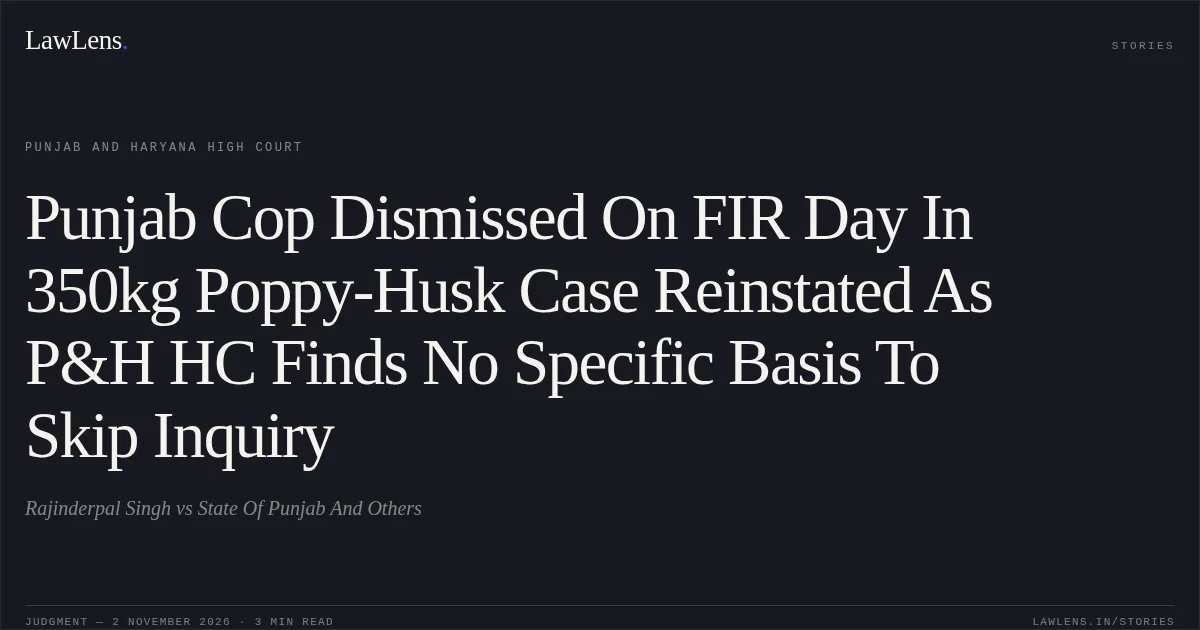
The petitioner, an Assistant Sub-Inspector with over 31 years’ service, was dismissed on 6 August 2021 under Article 311(2)(b) of the Constitution and Rule 16.2(1) of the Punjab Police Rules, 1934, without a departmental inquiry.
pp. 2–3The dismissal followed his arrest and registration of an NDPS case alleging recovery of 350 kg of poppy husk; the FIR and dismissal order were made on the same day.
pp. 2–3, 26His statutory appeal, filed on 7 August 2021, remained undecided for nearly four years.
pp. 4–5After the petitioner approached the High Court, the appeal was consigned to the office on the ground that it had been received before the appellate authority’s final order and that a revision could be filed only thereafter.
pp. 4–5, 2802Issues
i.1. Whether the authority validly invoked Article 311(2)(b) to dispense with a departmental inquiry, on the reasons and material recorded in the dismissal order.
pp. 25–28ii.2. Whether the petitioner’s appeal was lawfully dealt with when it was consigned to the office without determination on its merits.
p. 28iii.3. Whether the dismissal order adequately considered the petitioner’s length of service, service record, and pension-related considerations under Rule 16.2(1).
p. 2903Law Applied
Article 311(2) ordinarily requires an inquiry and a reasonable opportunity to answer the charges; under its second proviso, clause (b), the competent authority may dispense with an inquiry only where it records in writing a reasoned satisfaction, supported by relevant material, that holding the inquiry is not reasonably practicable.
pp. 7–8, 14–17Under Union of India v. Tulsiram Patel, (1985) 3 SCC 398, this exceptional power cannot be used arbitrarily, mechanically, or merely to avoid an inquiry, and its exercise remains subject to judicial review.
pp. 7–8, 14–17The Court also relied on Manohar Lal v. Commissioner of Police, 2026 SCC OnLine SC 363, for the requirement of objective circumstances rather than an unsupported apprehension.
p. 25Rule 16.2(1) of the Punjab Police Rules, 1934, requires dismissal to be reserved for the gravest misconduct or the cumulative effect of misconduct demonstrating incorrigibility and complete unfitness for police service, making the officer’s service and record relevant to the decision.
p. 29The Court additionally referred to the Punjab DGP’s guidelines dated 2 September 2022, which caution against vague or formulaic reasons for dispensing with an inquiry.
pp. 19–22Provisions in the judgment · 5 · Linked ones open on LawLens
Narcotic Drugs and Psychotropic Substances Act, 1985 Section 15Section 29
Indian Penal Code, 1860 Section 384
04Reasoning
The dismissal order relied on the alleged seriousness of the NDPS offence, the asserted harm to the police force’s image, and the view that the petitioner’s continued service could be detrimental to the State and public.
pp. 26–28It identified no specific threat, intimidation, interference with an inquiry officer, or tampering with evidence that made an inquiry impracticable; the respondents’ later general assertion that police witnesses may be reluctant to testify did not supply that missing, case-specific basis.
pp. 26–28The fact that the petitioner was a police officer did not justify presuming that witnesses could not depose freely.
pp. 26–28The order’s recital that the authority had independently considered the matter also failed to establish the required rational nexus between actual circumstances and the impracticability of an inquiry.
p. 28Further, neither the dismissal order nor the appeal order showed consideration of the petitioner’s lengthy service, service record, or pension claim, and the appeal order did not address the merits of his challenge.
pp. 28–2905Holding
The Court held that the dismissal did not satisfy Article 311(2)(b), and that consigning the appeal to the office without adjudicating it on the merits could not be sustained.
p. 29It allowed the petition, quashed the dismissal order dated 6 August 2021 and the appeal order dated 19 June 2025, and directed the respondents to reinstate the petitioner with all consequential benefits.
p. 30The respondents remain free to conduct a departmental inquiry in accordance with the Punjab Police Rules or to take an appropriate decision after conclusion of the criminal proceedings.
p. 30Original Court PDF
Rajinderpal SinghvsState Of Punjab And Others
Click to open original judgment
Original judgment, available to read, download and summarize on LawLens.in