01Facts
The dispute concerned property No. 4677, comprising parts A–E.
Girdhari Lal’s registered gift deed of 1959 dealt with parts A and B; his 1982 will referred to part C as property No. 3 and parts D and E as property No. 4.
¶ 6Bhagwan Dai sued for a declaration and injunction. The trial court dismissed the suit; on appeal, the Additional District Judge held that Varinder Kumar was Girdhari Lal’s biological son, upheld the will, and found Sanjiv Kumar to be Bhagwan Dai’s adopted son.
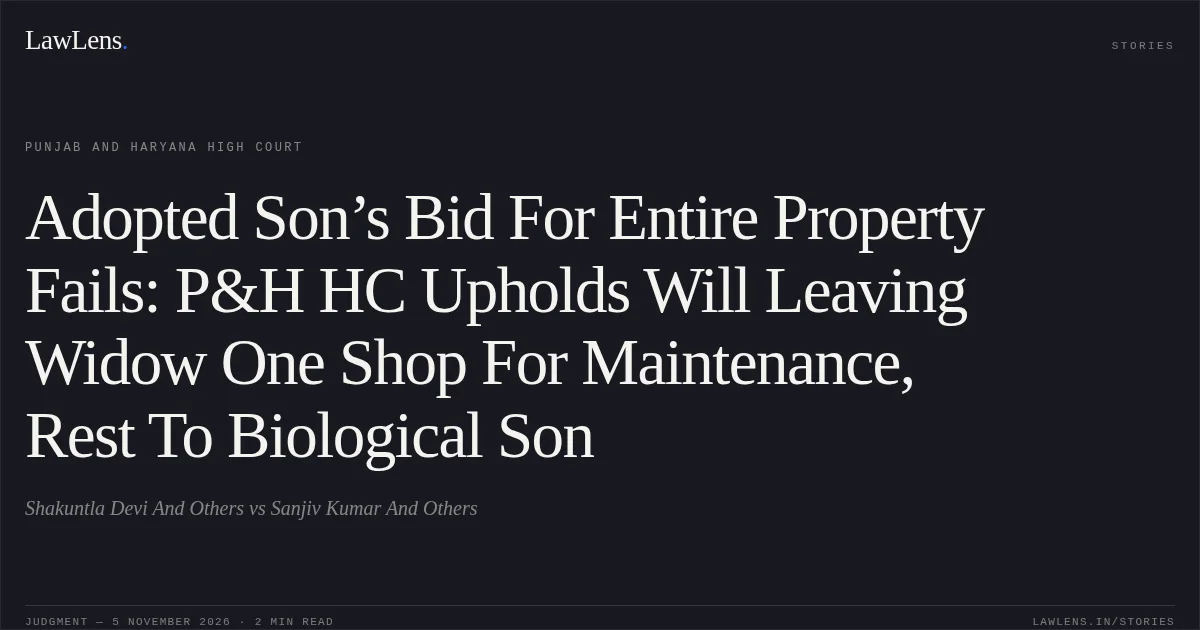
¶ 5–8It declared Bhagwan Dai owner of part C, which had been provided for her maintenance, while parts D and E vested under the will in Varinder.
¶ 5–8Sanjiv’s cross-objections challenged, among other matters, the finding on Varinder’s parentage and the limitation of his entitlement to part C. The High Court considered only the cross-objections after the Supreme Court’s order concerning the impleadment of subsequent purchasers.
¶ 5–8, 14–1602Issues
i.Whether the finding that Varinder Kumar was Girdhari Lal’s biological son warranted interference in the cross-objections.
¶ 9–10ii.Whether the finding that Sanjiv Kumar was adopted by Bhagwan Dai was open to challenge by the subsequent purchasers in these cross-objections.
¶ 11–13iii.Whether the will entitled Sanjiv, as Bhagwan Dai’s successor, to the whole of property No. 4677, rather than only part C.
¶ 14–1603Law Applied
The court relied on the terms of the registered gift deed and the will to determine the allocation of the disputed property: the deed covered parts A and B, while the will gave Bhagwan Dai a maintenance-related interest in part C and dealt separately with parts D and E.
¶ 6, 15–16It also applied the principle that factual findings based on appraisal of evidence do not warrant interference where no question of law arises.
¶ 10Sections 7 and 11 of the Hindu Adoption and Maintenance Act, 1956, were referred to in connection with the adoption; however, the court did not decide the purchasers’ argument under section 11 because adoption was not an issue in the cross-objections and the purchasers’ rights were confined to the property they had bought.
¶ 12–13No precedent was cited.
Provisions in the judgment · 2 · Linked ones open on LawLens
Hindu Adoptions and Maintenance Act, 1956 Section 7Section 11
04Reasoning
The court found that the concurrent findings on Varinder’s parentage rested on evidence including a school register and a congratulatory letter from Bhagwan Dai, and disclosed no question of law warranting interference.
¶ 9–10It declined to reopen the adoption finding because the purchasers had bought only parts D and E and could not use the cross-objections to challenge a finding affecting property they had not purchased.
¶ 13On the will’s language, the court found that only part C had been provided to Bhagwan Dai for maintenance; parts D and E were not so provided and were to vest in Varinder under the will. Accordingly, Sanjiv’s claim to the entire property was unsupported.
¶ 15–1605Holding
The High Court upheld the first appellate court’s findings on Varinder’s parentage, Sanjiv’s adoption, and the parties’ rights under the will.
¶ 17–18It held that Sanjiv was not entitled to parts D and E and dismissed the cross-objections.
¶ 17–18Pending miscellaneous applications were also disposed of.
¶ 17–18Original Court PDF
Shakuntla Devi And OthersvsSanjiv Kumar And Others
Click to open original judgment
Original judgment, available to read, download and summarize on LawLens.in