Facts
The appellants (claimants) filed a claim petition under Section 16 of the Railway Claims Tribunal Act, 1897, following the death of the deceased, who allegedly fell from Train No. 9058 Up Vadodara-Valsad Intercity on August 8, 2005
Source reference: para. 3.1The claimants asserted the deceased was a bona fide passenger holding ticket No. B 35003795, which was seized by the police during the investigation
Source reference: para. 3.2The Railway Claims Tribunal dismissed the claim on December 8, 2011, citing a variance between the pleadings (stating the accident occurred on Aug 8) and the recovery of the body on August 10, concluding the deceased must have been traveling on a different train without a valid ticket
Source reference: para. 3.4, 7The claimants appealed this dismissal to the High Court
Source reference: para. 3.5Issues
1. Whether the deceased was a "bona fide passenger" within the meaning of the Railways Act, 1989, despite the time gap between the alleged travel and the recovery of the body
Source reference: para. 102. Whether the incident constitutes an "untoward incident" under Section 123(c)(2) of the Railways Act, justifying compensation under Section 124A
Source reference: para. 13Law Applied
The Court applied Section 123(c)(2) and Section 124A of the Railways Act, 1989, which define "untoward incident" and establish "no-fault liability" for the Railway Administration regardless of neglect or default
Source reference: para. 5, 6It relied on the Supreme Court precedent in Union of India v. Rina Devi (2019), which held that the initial burden of proof regarding bona fide status is discharged if the claimant files an affidavit of relevant facts, shifting the burden to the Railways
Source reference: para. 9It further applied Lata v. Union of India (2026) regarding the "purposive construction" of beneficial legislation
Source reference: para. 8Doli Rani Saha v. Union of India (2024), which established that the mere absence of a ticket or a delay in finding a body does not automatically negate a claim
Source reference: para. 12Reasoning
The High Court found that the Tribunal erred by relying on mere presumptions regarding the decomposition of the body and the validity of the ticket for a specific train class
Source reference: para. 7, 10The Court noted that the police had recovered a ticket from the deceased dated August 8, 2005 (Exh. A-6), supporting the claimants' version
Source reference: para. 3.2, 10It observed that the Railway failed to provide evidence of suicide, self-inflicted injury, or intoxication (the exceptions under Section 124A), and the DRM report itself admitted the deceased fell under a train
Source reference: para. 5, 10Following the principle of "preponderance of probabilities" rather than "beyond reasonable doubt," the Court held that the recovery of the body two days later did not disprove the occurrence of an untoward incident on the date of travel
Source reference: para. 9, 11Holding
The High Court allowed the appeal and set aside the Tribunal’s judgment
It held that the deceased was a bona fide passenger who died in an untoward incident
Source reference: para. 13The Court ordered the Union of India to pay the claimants a sum of ₹4 lakh with 9% interest from the date of the petition, or a flat sum of ₹8 lakhs, whichever is higher. Order for the return of R&P was issued
Source reference: para. 15, 16Acts & Sections Cited
6 provisions across 2 statutes referred to in this judgment. Each provision opens on LawLens.
Railway Claims Tribunal Act, 19872
Railways Act, 19894
Original Court PDF
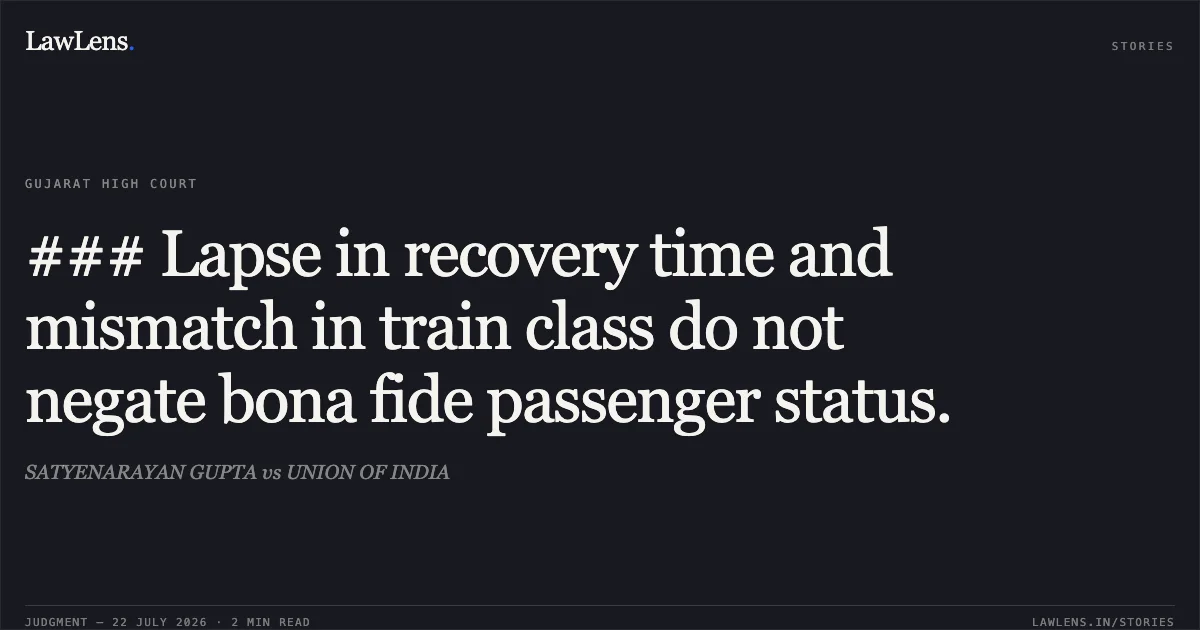
SATYENARAYAN GUPTAvsUNION OF INDIA
Click to open original judgment
Original judgment, available to read, download and summarize on LawLens.in