Facts
The appeals challenged orders passed at the instance of the Central Board of Trustees/Employees’ Provident Fund Organisation (EPFO), which directed the Successful Resolution Applicants (SRAs) to satisfy provident fund (PF), gratuity and related statutory dues of workmen and employees, notwithstanding the approval and implementation of resolution plans under the Insolvency and Bankruptcy Code, 2016 (IBC).
Source reference: pp.1–2; paras.1–2The EPFO relied on Maharashtra State Cooperative Bank Ltd. v. Assistant Provident Fund Commissioner, the decision in the Jet Airways insolvency proceedings, and subsequent decisions holding that PF dues fall outside the liquidation estate and cannot be distributed under the IBC waterfall mechanism.
Source reference: pp.2–4; paras.2–4The Court also considered whether damages imposed under Section 14B of the Employees’ Provident Funds and Miscellaneous Provisions Act, 1952 (EPF Act) were mandatory or whether the competent authority retained discretion to levy or waive them.
Source reference: pp.5–13; paras.6–16Issues
1. Whether PF and gratuity dues payable under the EPF Act must be paid in full and kept outside the liquidation estate and the waterfall mechanism under Section 53(1) of the IBC, thereby binding the SRA under the approved resolution plan.
Source reference: pp.3–5; paras.4–52. Whether the liability of the SRA extends to interest under Section 7Q and damages/penalty under Section 14B of the EPF Act.
Source reference: pp.4–5, 12–13; paras.5, 163. Whether, after the amendment to Section 14B, the authorised officer retains discretion to impose or waive damages, or whether levy of damages is mandatory once default is established.
Source reference: pp.6–13; paras.7–164. Whether the Central Board may consider reduction or waiver of Section 14B damages for an establishment undergoing resolution under the IBC, by analogy with the rehabilitation mechanism under the repealed SICA.
Source reference: pp.5–6, 13; paras.6, 18Law Applied
Section 11(2) of the EPF Act creates a statutory first charge over the assets of the establishment for amounts due under the Act, including contributions, interest and damages; such first charge prevails over competing statutory priorities and non-obstante clauses.
Source reference: pp.2–3; para.3Under Section 36(4)(b)(iii) of the IBC, provident fund, pension fund and gratuity amounts do not form part of the liquidation estate, and Section 30(2)(e) requires a resolution plan to comply with applicable law.
Source reference: pp.3–5; para.4The Court relied on Maharashtra State Cooperative Bank Ltd. v. Assistant Provident Fund Commissioner, (2009) 10 SCC 123, and Jalgaon District Central Coop. Bank Ltd. v. State of Maharashtra, 2025 SCC OnLine SC 2513, for the statutory-first-charge principle; on Jet Aircraft Maintenance Engineers Welfare Association v. Ashish Chhawchharia, 2022 SCC OnLine NCLAT 418, and the Court’s order in Jalan Fritsch Consortium v. Regional Provident Fund Commissioner, for the rule that PF and gratuity dues must be paid in full outside the liquidation waterfall.
Source reference: pp.2–4; paras.3–4Section 7Q imposes statutory interest on delayed payment, whereas amended Section 14B authorises recovery “by way of penalty” of damages as specified in the Scheme, subject to the prescribed procedure and hearing.
Source reference: pp.9–11; paras.10–13Following Organo Chemical Industries v. Union of India, (1979) 4 SCC 573, the Court held that the words “may recover” confer discretion regarding whether damages should be imposed; however, the quantum, once damages are imposed, is governed by the Scheme.
Source reference: pp.7–9, 11–13; paras.8–9, 13–15Reasoning
The Court treated PF and gratuity dues as statutory employee entitlements excluded from the liquidation estate under Section 36(4)(b)(iii) of the IBC, and therefore not subject to distribution under Section 53(1). Since an approved resolution plan must comply with applicable law under Section 30(2)(e), the SRA was required to provide for payment of the admitted PF and gratuity dues in full.
Source reference: pp.3–5; paras.4–5The Court further accepted that Section 7Q interest is mandatory and forms part of the dues payable under the EPF Act.
Source reference: pp.9–11; paras.11–12However, it distinguished statutory interest from Section 14B damages: after the 1988 amendment, Section 14B principally concerns a penal levy, and the expression “may recover” leaves the authorised officer with discretion to impose or not impose damages after considering the circumstances and observing natural justice.
Source reference: pp.7–13; paras.8–16Financial difficulty alone would not necessarily justify waiver, but extenuating circumstances may warrant non-imposition or reduction. Because this interpretation conflicted with the earlier decision in Horticulture Experiment Station Gonikoppal, Coorg v. Regional Provident Fund Organization, (2022) 4 SCC 516, the Court referred the question to a larger Bench.
Source reference: pp.6–7, 12–13; paras.7, 16–17Holding
The Court affirmed that PF and gratuity dues payable under the EPF Act are outside the liquidation estate and cannot be reduced or distributed through the IBC waterfall; the SRA must satisfy such dues in full, together with statutory interest under Section 7Q.
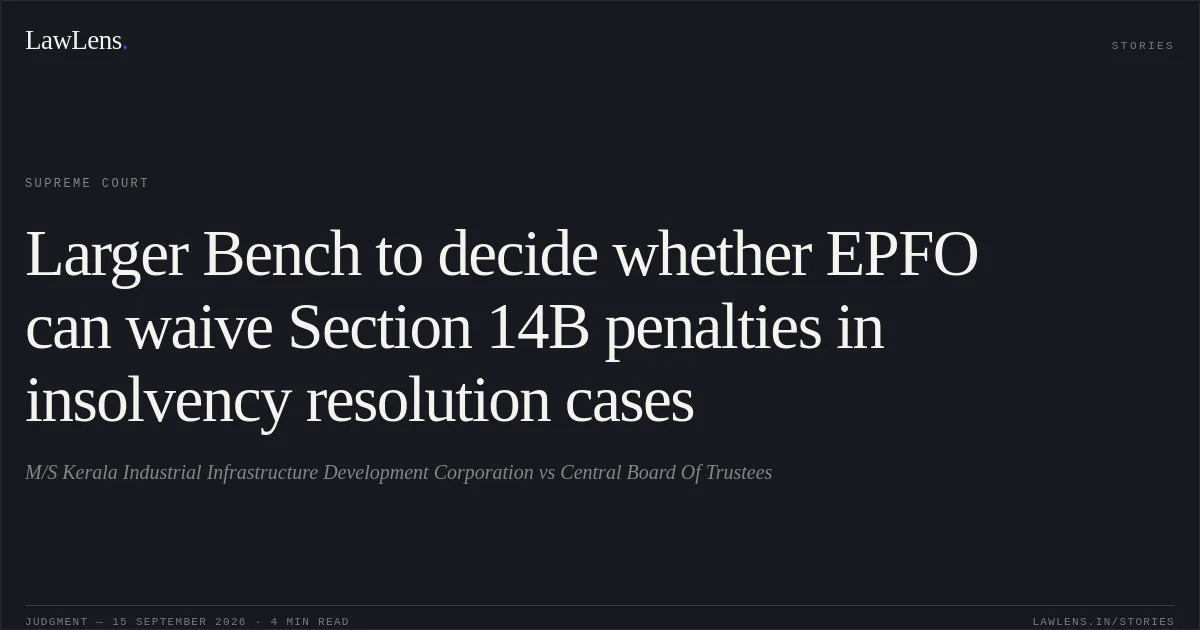
The Court expressed the view that Section 14B confers discretion on the authorised officer to levy or not levy damages, although the issue was referred to a larger Bench because of the conflicting view in Horticulture Experiment Station.
Source reference: pp.12–13; paras.16–17The reference was stated not to prejudice the SRAs’ right to seek reduction or waiver from the Central Board under the second proviso to Section 14B.
Source reference: p.13; para.18Pending resolution of the reference, the appellants were directed to pay the EPF dues and Section 7Q interest in four quarterly instalments commencing on 15 December 2026 and ending on 15 September 2027, with additional interest arising from deferment to be paid by 15 October 2027; any default would entitle the EPFO to initiate recovery.
Source reference: p.13; para.19Acts & Sections Cited
5 provisions across 2 statutes referred to in this judgment. Each provision opens on LawLens.
Securitisation and Reconstruction of Financial Assets and Enforcement of Security Interest Act, 20022
Insolvency and Bankruptcy Code, 2016.3
Original Court PDF
M/S Kerala Industrial Infrastructure Development CorporationvsCentral Board Of Trustees
Click to open original judgment
Original judgment, available to read, download and summarize on LawLens.in