01Facts
Suresh was found dead in the Nethravathi River on 17 October 2015. The prosecution alleged that the appellants and others had taken him to the river and throttled him. The initial UDR recorded a report of accidental drowning; the post-mortem examination later attributed death to throttling and found no signs of drowning.
¶ 6–11, 23, 31The prosecution relied principally on PW.13’s evidence that the deceased went towards the river with the accused during the afternoon, and on the appellants’ role in finding and reporting the body.
¶ 19–20, 28The Sessions Court convicted accused Nos. 1 and 2 under Sections 302 and 201 IPC and acquitted accused Nos. 3 to 5.
¶ 2, 26Accused Nos. 1 and 2 appealed.
¶ 102Issues
i.1. Whether the convictions of accused Nos. 1 and 2 under Sections 302 and 201 IPC were justified
¶ 29(i)ii.2. Whether the last-seen evidence was sufficient to sustain conviction in a case based entirely on circumstantial evidence
¶ 29(ii)03Law Applied
Under Sections 302 and 201 IPC, the prosecution must prove the accused’s responsibility for the homicide and the charged act of causing disappearance of evidence, as applicable.
In a case based on circumstantial evidence, each circumstance must be proved, the circumstances must point conclusively to guilt, exclude reasonable hypotheses consistent with innocence, and form a complete chain.
¶ 38–40Last-seen evidence is not, by itself, proof of guilt; its force depends significantly on the proximity between the last sighting and the death and on corroborating circumstances (Manoj alias Munna v. State of Chhattisgarh, 2025 SCC OnLine SC 2858; Papan Sarkar @ Pranab v. State of West Bengal, 2026 INSC 528).
¶ 33–34Section 106 of the Evidence Act does not displace the prosecution’s burden to prove its case beyond reasonable doubt; an accused’s failure to explain may only add to an otherwise established chain and cannot fill its fundamental gaps.
¶ 49–52Provisions in the judgment · 4 · Linked ones open on LawLens
Code of Criminal Procedure, 1973 Section 374
Indian Penal Code, 1860 Section 302Section 201Section 34
04Reasoning
The medical evidence established that Suresh died homicidally by throttling, but did not establish when he died or identify the assailant.
¶ 31, 47PW.13’s evidence, even if accepted, placed the deceased with the accused during the afternoon but did not show that the appellants remained with him until his death; the other witnesses did not reliably establish their continuous presence together.
¶ 35–37, 40The alleged arecanut-theft motive was unsupported by substantive evidence.
¶ 42–46Nor did the initial drowning report, the appellants’ post-occurrence conduct, or their failure to explain the death independently complete the evidentiary chain.
¶ 48–52, 56–57The prosecution therefore failed to exclude the reasonable possibility of intervening events and did not prove guilt beyond reasonable doubt.
¶ 53–5805Holding
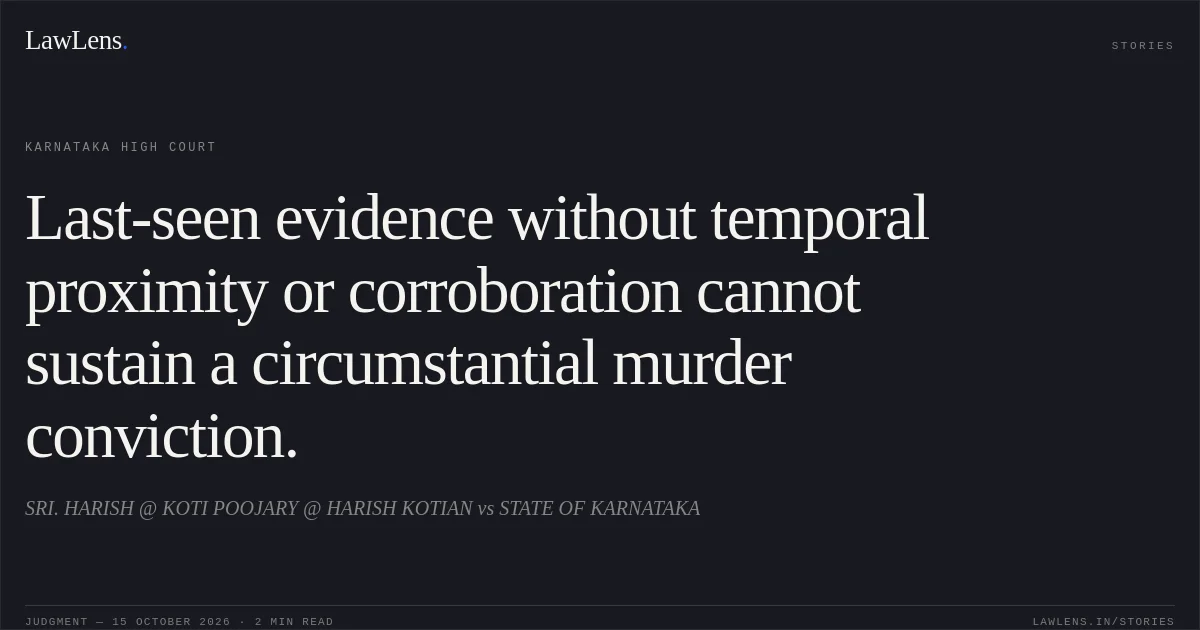
The Court answered both issues in the negative and allowed the appeals.
¶ 59It set aside the convictions and sentences of accused Nos. 1 and 2 and acquitted them of the offences under Sections 302 and 201 IPC. It directed their release forthwith if their custody was not required in another matter; accused No. 2’s bail bond was cancelled and any sureties discharged.
¶ 59Original Court PDF
SRI. HARISH @ KOTI POOJARY @ HARISH KOTIANvsSTATE OF KARNATAKA
Click to open original judgment
Original judgment, available to read, download and summarize on LawLens.in



