Facts
The deceased, Ved Singh, went missing on 15.11.2016 after allegedly being called away by appellant Omprakash.
Source reference: para. 6His highly decomposed body was discovered a month later in a ravine.
Source reference: para. 7The prosecution alleged that Omprakash murdered the deceased for molesting his wife, Neera Bai, and that other appellants helped dispose of the body.
Source reference: para. 10The trial court convicted Omprakash, Sukhu Bhaina, and Neera Bai under Sections 302/34 and 201/34 of the IPC, and Vinod Bhaina under Section 201/34 IPC.
Source reference: para. 5The appellants challenged this conviction, arguing that the chain of circumstantial evidence was incomplete and based on inadmissible confessions.
Source reference: para. 18-20Issues
1. Whether the death of the deceased was homicidal in nature despite the lack of a conclusive medical opinion on the cause of death.
Source reference: para. 252. Whether the recovery of incriminating articles (sticks/jerrycan) based on the memorandum statement of the accused is admissible and sufficient for conviction.
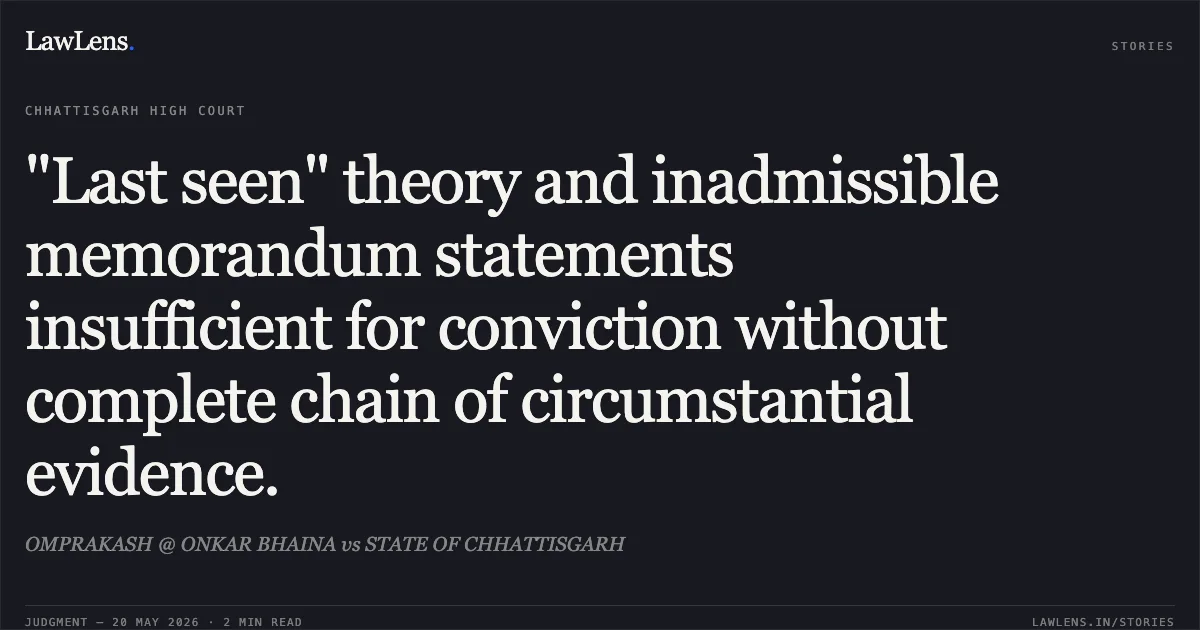
Source reference: para. 313. Whether the "last seen together" theory can form the sole basis of conviction given a significant time gap between the disappearance and recovery of the body.
Source reference: para. 47Law Applied
The court primarily applied Section 302 (Murder) and Section 201 (Causing disappearance of evidence) of the IPC.
Source reference: para. 5Section 27 of the Indian Evidence Act, 1872, as interpreted in Pulukuri Kotayya v. King Emperor and Asar Mohammad v. State of U.P., which mandates that only the part of a confession leading distinctly to the discovery of a fact is admissible.
Source reference: para. 38-40Doctrine from Aghnoo Nagesia v. State of Bihar, holding that confessions to police are hit by Sections 25 and 26 of the Evidence Act.
Source reference: para. 42Five golden principles for circumstantial evidence from Sharad Birdhichand Sarda v. State of Maharashtra.
Source reference: para. 50"Last seen" doctrine from Arjun Marik v. State of Bihar and State of Goa v. Sanjay Thakran.
Source reference: para. 51-52Reasoning
The Court observed that while the death was homicidal due to antemortem injuries, the prosecution's case failed to link the appellants to the crime.
Source reference: para. 29The memorandum statements were largely confessional and hit by Sections 25 and 26 of the Evidence Act; only the physical discovery of the stick was admissible under Section 27.
Source reference: para. 41, 43The FSL report failed to determine the blood group on the seized stick, rendering it inconclusive as a link to the deceased.
Source reference: para. 45, 56, 60The "last seen" evidence provided by PW-3 was insufficient because there was a "considerable time gap" of nearly one month between the deceased being seen with Omprakash and the discovery of the body, failing the proximity test.
Source reference: para. 48, 55The court found that suspicion, however strong, cannot replace proof, and the prosecution failed to establish an unbroken chain of circumstances.
Source reference: para. 64-65Holding
The Court answered the first issue in the affirmative (homicidal death) and the remaining issues in the negative.
The High Court allowed the appeals, set aside the judgment of conviction and order of sentence dated 19.04.2018, and acquitted all appellants of all charges.
Source reference: para. 66The appellants' bail bonds were ordered to remain in force for six months pursuant to Section 437-A Cr.P.C.
Source reference: para. 67Acts & Sections Cited
9 provisions across 3 statutes referred to in this judgment. Each provision opens on LawLens.
Code of Criminal Procedure, 19735
Indian Penal Code, 18603
Bharatiya Nagarik Suraksha Sanhita, 20231
Original Court PDF
OMPRAKASH @ ONKAR BHAINAvsSTATE OF CHHATTISGARH
Click to open original judgment
Original judgment, available to read, download and summarize on LawLens.in