Facts
The appellant, Ajay Mahto, was a driver for the deceased, Ram Murti Pandey, who owned a TATA Truck.
Source reference: para. 4On 31.10.1998, the deceased left Delhi for Patna in the truck.
Source reference: para. 4On 19.12.1998, the deceased's wife (PW-1) lodged a complaint suspecting that the appellant and his associates had kidnapped her husband and stolen the vehicle.
Source reference: para. 4The appellant was arrested on 06.01.1999, and the truck was recovered at his instance.
Source reference: para. 6It was discovered that the deceased’s body had been found on 08.11.1998 in Patna.
Source reference: para. 6The Trial Court convicted the appellant on 28.09.2001 under Section 302 IPC, primarily based on the "last seen" theory and circumstantial evidence.
Source reference: para. 1, 12The sentence was suspended in 2006, but the appellant subsequently absconded and was declared a Proclaimed Offender in 2025; the appeal was heard through an Amicus Curiae.
Source reference: para. 3Issues
1. Whether the prosecution established a complete chain of circumstantial evidence sufficient to prove the appellant's guilt beyond a reasonable doubt.
Source reference: para. 302. Whether the "last seen" theory was applicable given the appellant's explanation regarding the parting of ways with the deceased.
Source reference: para. 32-333. Whether material contradictions and non-disclosure of facts in the initial FIR vitiated the prosecution’s case.
Source reference: para. 29-31Law Applied
The court primarily applied Section 302 of the IPC regarding murder.
Source reference: para. 1It relied on the evidentiary principles of circumstantial evidence established in Manoj @ Munna v. State of Chhattisgarh (2025) and Narendrasinh Keshubhai Zala v. State of Gujarat (2023), which mandate that the chain of circumstances must be complete and inconsistent with the innocence of the accused.
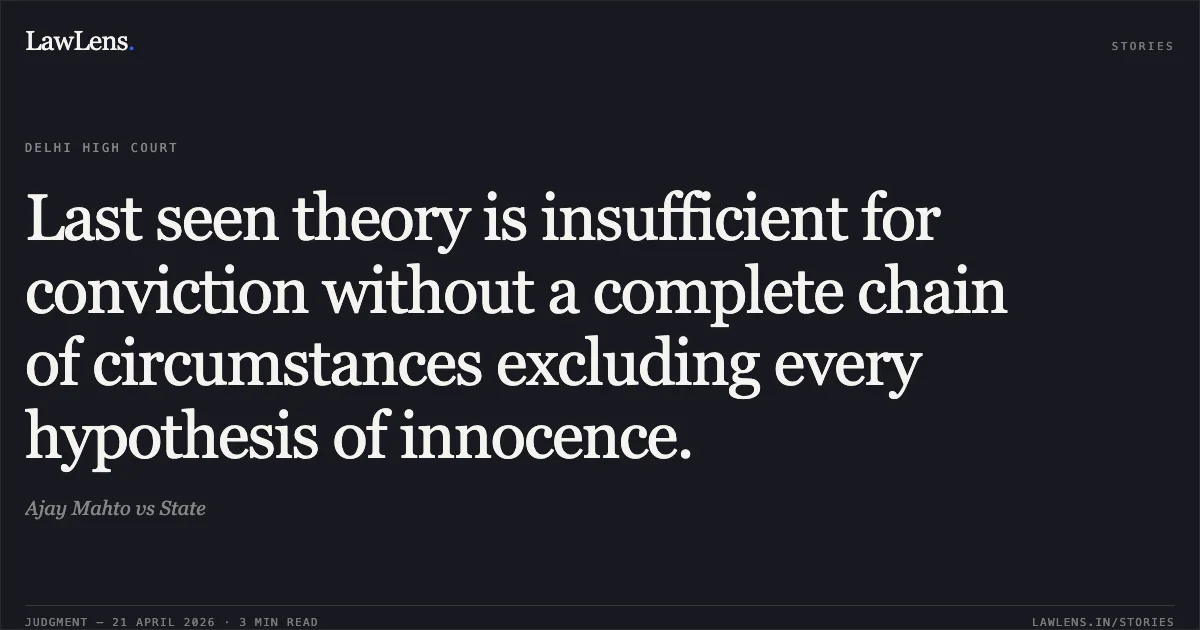
Source reference: para. 30The court further applied the doctrine of "last seen theory," noting that while it creates a presumption, it cannot be the sole basis for conviction without a complete chain of incriminating circumstances, as held in Manoj @ Munna.
Source reference: para. 32Reasoning
The High Court found that the prosecution failed to bridge the gap between suspicion and proof.
Source reference: no citationFirstly, the court noted significant contradictions: while PW-1 (the wife) testified that she had no contact with the deceased after he left, the brothers of the deceased (PW-2 and PW-10) claimed she received a phone call on 07.11.1998.
Source reference: para. 24Secondly, vital information—such as the truck’s breakdown and the appellant’s phone call to the transporter (PW-15)—was suppressed in the initial complaint, which the court held cast doubt on the prosecution’s inception.
Source reference: para. 29, 31Regarding the "last seen" theory, the court observed that PW-15 himself testified that the appellant called him on 08.11.1998 stating the truck had broken down and the deceased had left for Allahabad to arrange funds.
Source reference: para. 33This provided a plausible explanation for the parting of company, which the prosecution failed to rebut.
Source reference: para. 33Furthermore, the court found the "discovery" of the truck at the appellant's instance to be doubtful, as the deceased's family already had prior information about its location.
Source reference: para. 34Holding
The court held that the prosecution failed to establish a complete chain of circumstantial evidence, and the distance between "may be true" and "must be true" was not covered.
The "last seen" theory was neutralized by the evidence of the appellant’s communication regarding the truck's breakdown.
Source reference: para. 33Consequently, the High Court set aside the Trial Court's judgment dated 28.09.2001 and the Order on Sentence dated 29.09.2001.
Source reference: para. 37The appellant was acquitted of the charge under Section 302 IPC, and his bail bonds and surety were discharged.
Source reference: para. 38-39Acts & Sections Cited
8 provisions across 2 statutes referred to in this judgment. Each provision opens on LawLens.
Indian Penal Code, 18607
Code of Criminal Procedure, 19731
Original Court PDF
Ajay MahtovsState
Click to open original judgment
Original judgment, available to read, download and summarize on LawLens.in