Facts
The Appellant was accused of kidnapping and sexually assaulting a girl reported missing by her mother on 13.04.2016.
Source reference: para. 1The Investigating Officer (I/O) filed a charge sheet under Sections 363/376(2)(i) of the IPC and Sections 4/6 of the POCSO Act.
Source reference: para. 2During the trial, the survivor (PW-2) testified that she was in a "love relationship" with the Appellant, fled with him voluntarily, and consented to sexual intercourse.
Source reference: para. 8She further admitted to leading the Appellant to believe she was over 18.
Source reference: para. 8Medical evidence showed no signs of struggle or injuries.
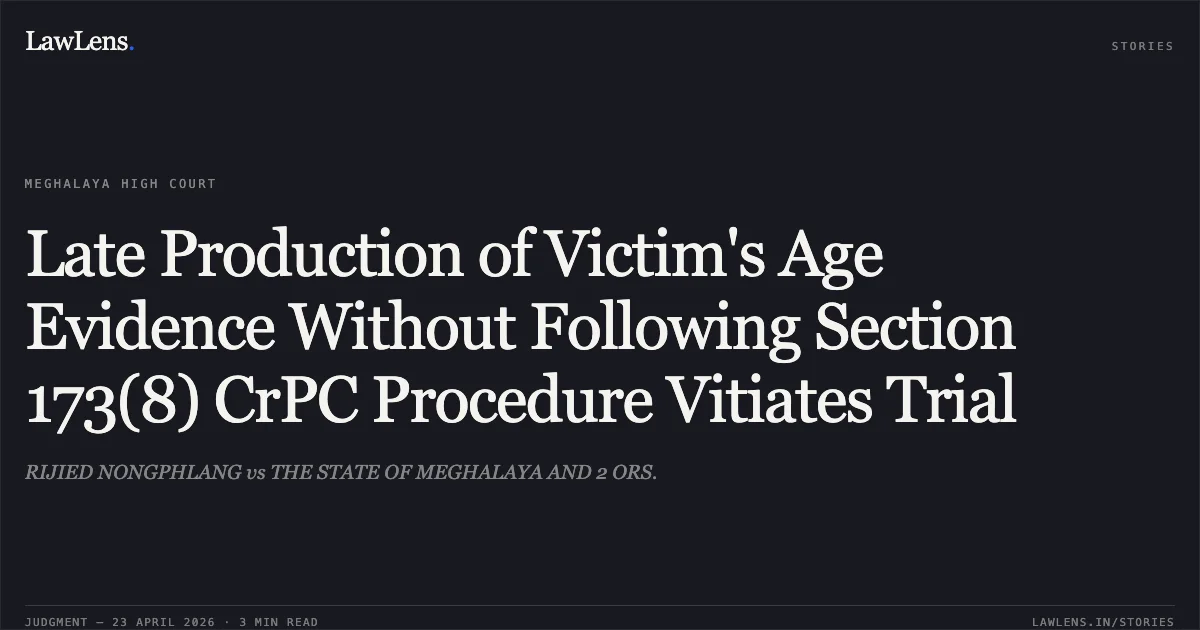
Source reference: para. 9At a late stage of the trial (10.02.2020), the I/O seized and introduced a birth certificate as Material Exhibit-10 without filing a supplementary charge sheet.
Source reference: paras. 11-12The Trial Court convicted the Appellant, sentencing him to varying terms of rigorous imprisonment up to 10 years.
Source reference: para. 6Issues
1. Whether the belated introduction of the survivor's birth certificate without following the procedure under Section 173(8) of the CrPC was legally sustainable.
Source reference: paras. 13-14, 302. Whether the lack of examination under Section 313 of the CrPC regarding the birth certificate prejudiced the accused and vitiated the conviction.
Source reference: paras. 15, 313. Whether the prosecution established the minor status of the survivor beyond reasonable doubt to negate the defense of consent.
Source reference: paras. 16, 27, 32Law Applied
Section 173(8) of the CrPC, which mandates that evidence from further investigation must be submitted via a supplementary report/charge sheet following specific procedural protocols.
Source reference: paras. 13, 30Statement on the doctrine derived from Mariam Fassihuddin v. State regarding the necessity of a prescribed form for supplementary reports.
Source reference: para. 13Vinay Tyagi v. Arshad Ali regarding the practice of seeking court leave for further investigation.
Source reference: para. 14Section 313 of the CrPC, as interpreted in Samsul Haque v. State of Assam, which requires that all incriminating evidence (specifically the birth certificate) must be put to the accused to provide an opportunity for explanation.
Source reference: para. 15The principle from State v. Kaishar Ali regarding the necessity of proving the survivor's age beyond reasonable doubt to attract POCSO/rape charges when consent is apparent.
Source reference: para. 16Reasoning
The High Court found that the I/O’s conduct regarding the birth certificate was procedurally flawed; the I/O seized the document mid-trial after falsely suggesting it was already in her possession.
Source reference: para. 30This deviation from Section 173(8) CrPC meant the document was introduced without a supplementary charge sheet or prior notice to the Appellant.
Source reference: para. 30Crucially, the Trial Court failed to confront the Appellant with this specific piece of evidence during his Section 313 examination, which constitutes a fatal procedural error.
Source reference: para. 31In the absence of admissible proof of age, the Court accepted the survivor's testimony that she represented herself as an adult.
Source reference: para. 32Applying the principle of leanancy toward the accused in criminal jurisprudence, the Court held that since the survivor's consent was "manifestly voluntary," the lack of reliable proof of minority meant the ingredients of the alleged offenses were not established.
Source reference: paras. 32-33Holding
The Court answered the issues in the negative, holding that the procedural lapses and the failure to prove the victim's age beyond reasonable doubt vitiated the conviction.
The High Court set aside and quashed the impugned judgment and order of sentence dated 13.12.2022 and 22.12.2022. The Appellant was ordered to be discharged forthwith from all liabilities.
Source reference: paras. 34-35Acts & Sections Cited
10 provisions across 3 statutes referred to in this judgment. Each provision opens on LawLens.
Indian Penal Code, 18603
Protection of Children from Sexual Offences Act, 20124
Code of Criminal Procedure, 19733
Original Court PDF
RIJIED NONGPHLANGvsTHE STATE OF MEGHALAYA AND 2 ORS.
Click to open original judgment
Original judgment, available to read, download and summarize on LawLens.in