Facts
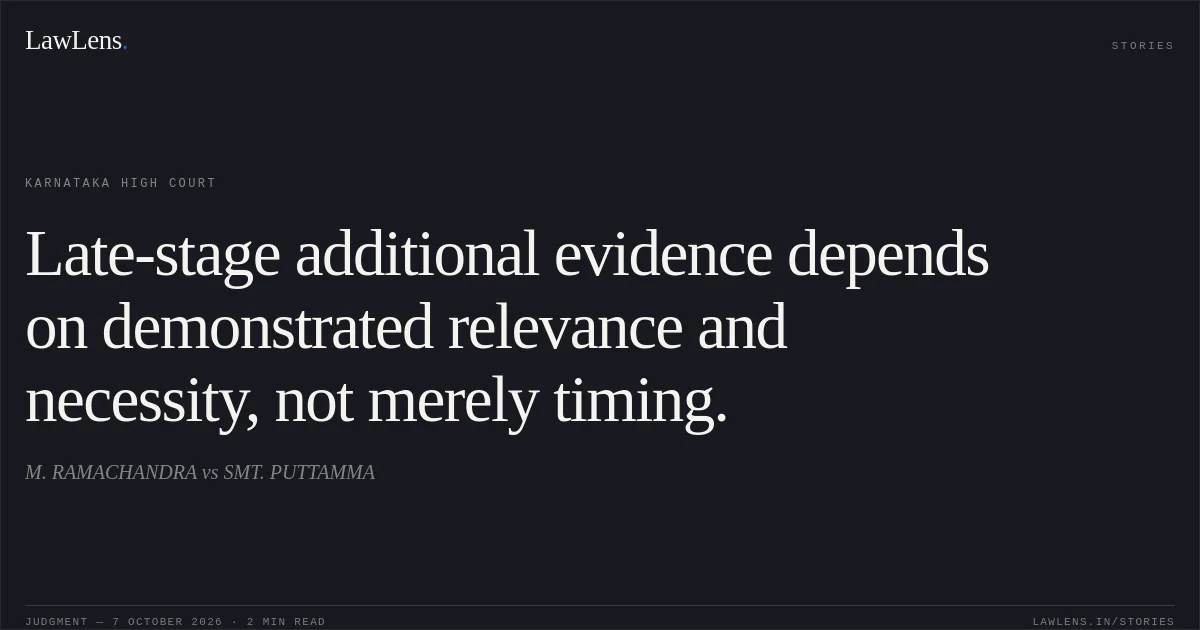
The plaintiffs, legal representatives of M. Ramachandra, challenged a common order in their suit seeking a declaration that a 1973 Gift Deed was void and not binding on them, or alternatively that they had acquired title by adverse possession.
Source reference: para. 2–6After both sides had led evidence and the suit was posted for arguments, the plaintiffs sought to summon an Income Tax Officer (I.A. No. 16) and obtain comparison of admitted and disputed signatures (I.A. No. 19).
Source reference: para. 2–6The defendants sought to reopen their evidence and examine the legal heir of an attesting witness to the Gift Deed (I.A. Nos. 17 and 18).
Source reference: para. 2–6The Trial Court rejected the plaintiffs’ applications and allowed the defendants’ applications. The plaintiffs challenged that order under Article 227 of the Constitution.
Source reference: para. 2–6Issues
1. Whether the Trial Court’s rejection of the plaintiffs’ applications for additional evidence and signature comparison warranted interference under Article 227
Source reference: para. 14–202. Whether the Trial Court’s decision to permit the defendants to reopen their evidence to examine the legal heir of an attesting witness was a proper exercise of discretion, notwithstanding the stage at which the applications were filed
Source reference: para. 21–29Law Applied
The Court applied the supervisory jurisdiction under Article 227 of the Constitution, under which an interlocutory order is not to be disturbed absent arbitrariness, perversity, or jurisdictional error.
Source reference: para. 20In considering requests to introduce further evidence, the Court assessed whether the proposed evidence had a demonstrated nexus to the issues in the suit and whether it was relevant and necessary for proper adjudication; delay alone is not invariably determinative, but delay combined with failure to establish relevance or necessity may justify refusal.
Source reference: para. 16, 25, 28The judgment cites no specific statutory provision or precedent beyond Article 227.
Source reference: no citationReasoning
The plaintiffs’ applications did not explain how the Income Tax Officer’s evidence or the proposed signature comparison related to the validity or binding effect of the Gift Deed—the principal controversy—and the plaintiffs identified no supporting material establishing that connection. The Trial Court was therefore justified in rejecting those applications, despite the brevity of its reasons.
Source reference: para. 15–19By contrast, the defendants’ proposed evidence was limited to examining the legal heir of an attesting witness and was relevant to the execution of the Gift Deed under challenge. The Court held that the applications could not be treated alike merely because they were filed at the arguments stage: relevance, necessity, and potential prejudice were material considerations, and no unremediable prejudice to the plaintiffs was shown.
Source reference: para. 21–26The absence of a convincing explanation for the plaintiffs’ belated applications further supported the Trial Court’s decision.
Source reference: para. 27–29Holding
The High Court found no perversity or jurisdictional error warranting intervention under Article 227.
It dismissed the writ petition, leaving in place the rejection of I.A. Nos. 16 and 19 and the allowance of I.A. Nos. 17 and 18; it directed the Trial Court to proceed expeditiously and clarified that its observations were confined to the interlocutory applications and would not affect the merits of the suit.
Source reference: para. 29–31No order as to costs.
Source reference: p. 18Original Court PDF
M. RAMACHANDRAvsSMT. PUTTAMMA
Click to open original judgment
Original judgment, available to read, download and summarize on LawLens.in